Thirty metres above the Indian Ocean, at the island's southern tip — where the water wraps around you on almost every side. Land running from the coast road down to the sand. There is nowhere else quite like it.
Talalla, Sri LankaCliff to beach, one holdingClear title, clear deeds
Filmed from the air
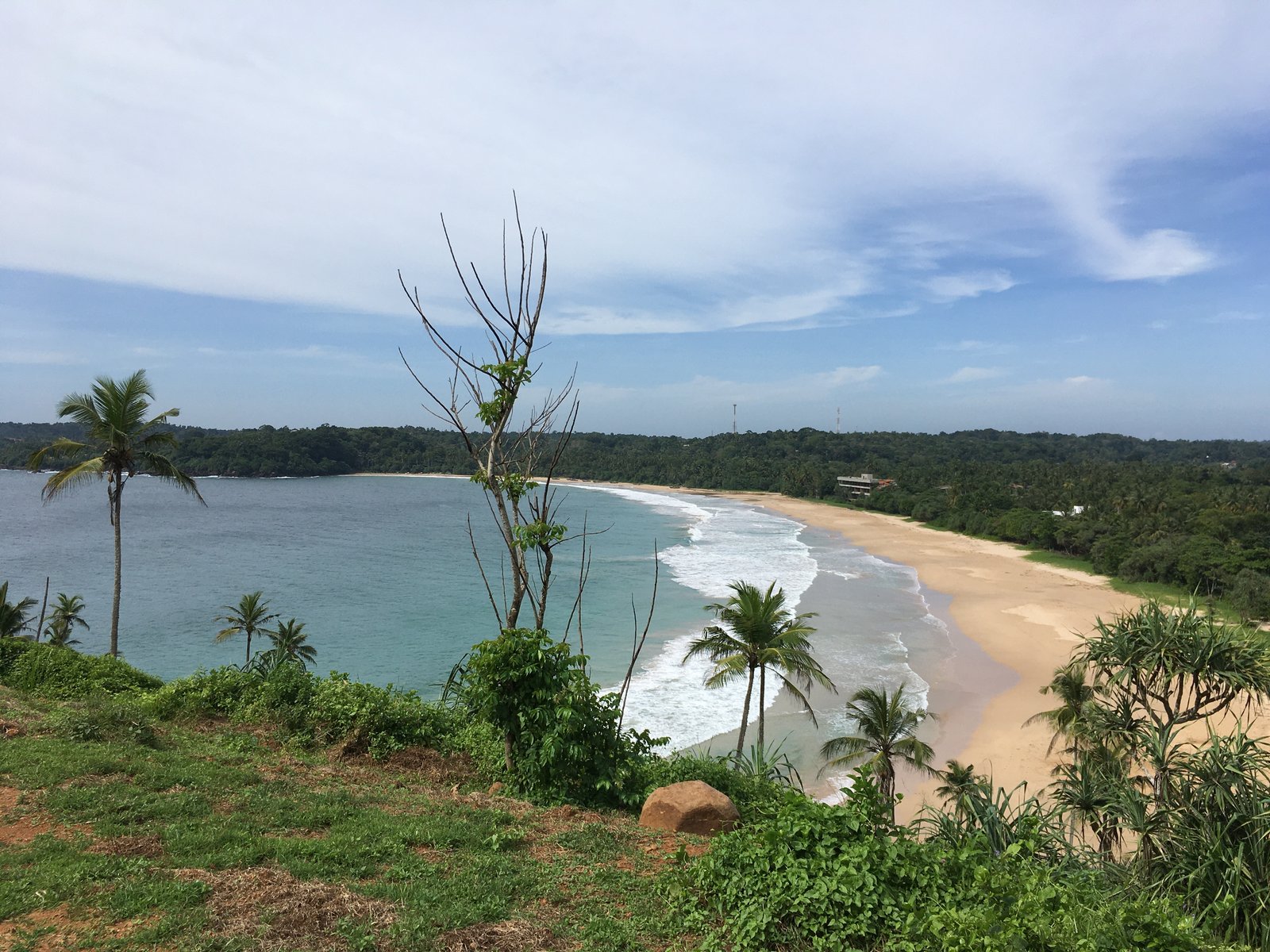
The headland, the beach below it, and the road behind — nothing here is drawn.
The Setting
Thirty metres up, with nothing but ocean.
Perched roughly 30 metres above the bay — a 360° sweep of the Indian Ocean from the top of the cliff
At Sri Lanka's southern tip, open water on almost every side — clean, uncrowded, and hard to find anywhere else on the island
Private beach access directly below the headland, with room for beachfront villas as well as the clifftop itself
No large hotels anywhere along this stretch — only small boutique villas and a handful of quiet guesthouses as neighbours
Frontage on the Colombo–Matara main road, running all the way down to the water
The same cliff, seen from the beach below
It's a 360° view from the top of the cliff.
Why It's Worth It
Land like this doesn't come up for sale.
Rooms at the high-end hotels up and down this coast rent for $280 to over $1,000 a night. A buyer here owns the whole cliff, road to water's edge, which is hard to put a ceiling on. We have not found another like it on Sri Lanka's south or southwest coast, and we would be glad to be shown one. What gets built here — a hotel, a private villa collection, or something else again — is still an open page, and the buyer's to write.
Running costs for hospitality here — staff, upkeep, services — are lower than in most parts of the world charging these kinds of rates.
Getting Down To The Water
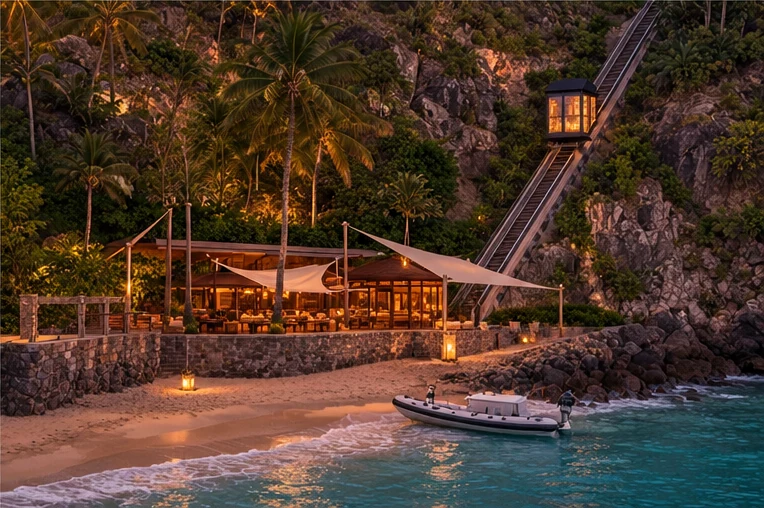
A funicular from the top to the sand.
You can walk to the beach. The land loops round to the road and back down to the sand, and plenty of people will. What you cannot do is go straight down — that side is thirty metres of rock, and it wants either steps cut into it or something better.
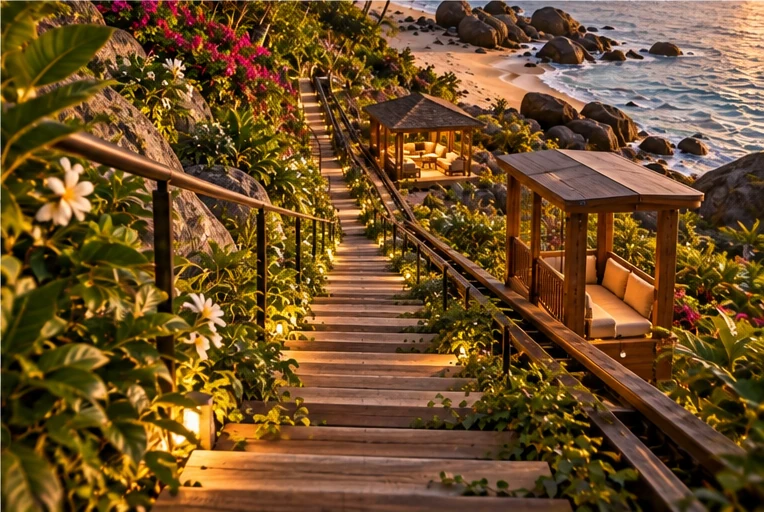
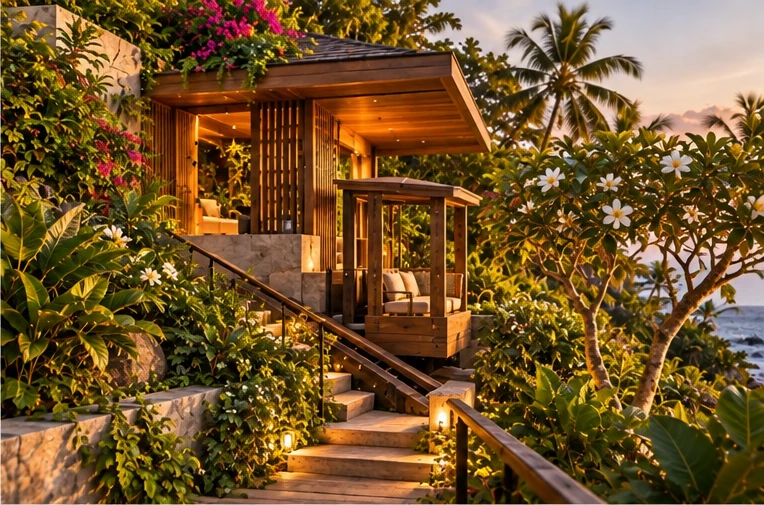
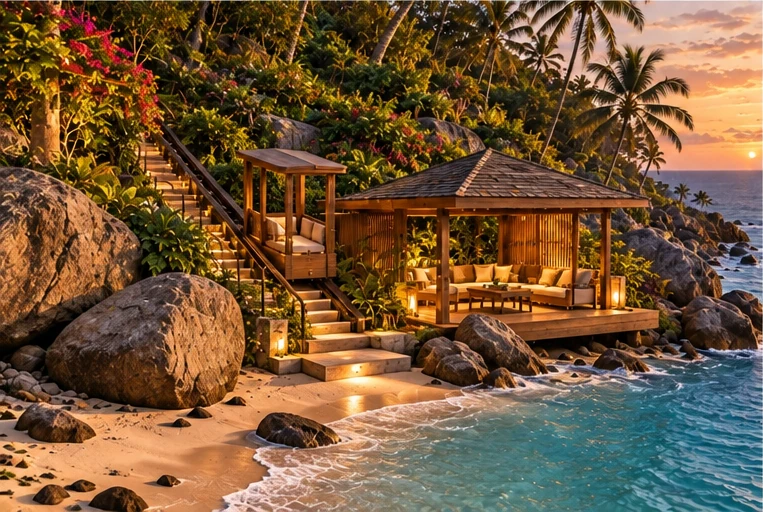
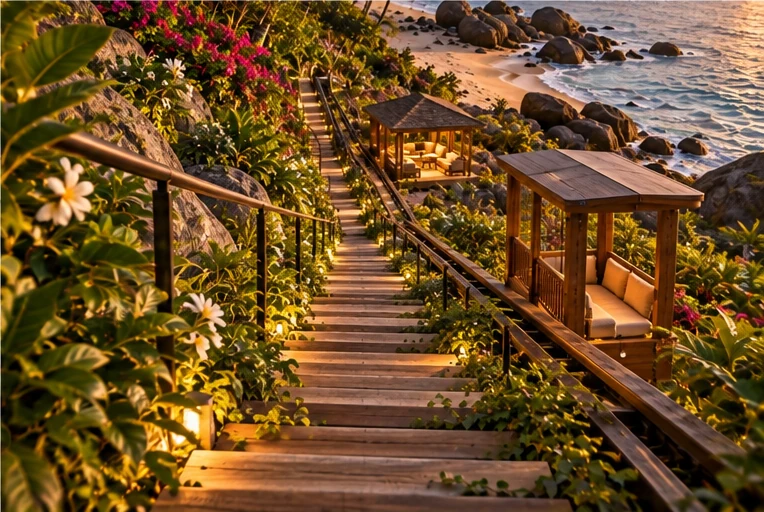
So: a modest inclined lift, running low along the slope rather than on tall piers, with simple steps beside it the whole way for anyone who would rather walk. It carries four to six people, and more to the point it carries bags, shopping, boards and coolers, up and down, without anyone thinking about it.
Timber treads on concrete, a slim rail, and the lift running alongsideThe upper station, half-buried in planting near the high pointThe last steps landing on the sand
Where This Is
Africa west. Thailand east. Antarctica south.
Talalla sits on the southern tip of Sri Lanka, out in the middle of the Indian Ocean. The Maldives are about an hour away by air. Nothing else is close, and that is rather the point.
Recommended · The Villa Scheme
Ten villas on a headland.
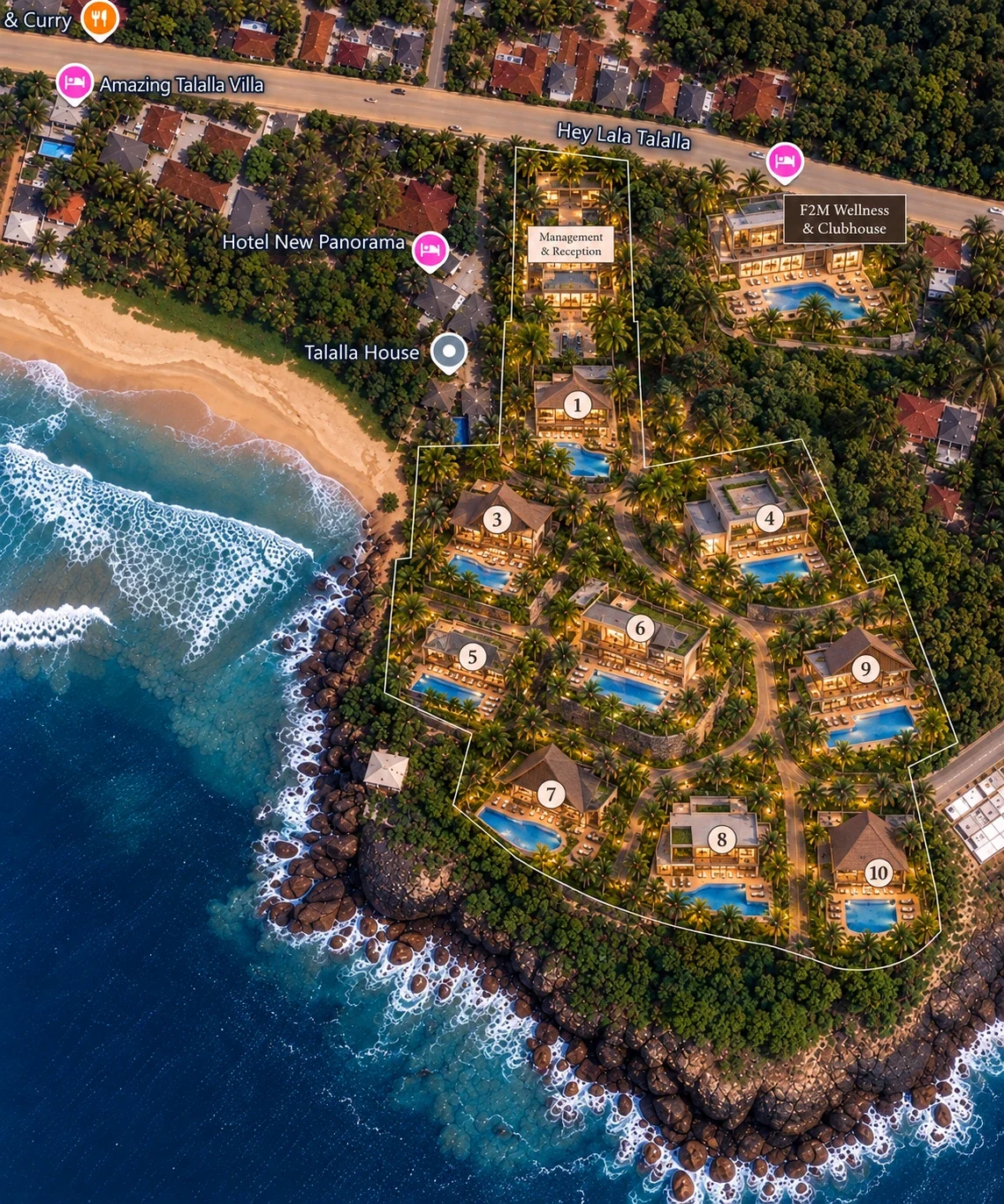
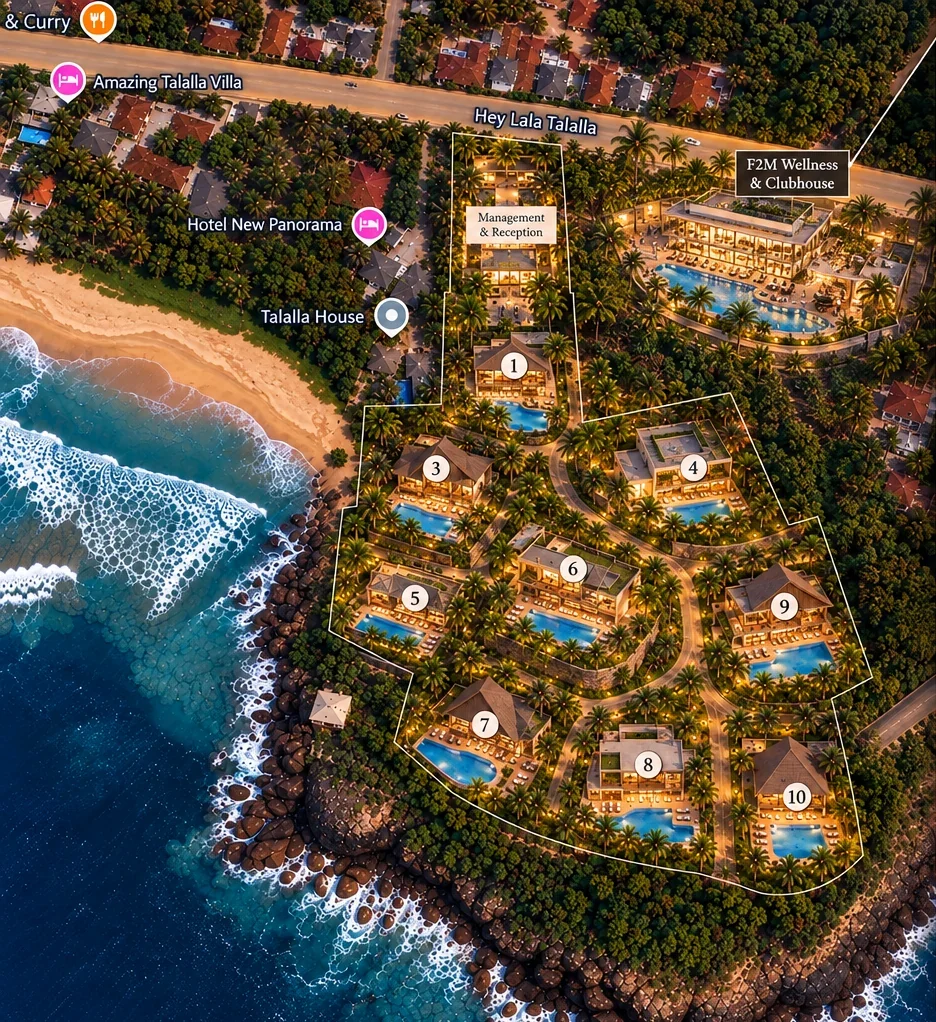
Illustrative masterplan — proposed buildings drawn over a real aerial photograph of the site. The ten numbered plots sit inside the land offered for sale; the F2M Wellness & Clubhouse shown to the north-east stands on adjoining land retained by the sellers and is not part of this sale.
The holding is sold whole, in a single transaction, to a developer — the sellers are not building these villas and are not selling them one by one. What follows is simply the scheme we would recommend to whoever does: ten private villas on a single clifftop, each between 400 and 800 square metres over two levels, with the option of a third cut into the rock below. Designed to sell from $2.5M to $5M — at an average of $3.5M, a gross development value of $35M.
10
Private villas, each with its own pool
700–1,000
Square metres of land per villa
$2.5–5M
Indicative price per villa
$35M
Gross development value at a $3.5M average
See the whole scheme—19 more images↓
The Feel Of The Place
Walking the headland.
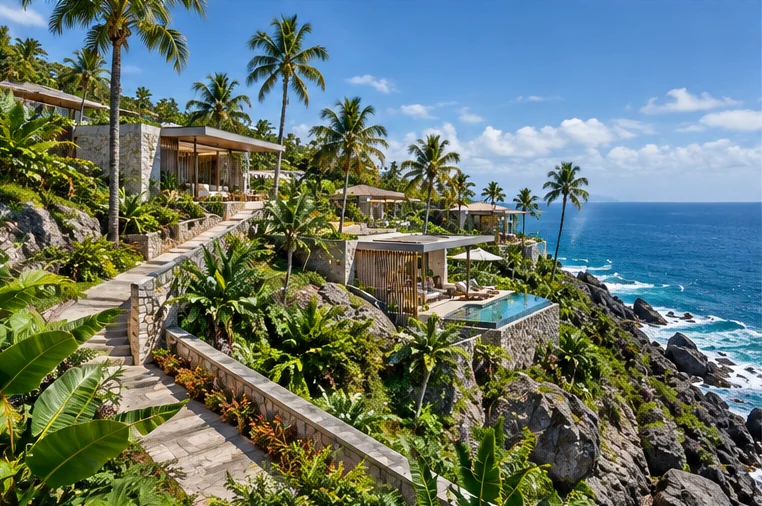
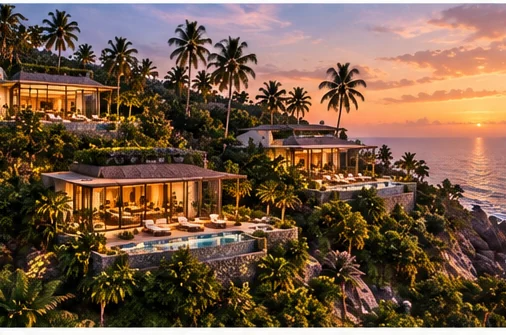
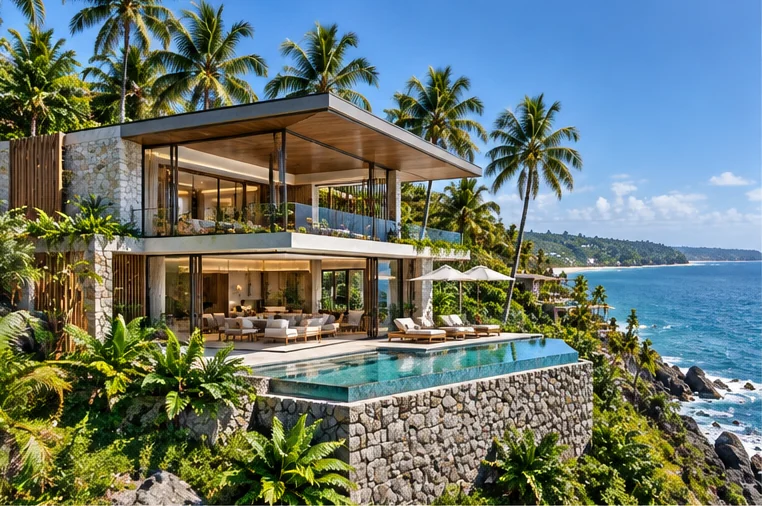
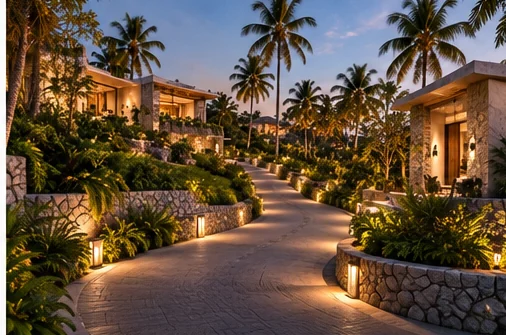
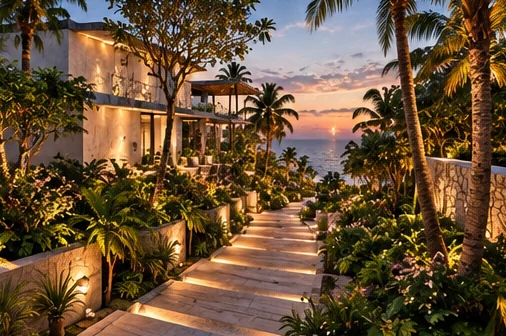
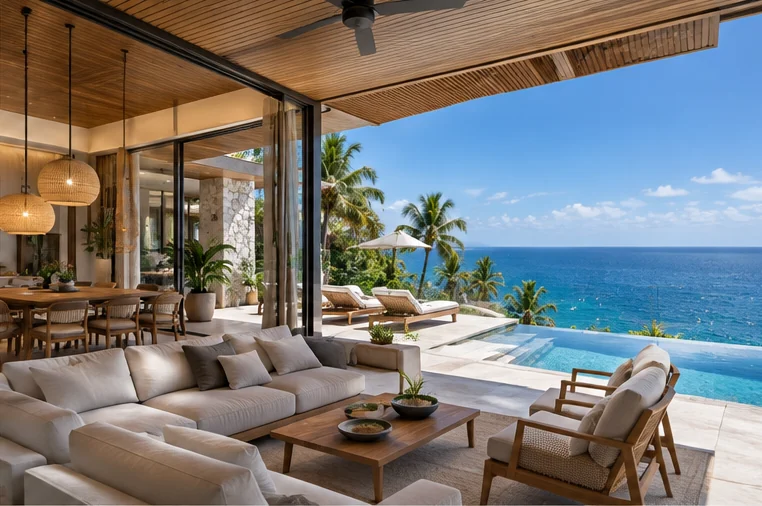
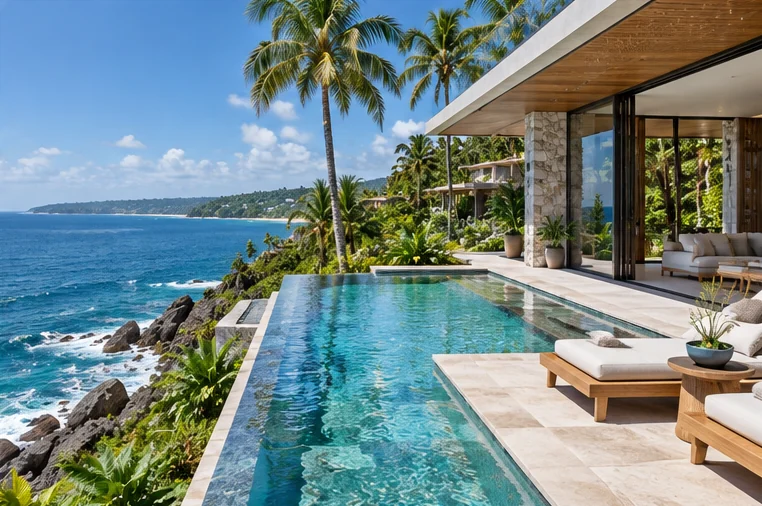
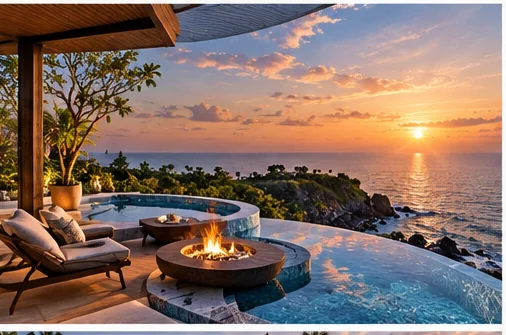
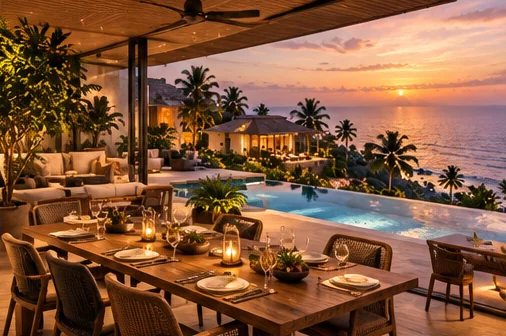
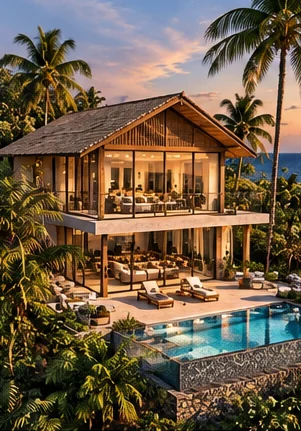
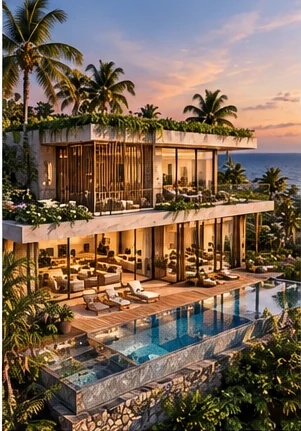
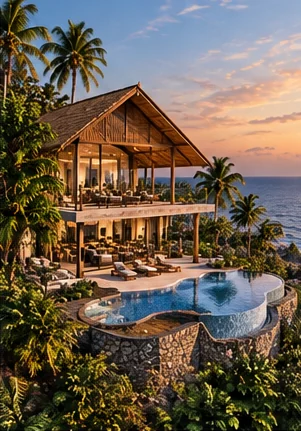
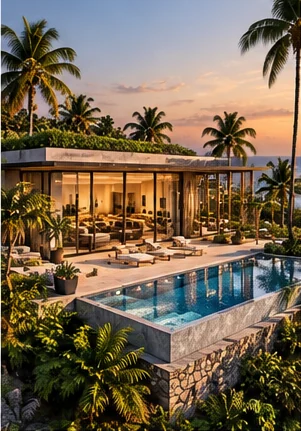
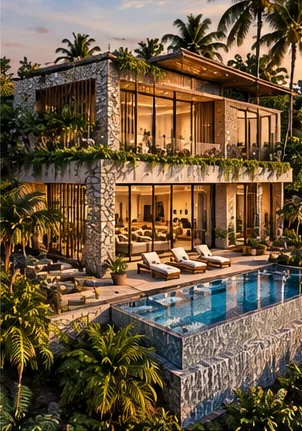
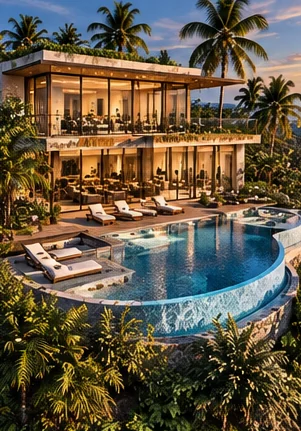
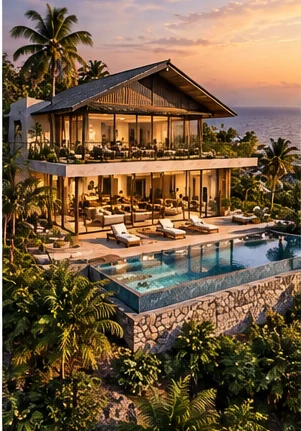
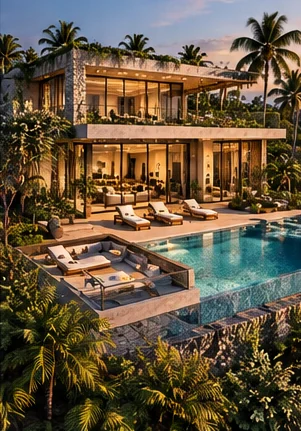
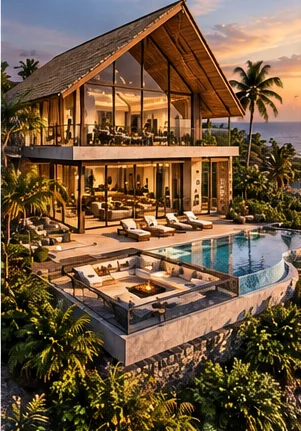
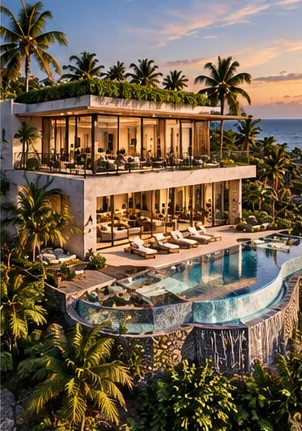
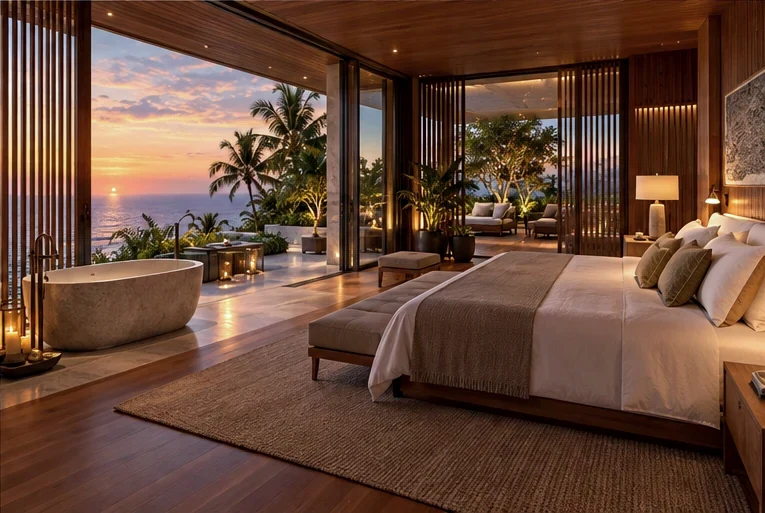
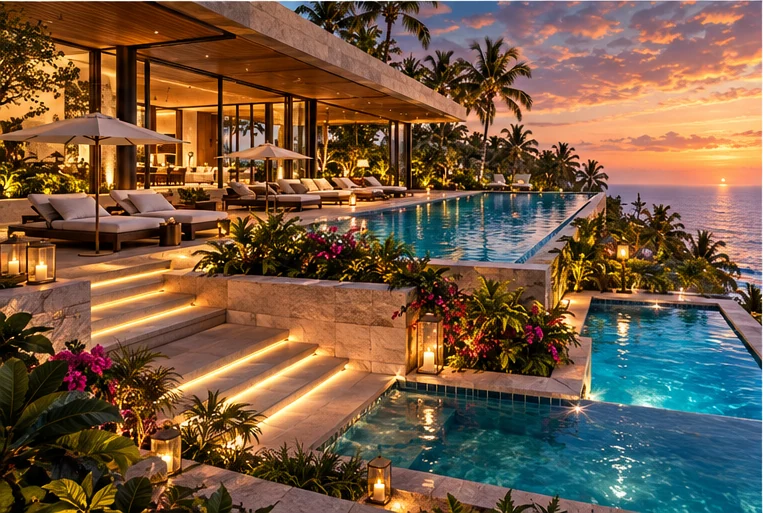
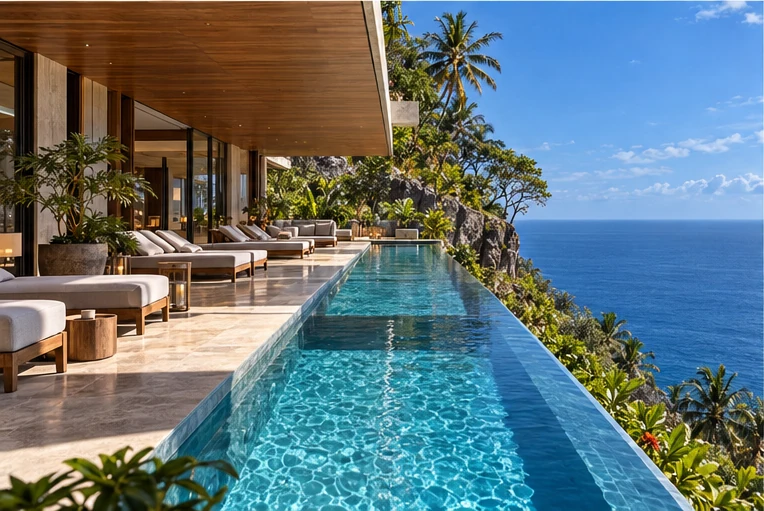
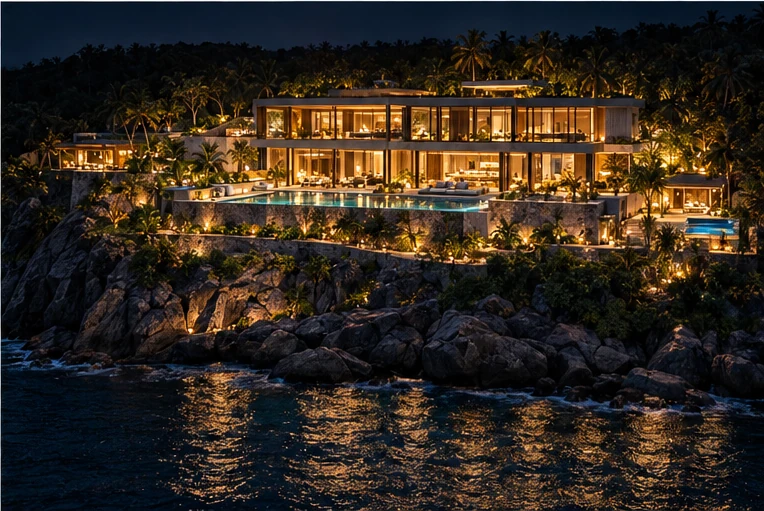
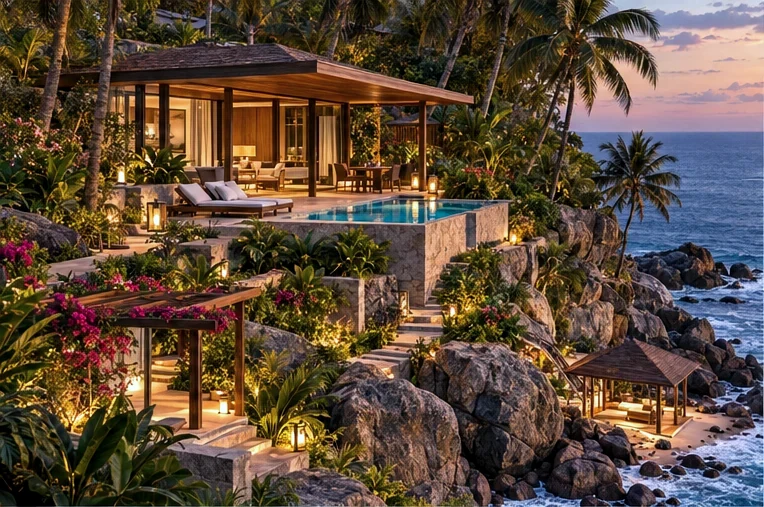
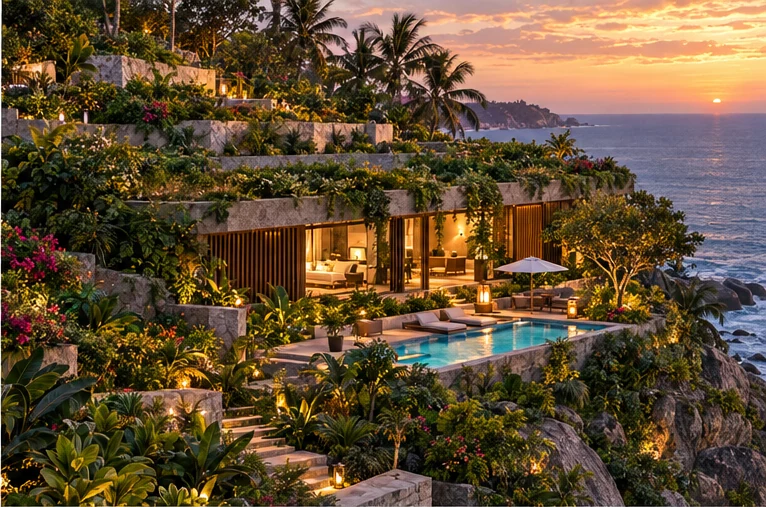
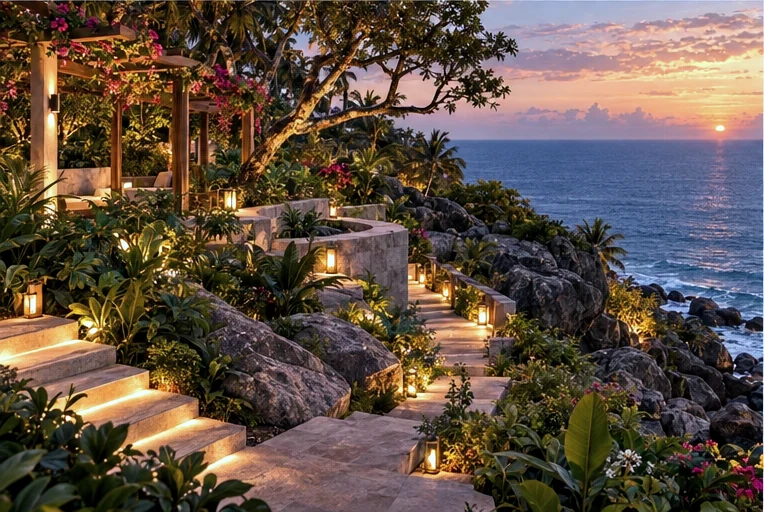
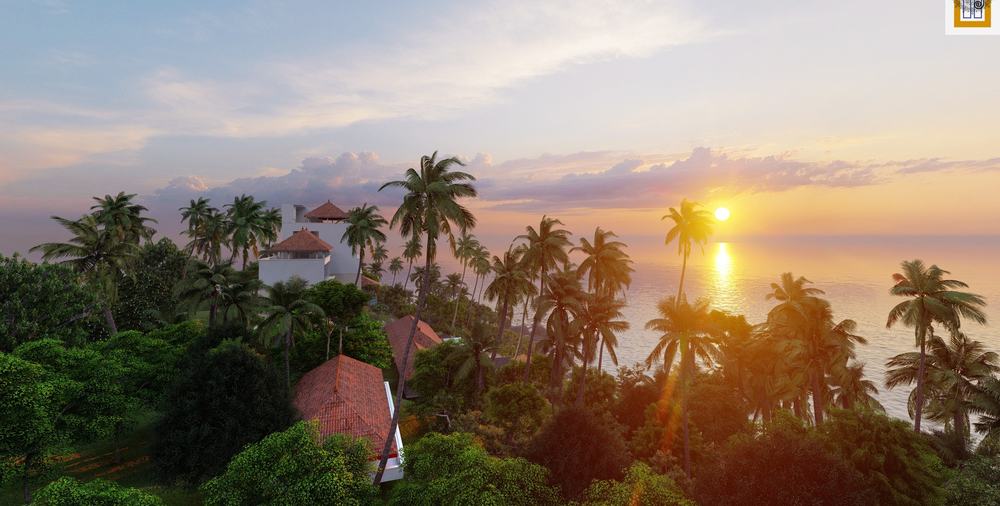
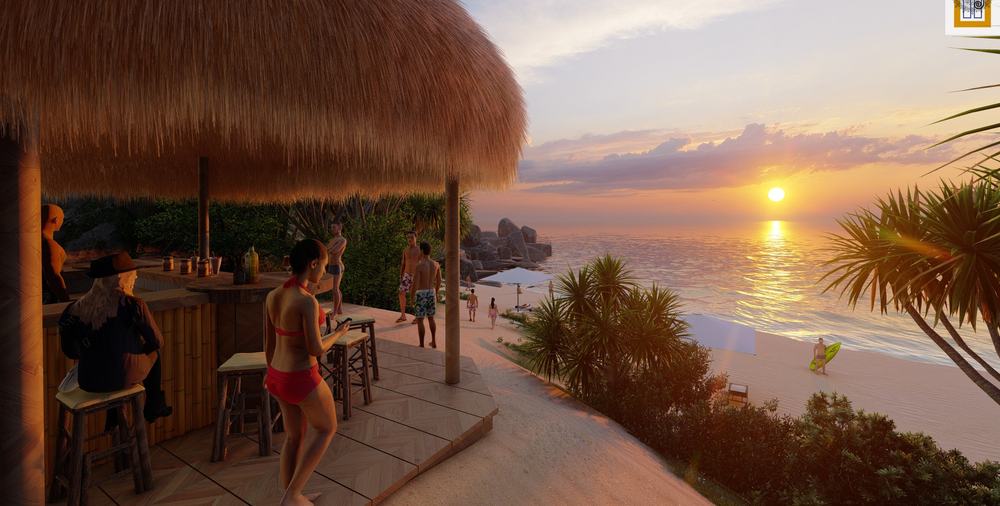
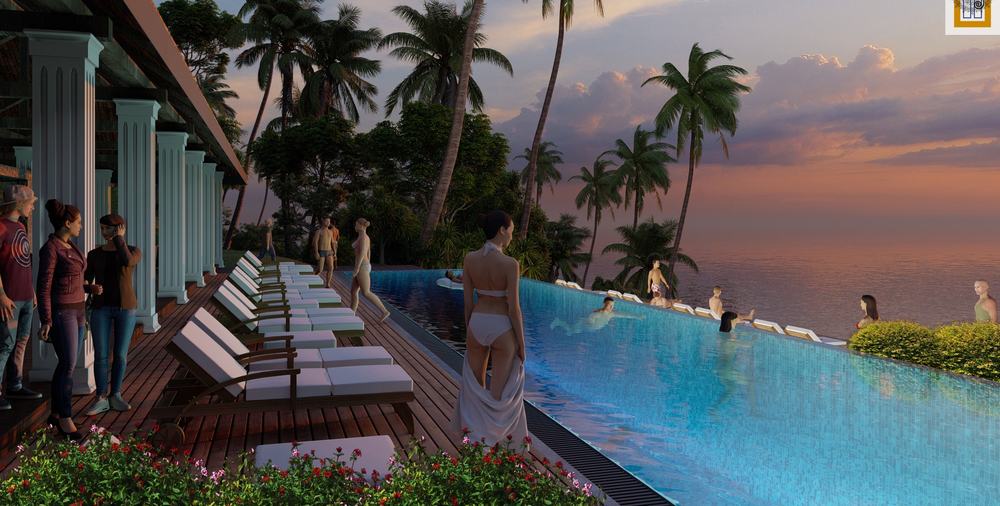
Ten houses on one clifftop, connected by stone paths and planting rather than fences, with the ocean on three sides. This is the character being aimed at — what it looks like to arrive, to walk between the houses, and to sit there at the end of a day.
Houses stepping down the slope rather than sitting on top of itSet among the existing palms, not cleared of themEach house with its own pool on the seaward sideStone paths between the plots, lit at nightPlanting and level changes doing the work of fencesLiving space opening straight onto the terraceThe pool edge as the boundary — no garden needed in frontA fire pit set into the terrace above the rocksEvening on a terrace, thirty metres above the water
Design studies, not photographs. The land as it actually stands today is in the filmed sections above.
The Villas
Ten studies, not ten blueprints.
What follows is one sketch of what ten houses on this headland could be — one study per plot, drawn to show scale and character rather than to fix anything. Nothing here is settled. Floor areas are indicative, the architecture is a suggestion, and a buyer is free to design each villa however they wish, to vary the mix, or to build fewer and larger.
Villa 1
400–450 m²
Villa 2
500–600 m²
Villa 3
450–550 m²
Villa 4
400–450 m²
Villa 5
500–650 m²
Villa 6
700–800 m²
Villa 7
700–800 m²
Villa 8
700–800 m²
Villa 9
700–750 m²
Villa 10
550–700 m²
Design studies only. Floor areas are indicative and spread over two levels, before any lower level cut into the rock. Final design, sizes and mix are entirely the buyer's to determine. Individual villas are not offered for sale — the land is sold as one holding.
On The Pricing
Why a clifftop is not a beachfront.
The comparison a buyer reaches for first is a beachfront villa, and it is the wrong one. Beachfront means sea level, a road behind you, and sand anyone can walk. What is being sold here is elevation — thirty metres of it, with the view carrying the whole way round and a beach below that is quiet enough to feel private. The honest comparison set is the headland properties.
Cape WeligamaClifftop resort villas on a headland, roughly 40 km west along the same coast
ÀNI Sri LankaElevated private resort at Dickwella, about fifteen minutes east of this site
AmanwellaSet above its own beach at Tangalle, further east along the coast
Named as points of reference for position and character, not as transaction evidence. Any scheme on this site is subject to Coast Conservation Department permitting; the relevant standard for a headland above the five-metre contour is a minimum setback from the cliff edge rather than the wider coastal buffer.
Recommended · The Single Estate
One house on the whole headland.
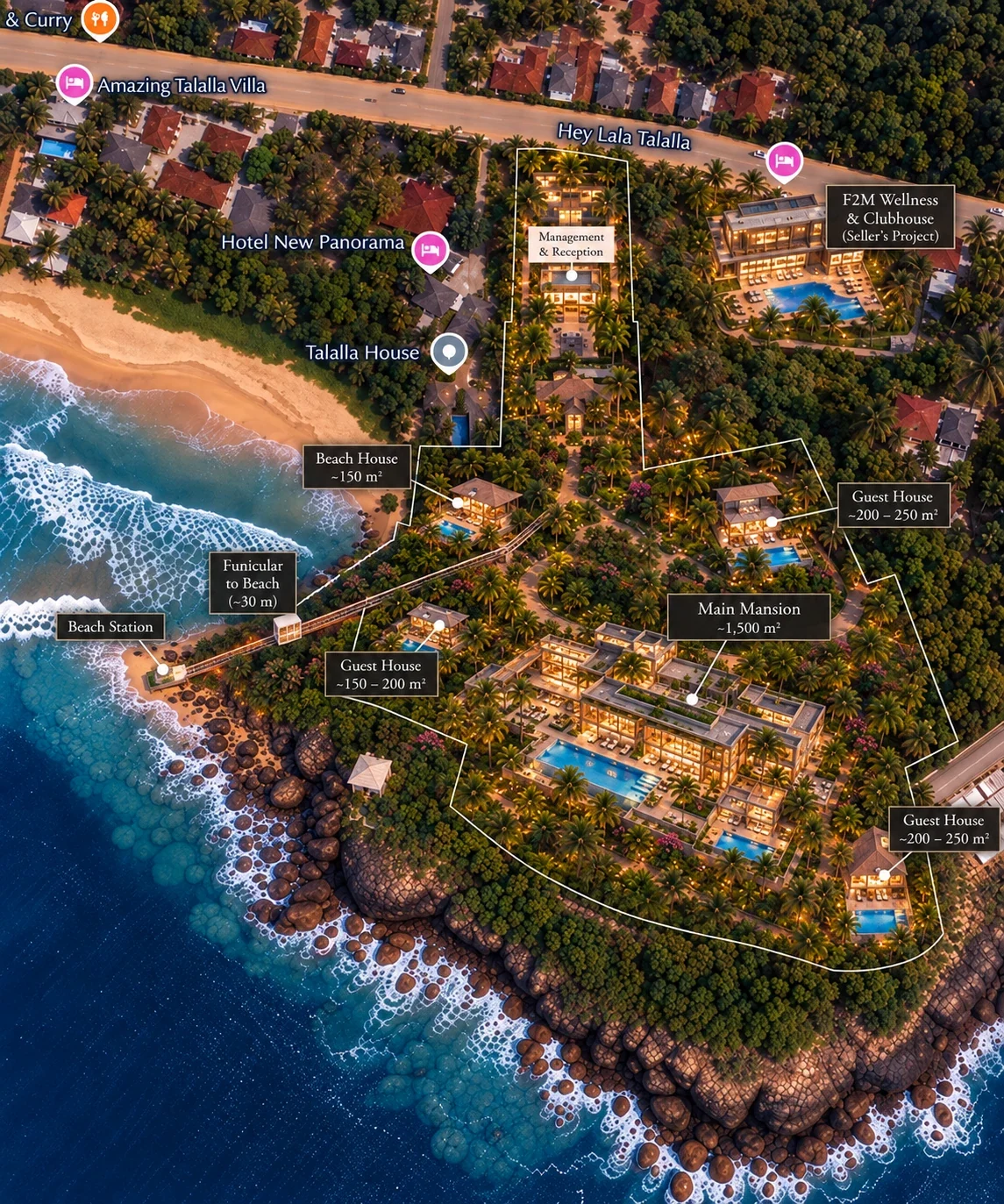
Illustrative masterplan — proposed buildings drawn over a real aerial photograph of the site. The F2M Wellness & Clubhouse to the north-east stands on adjoining land retained by the sellers and is not part of this sale.
The same land, one buyer. A single house of around 1,500 square metres above ground, stepping down the cliff on three levels, with two more cut into the rock beneath it. A beach house and three guest houses stand apart in the planting, from about 150 to 250 square metres each. Reception and management sit at the road, the funicular runs to the beach, and everything else is left as garden.
Six buildings on the whole headland, reception included, where the scheme above puts ten villas on the same ground.
1,500 m²
Main house above ground, over three levels
2
Further levels cut into the rock below
4
A beach house and three guest houses, 150–250 m²
11,600 m²
The entire headland, under one owner
See the house—25 more images↓
Above Ground
Three levels, stepping down the rock.
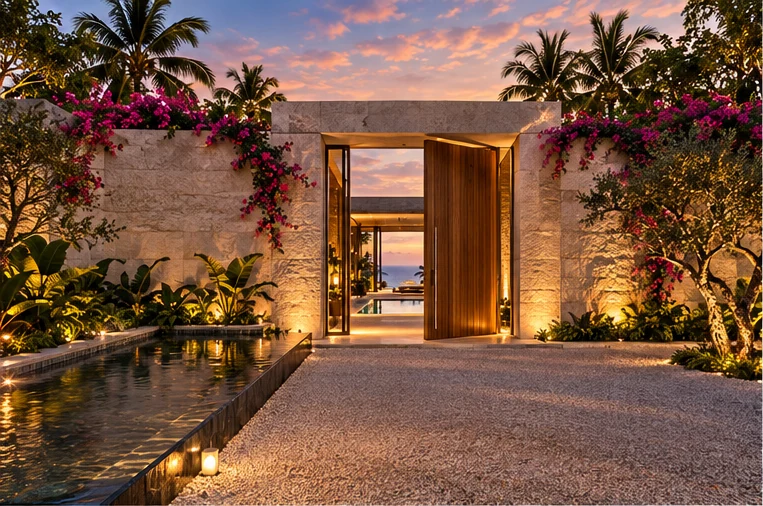
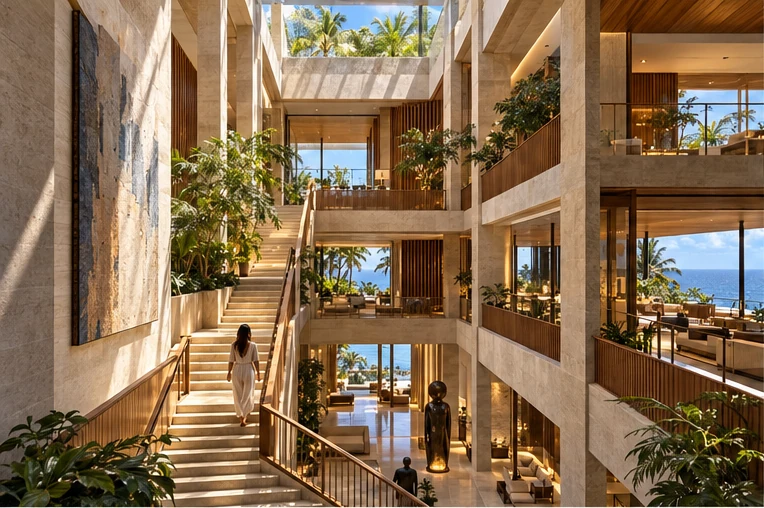
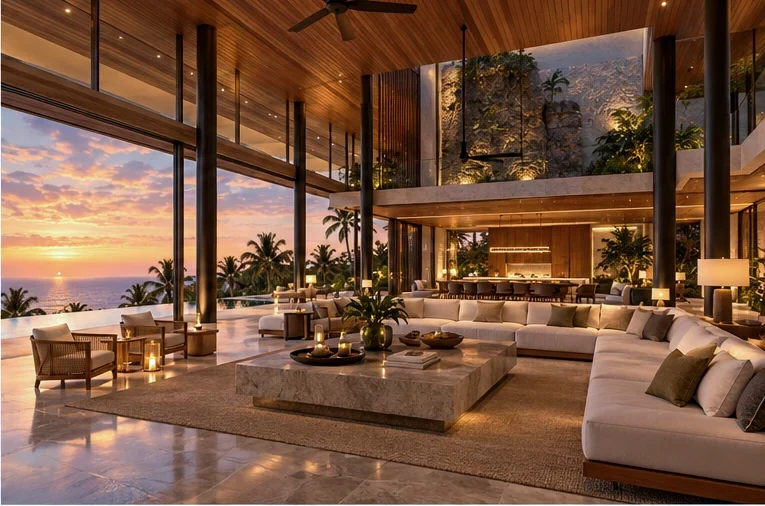
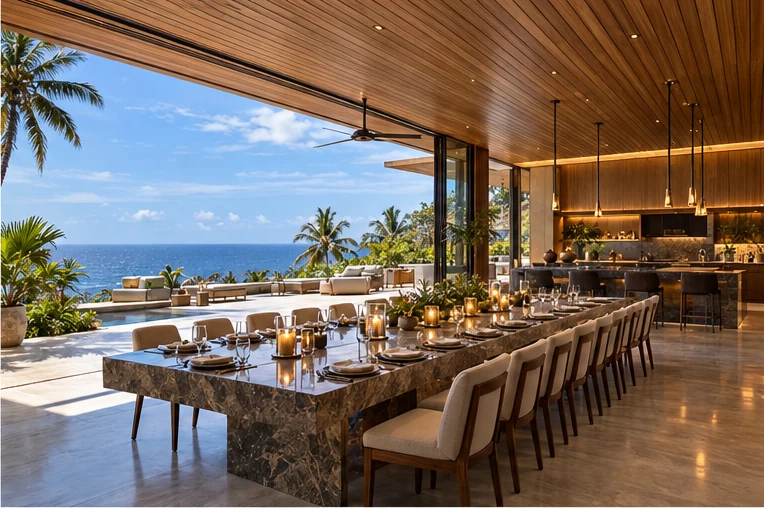
The house is entered from the high side, where there is deliberately little to see — a long wall, a door, a courtyard. Everything is on the other side of it. Inside the door the whole house opens at once: three levels stepping down the cliff, a stone stair running through all of them, and the ocean carrying the full way round. One table seats twenty. The lowest terrace is a lap pool with nothing past its edge but the drop.
The arrival court — a wall, a door, and nothing given awayInside the door: all three levels at onceThe main room, the glass slid fully awayOne table, twenty places, the kitchen behind it
The principal suite, on its own terraceTwo pools on two terraces, joined by a stone stairThe lowest terrace, and the drop beyond the pool edge
From the water, after dark — three levels, and the only light on the headland.
The Rest Of The Headland
Four more houses, and a great deal of garden.
Four smaller houses sit apart from the main one, each in its own planting — a beach house of around 150 square metres near the sand, and three guest houses of between 150 and 250. Reception and management stand at the road. With six buildings on the whole site, most of the headland stays what it already is: rock, palms, and whatever is planted between them.
A guest house on the seaward edgeA guest house terraced into the slopePaths and planting instead of fencesThe funicular, thirty metres down to the sand
Underneath
And then it goes down.
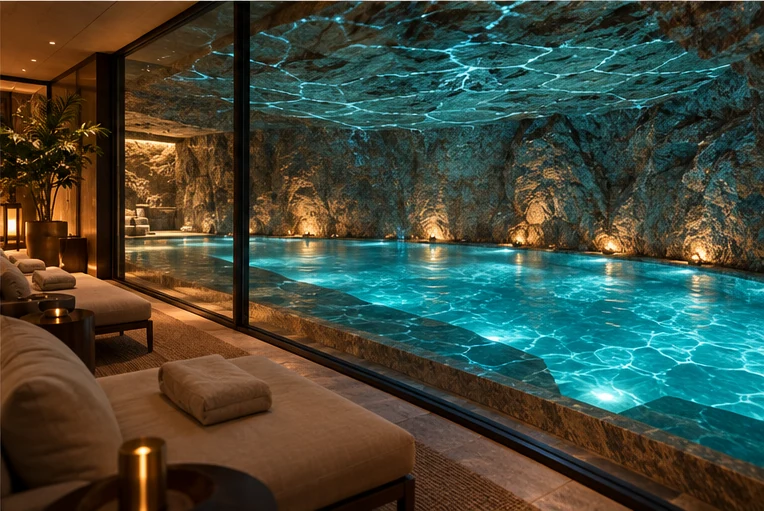
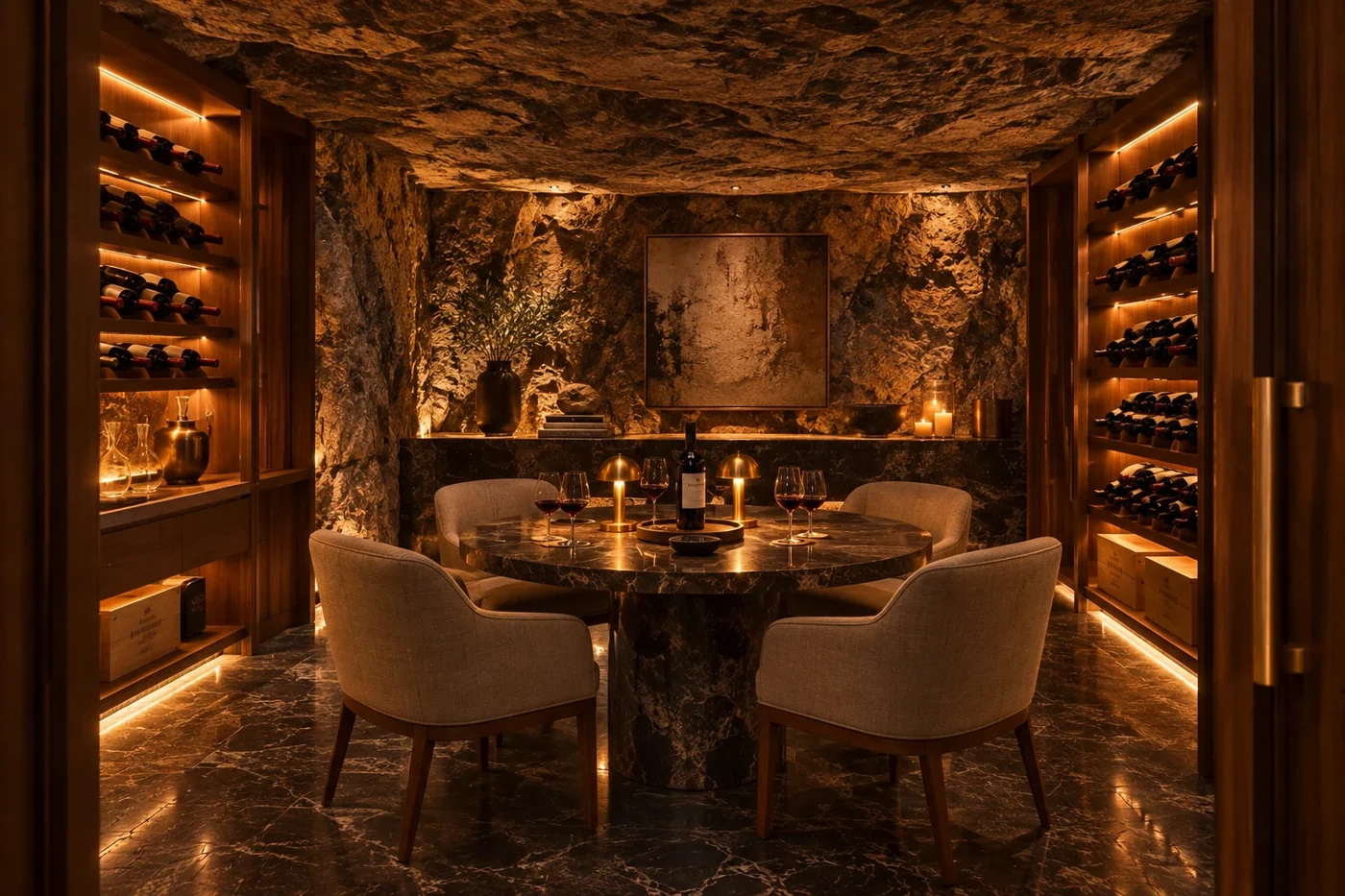
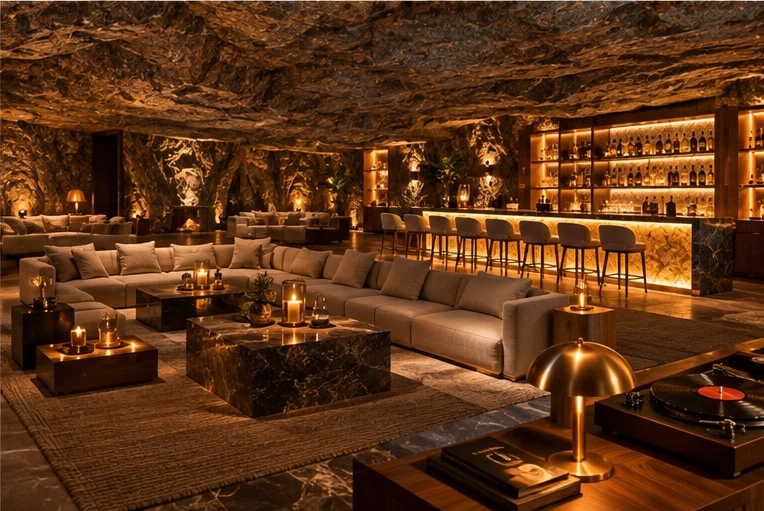
Because the headland is solid rock, a house here can go down as easily as up. Two further levels are cut into the rock beneath the terraces — rooms that want to be cool, quiet and dark, in the one material that gives all three without a compressor. Someone who has walked the whole headland above has not yet seen half of this house.
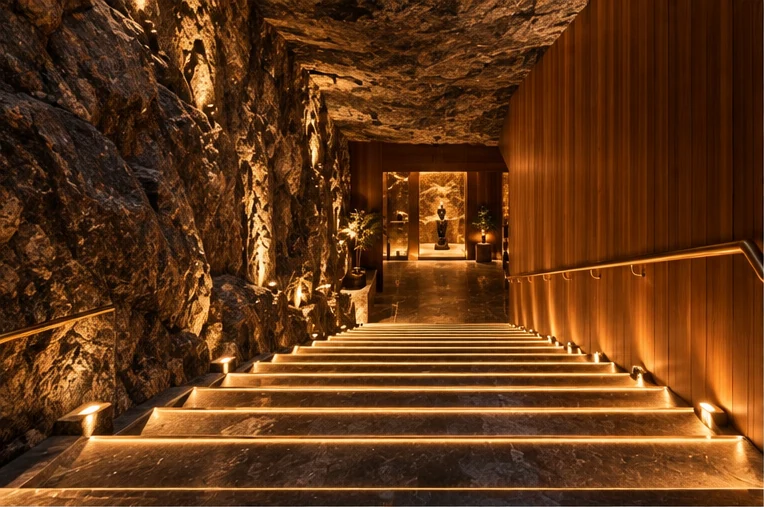
The stair down from the terrace level. Everything below this point is cut from the rock.
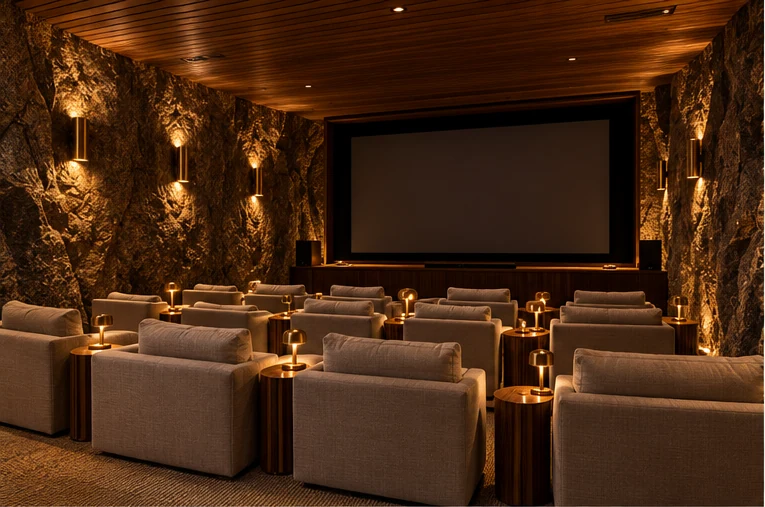
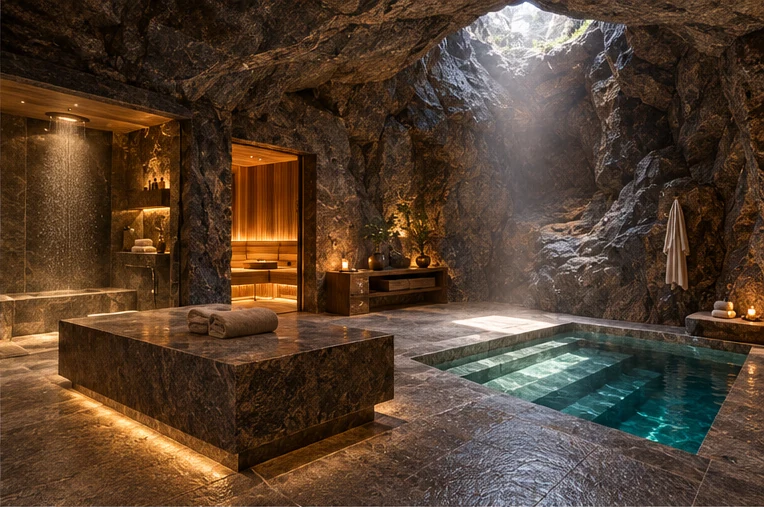
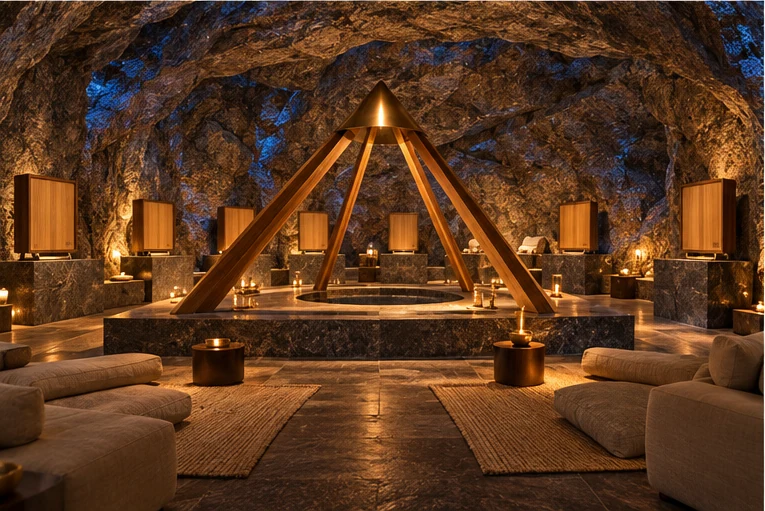
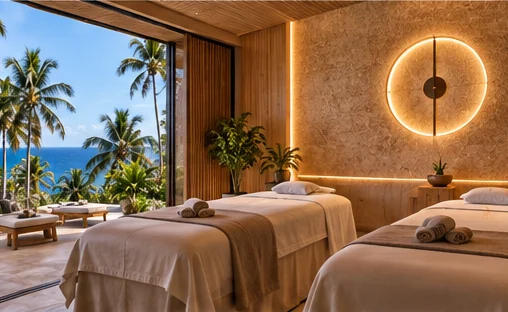
A cinema for twelveThe spa, with daylight dropped from a shaft aboveA hexagonal chamber lined with six scalar panelsA pool on the lower level, lit from within the waterThe wine roomA bar and lounge at the bottom of the house
Coming And Going
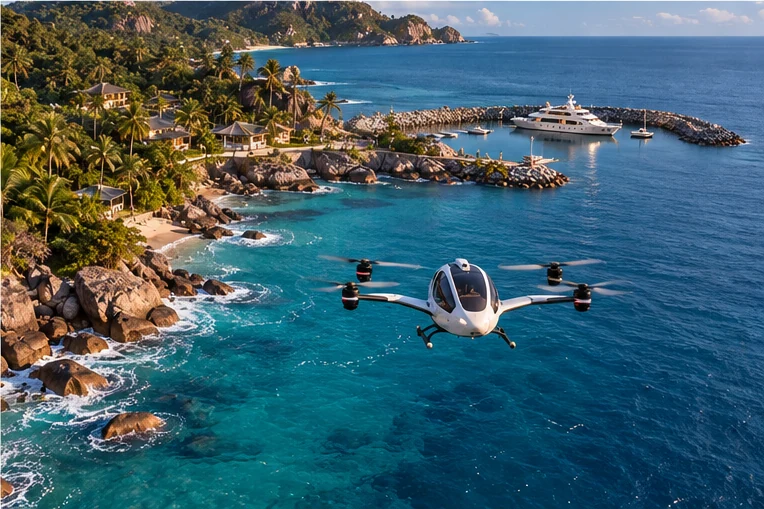
The harbour you can see from the terrace.
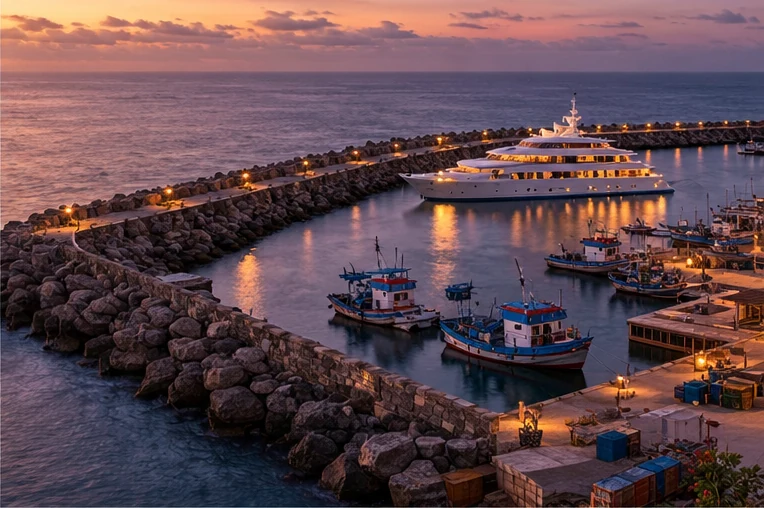
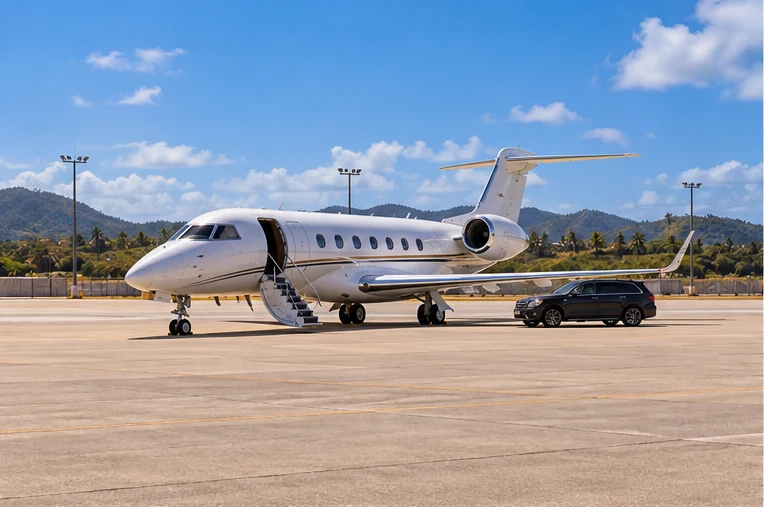
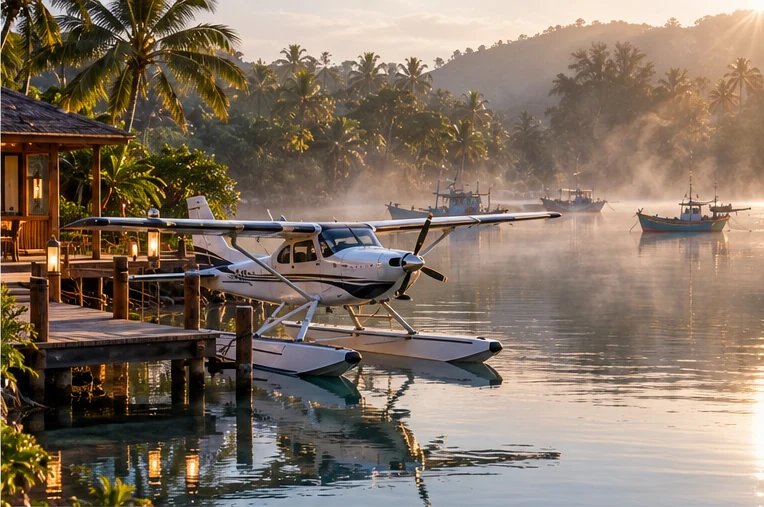
The small harbour at Gandara lies about two kilometres west — in sight of the house, five minutes by road. A boat can lie inside its breakwater, or at anchor in the bay below the headland. A jet lands at Mattala, 81 km east, or ten minutes to the roof by helicopter. The seaplane comes down on Mawella Lagoon, twenty minutes along the coast.
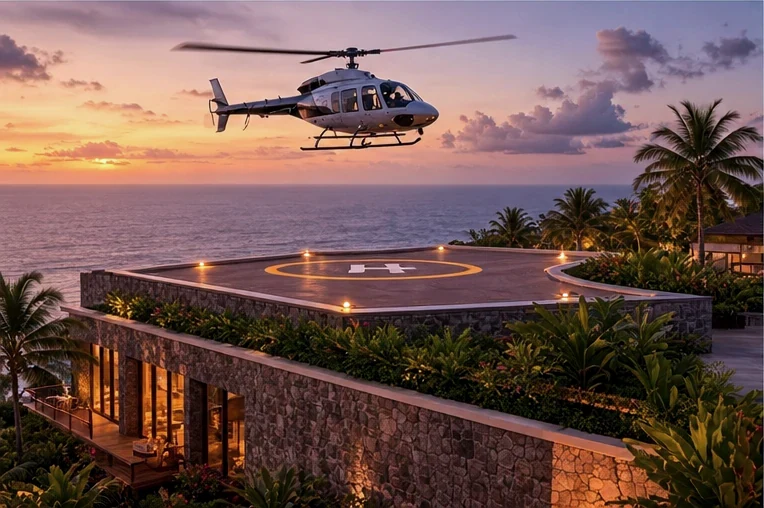
Gandara harbour — breakwater, or anchor in the bayThe pad on the roof of the main houseThe beach station, and a tender on the sandMattala — a 3,500 m runway and almost no trafficThe seaplane at Mawella LagoonA design study, not a service — see the note below
The helipad is designed and permitted as a helicopter landing site, which is what operates in Sri Lanka today; any landing site requires approval from the Civil Aviation Authority. Electric passenger aircraft are shown as a design study only — no such service exists here yet. The pad is sized so that it will not need rebuilding when one does.
Arriving
Jet, helicopter, seaplane, or the road.
Every way in below exists today except one — the pad on the roof, which is a slab of rock and a permit away. The nearest water landing is twenty minutes down the coast road; the international gateway at Colombo is a straight run up the highway.
Schematic, not to scale in any direction but along the coast — distances are by road from the site. Codes are the official airport identifiers.
Private jetMattala Rajapaksa International (HRI), 81 km east — a single 3,500 m runway and almost no scheduled traffic to queue behind — a jet lands, clears customs and parks without waiting for a slot. About ten minutes on from there in the air
HelicopterThe last leg from Mattala, or direct from Colombo. Civil Aviation operates a published approval route for a private helicopter landing site, assessed on the touchdown area, the safety margins and the surrounding obstacles — thirty metres of open rock above the sea answers most of that on its own
SeaplaneMawella Lagoon (DIW) at Dickwella, 15 km east — about twenty minutes by road. Scheduled amphibian service runs from Colombo, and the same aircraft reaches the highland lakes inland
Scheduled flightKoggala (KQZ), 62 km west, on the domestic network — the practical option for guests arriving without their own aircraft
InternationalBandaranaike International (CMB) at Colombo, 190 km north-west — the Southern Expressway runs almost the entire way, so it is motorway rather than cross-country, with very little traffic on it
RoadDirect frontage on the Colombo–Matara main road; Galle is about an hour west, Matara twenty minutes
HospitalMatara, about twenty minutes west — the district general hospital and private clinics, the largest medical centre on this stretch of coast
On the roof
A pad on top of the house.
A flat roof on solid rock, thirty metres up, with open water on three sides and no neighbouring structure to clear, is close to the ideal landing site — which is why it is worth drawing into a villa from the beginning rather than retrofitting later. Approval runs through Civil Aviation on the published route above, and sizing the pad is a design decision, not a planning obstacle. The same pad serves whatever replaces the helicopter: the aircraft will change, the slab will not.
Ship to shore
And from the roof to the water.
A helicopter that can land on the roof can land on a deck. For an owner keeping a boat on this coast, the useful sequence is jet into Mattala, helicopter to the villa, and the same aircraft out to the yacht — without the car ever being needed.
Distances and drive times are by public road and indicative. Any helicopter landing site, and any aerial activity over the site, requires approval from the Civil Aviation Authority of Sri Lanka; nothing here should be read as a permit already granted.
Next Door
And then there is what sits beside it.
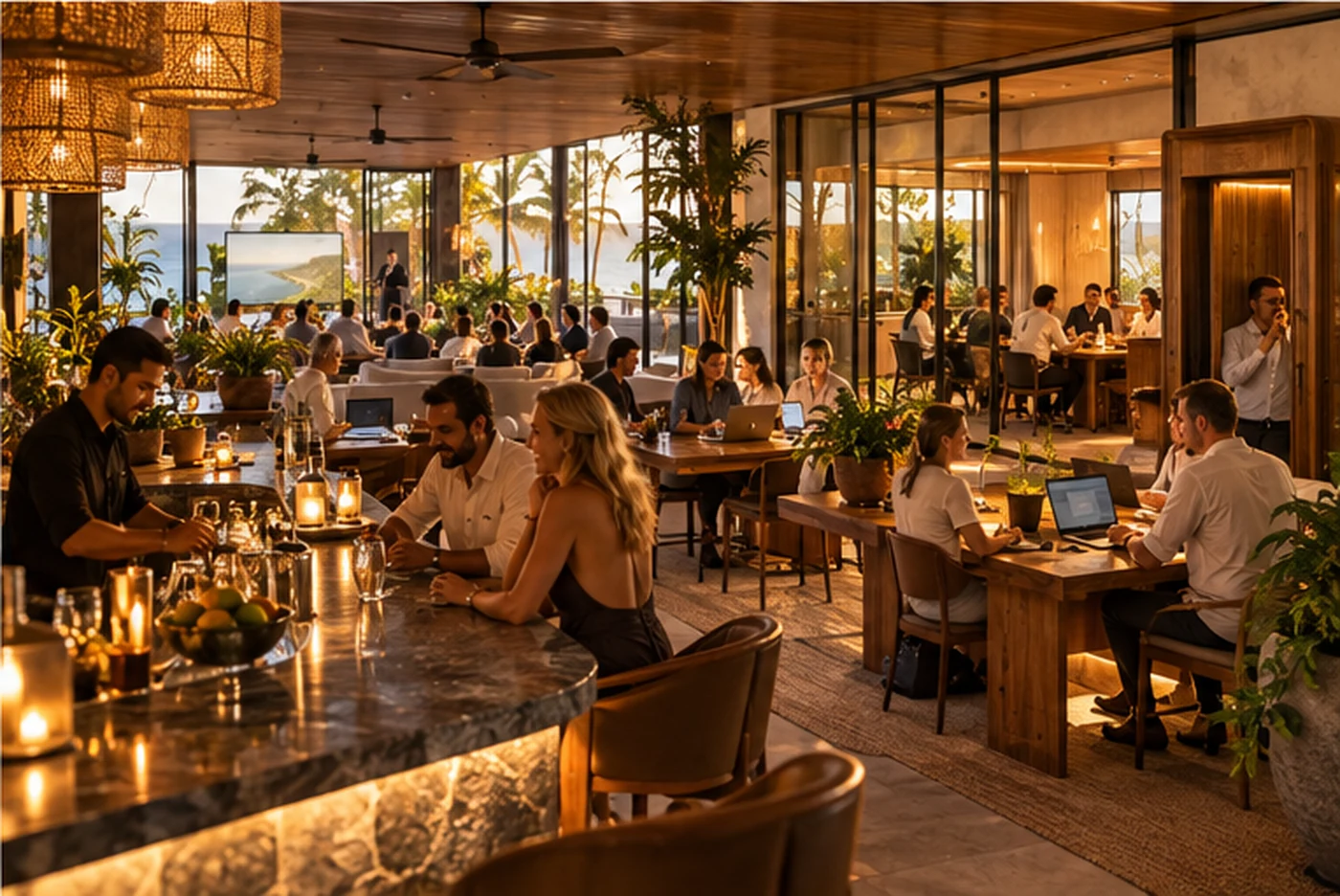
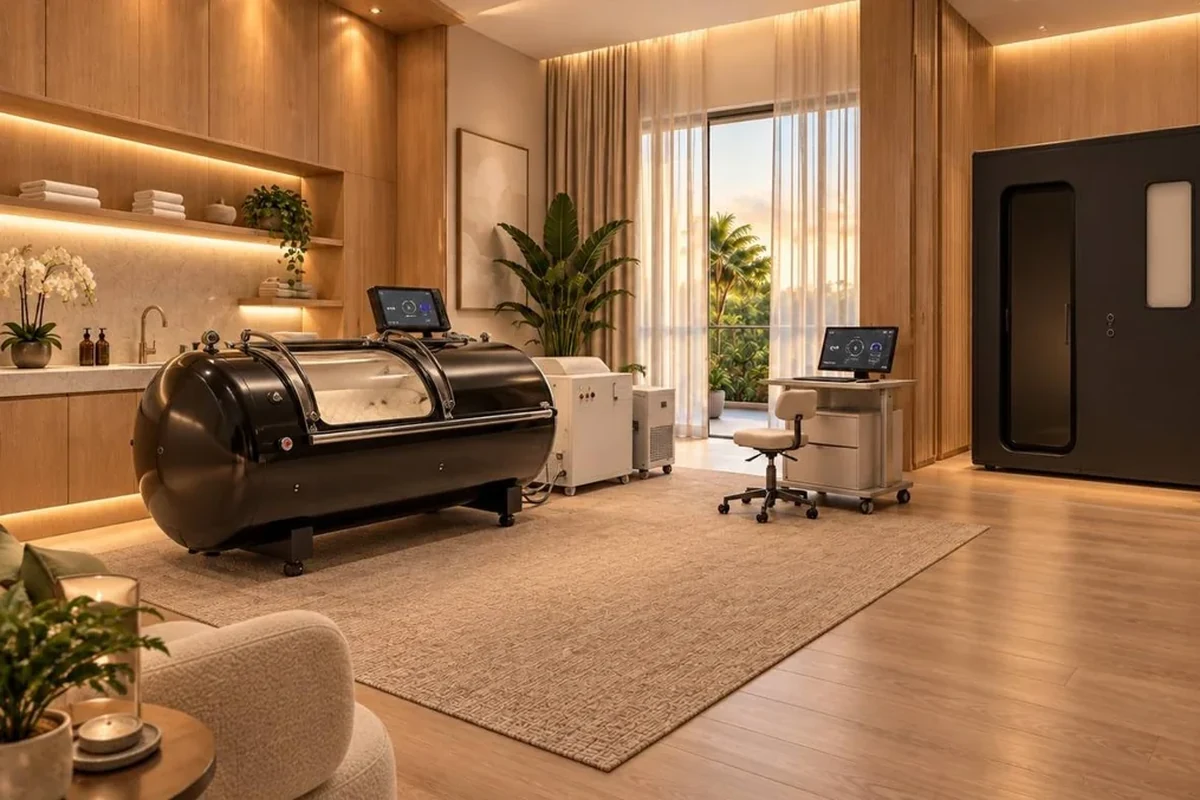
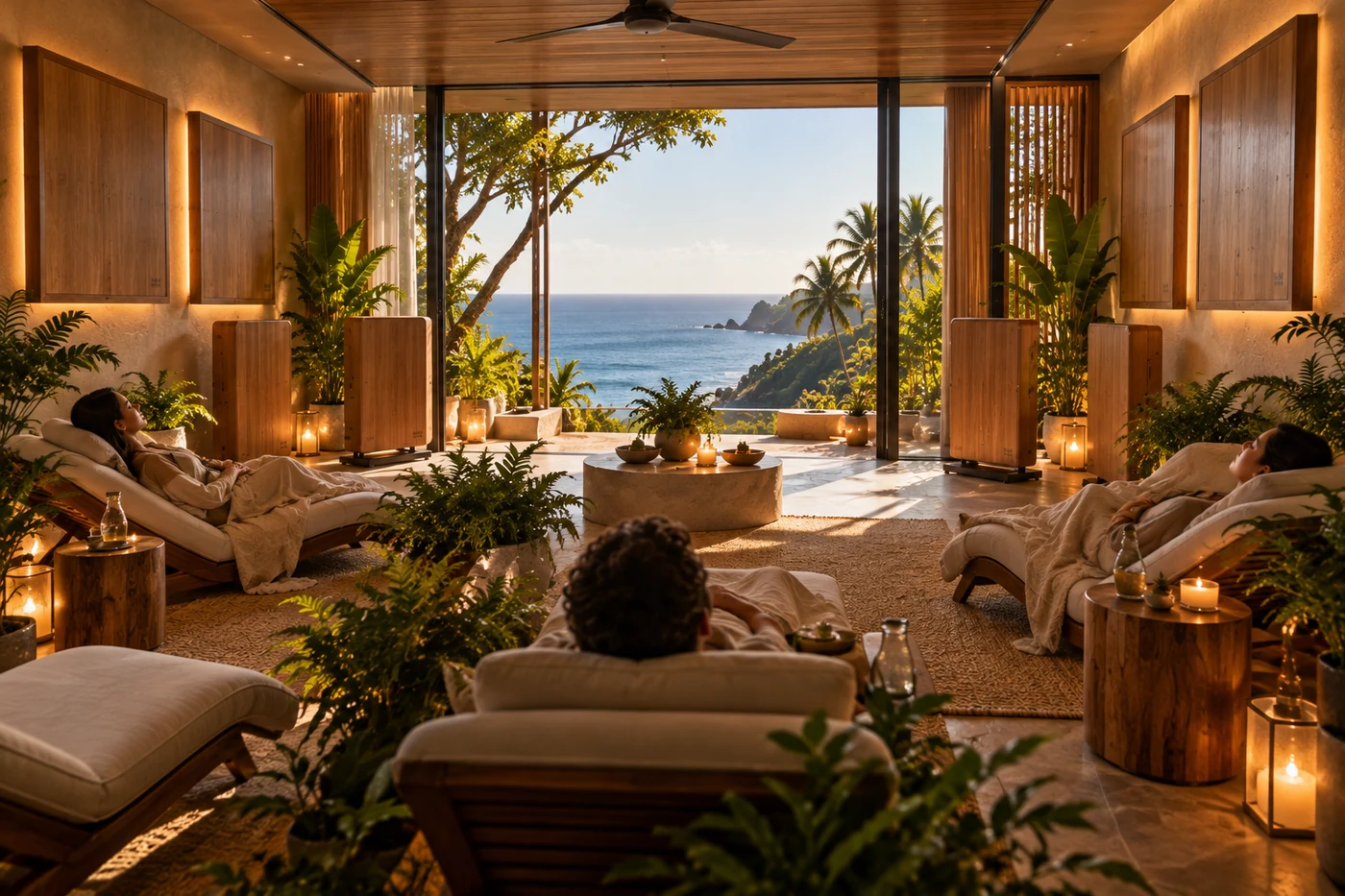
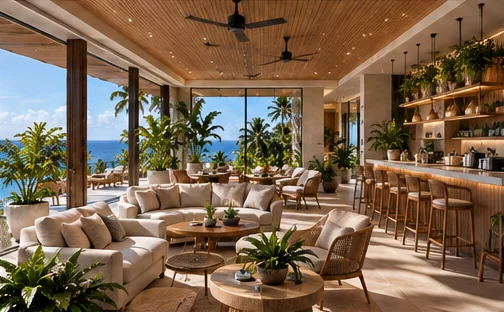
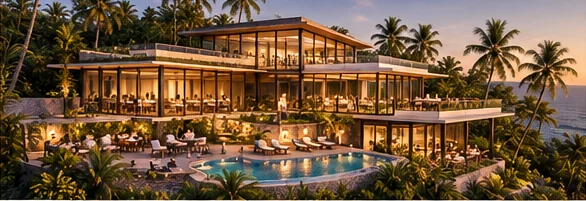
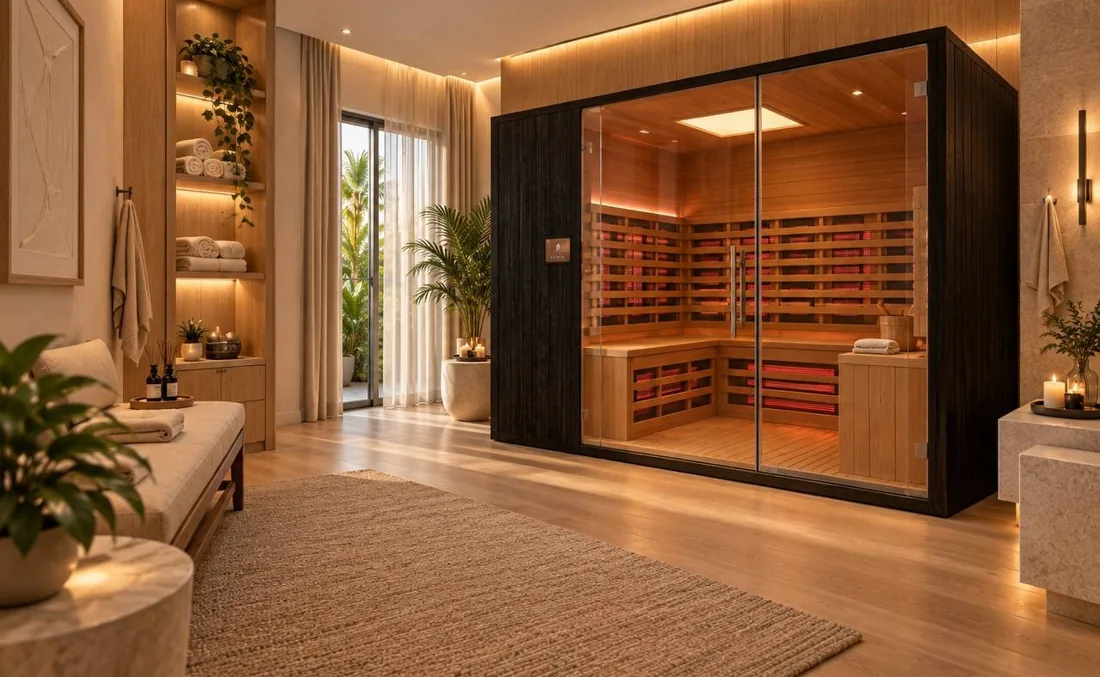
Picture whoever ends up living here. They wake up, walk a few minutes along the headland, and train on equipment that exists nowhere else on this coast. They take a meeting in the coworking room and have lunch on a terrace above the ocean. The afternoon is a hyperbaric chamber, an ice bath, an infrared sauna, or an hour doing nothing at all in a scalar lounge. There is a meditation class in the evening if they want one, and a long table afterwards with people who flew in from somewhere else entirely. None of it is in their house. None of it is theirs to build, to staff, or to pay for. It is simply there, in the back garden.
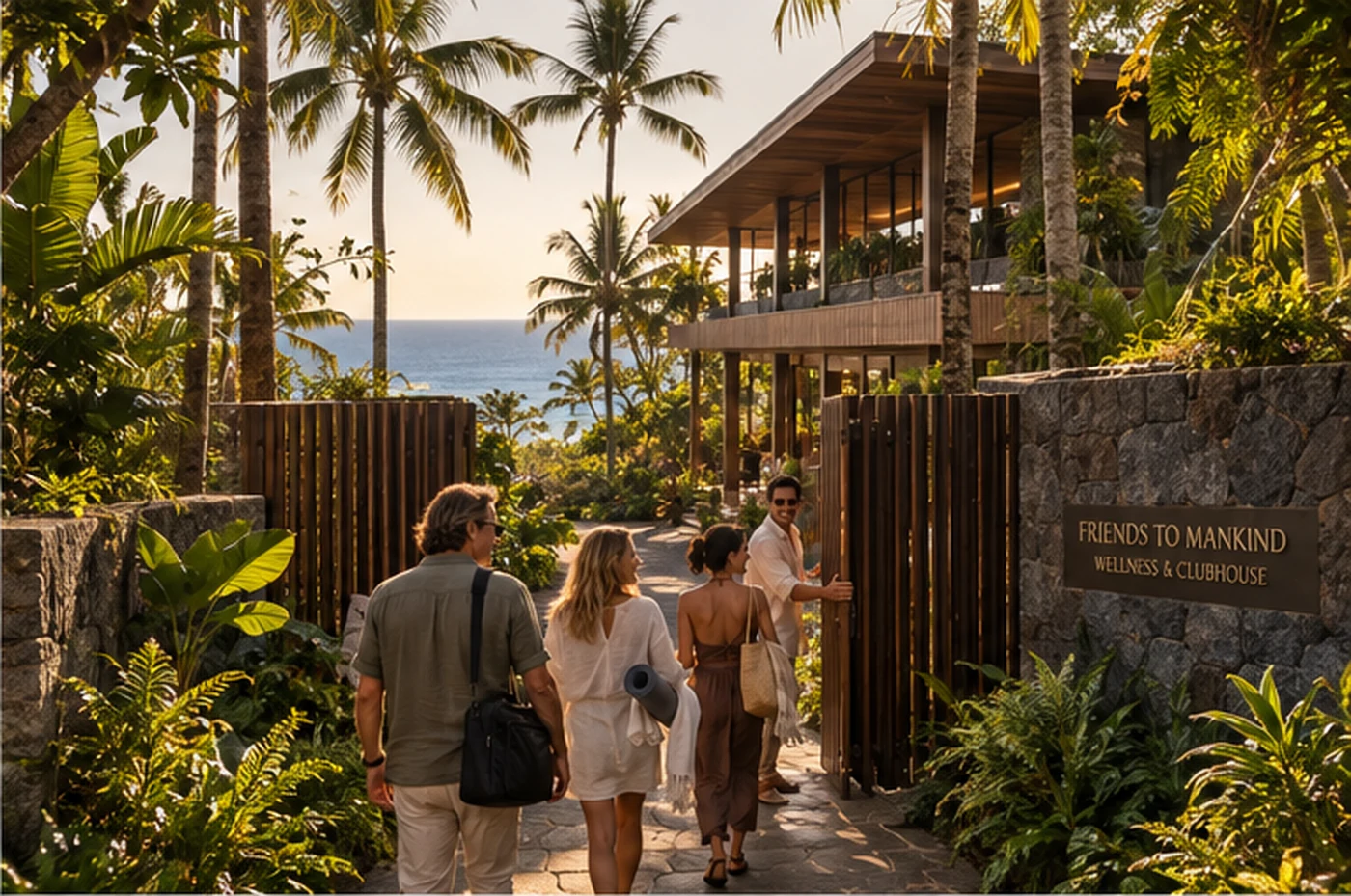
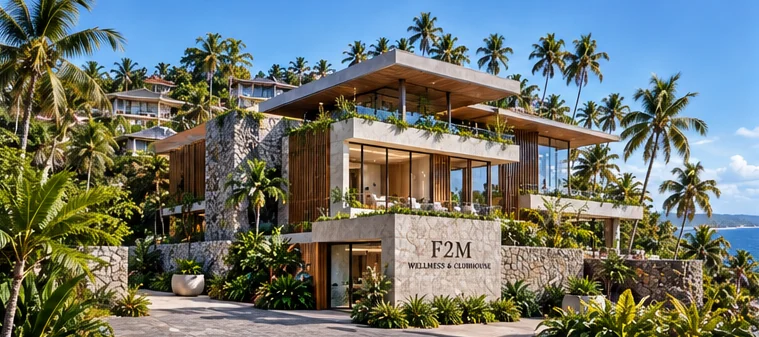
The sellers are keeping the adjoining parcel and intend to build a Friends to Mankind Wellness & Clubhouse on it — a members' club, a clinical treatment floor, a restaurant and an event space. It is not part of this sale and it costs the buyer of this land nothing. Nor is it unconditional: the sellers build the clubhouse alongside a scheme that is genuinely built and operating next door, not alongside a bare-land purchase. Build the headland out, and the clubhouse comes with it. For a resort development it is the rarest thing of all: a reason to be there in the first week, and still a reason in the fifth year.
The clubhouse on the retained parcel, a short walk from the houses. Illustrative plan over a real aerial photograph.
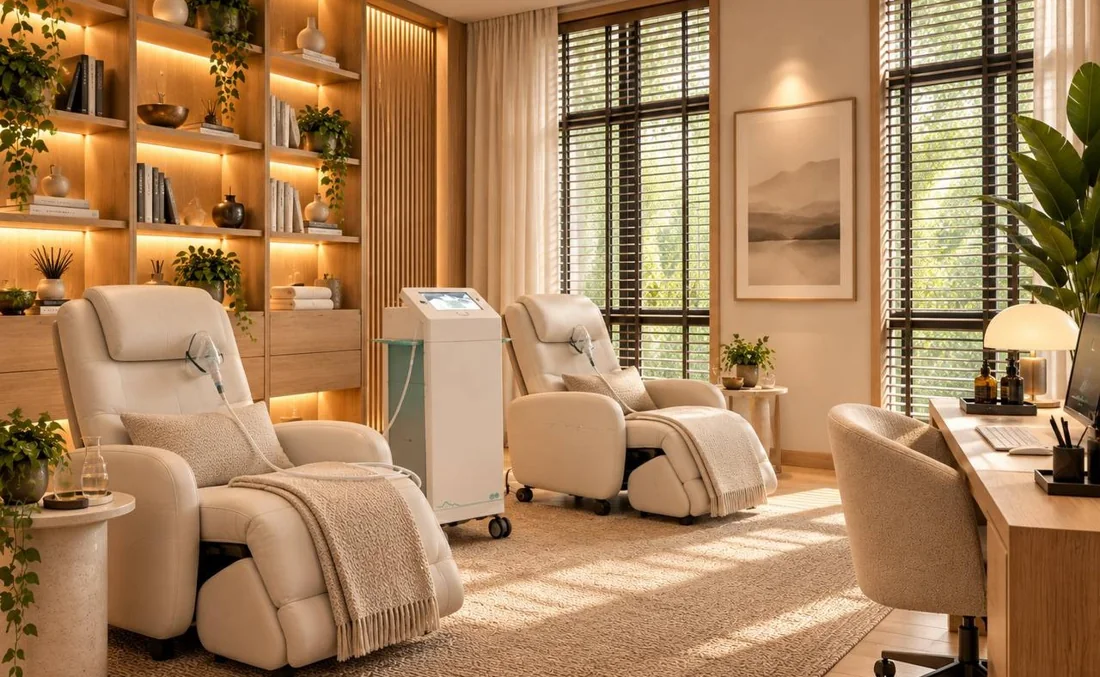
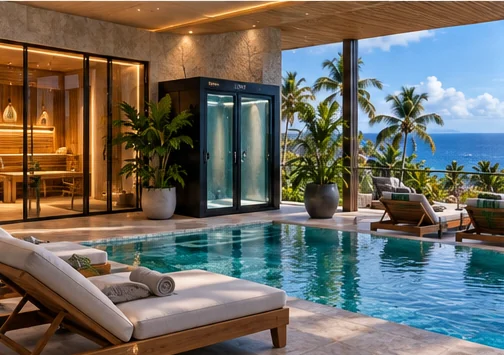
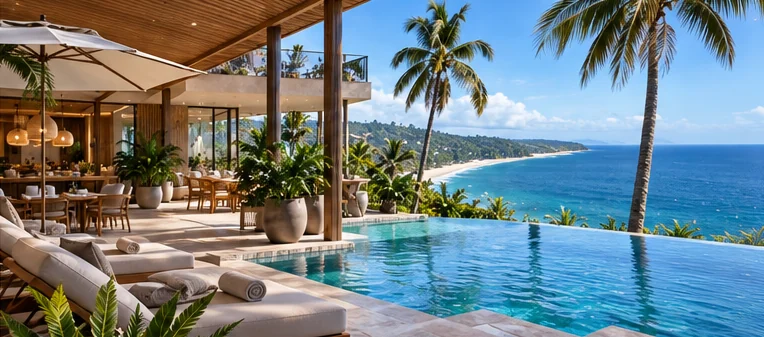
Out through your own gate, a few minutes along the headlandInside: a bar, a restaurant, desks, meeting rooms, a talk at the far endA hyperbaric oxygen suite on the treatment floorThe scalar lounge — the field fills the room; you sit in it and do nothing
Open
Everything that goes inside it
+
01 · Why this network
Founded to make change that lasts.
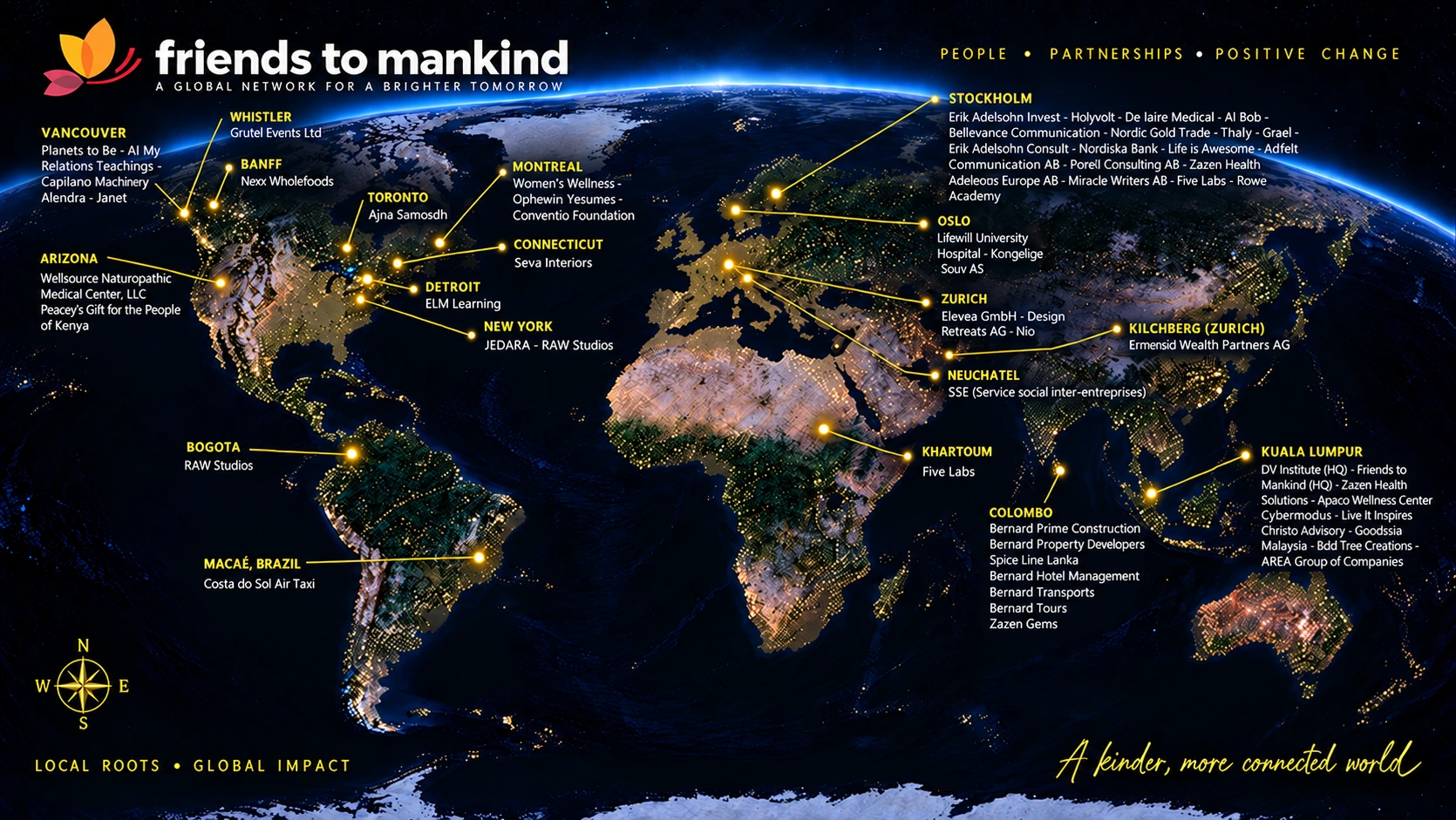
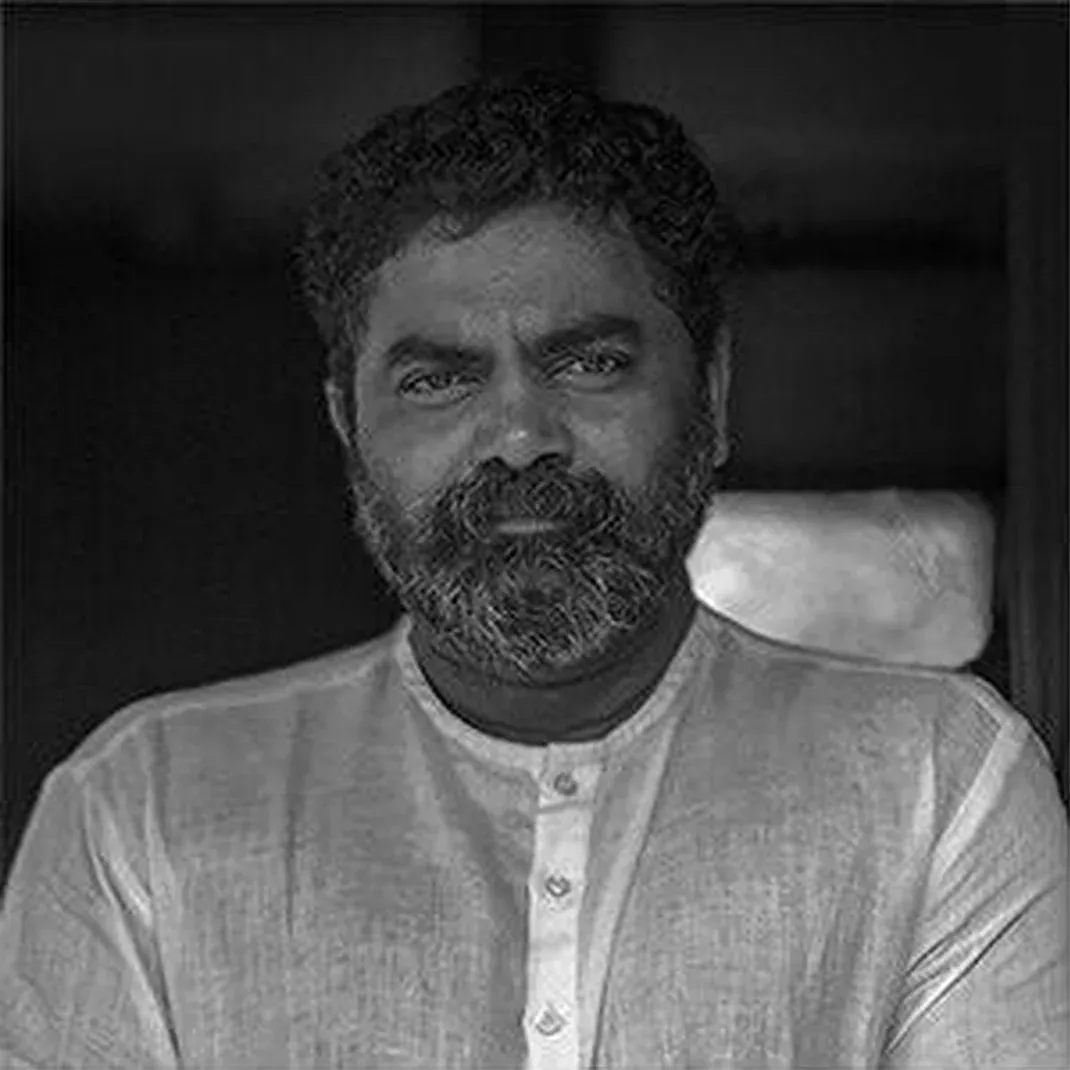
Friends to Mankind is an international non-profit network, founded in 2004 by Dhyan Vimal, working with individuals, corporations and humanitarian organisations for the betterment of humanity. It is headquartered in Canada, with offices and representatives across Malaysia, the United States, the United Kingdom, Switzerland, Spain, Sweden, Singapore, Germany and Australia — twenty-two years, and still expanding.
Local roots, global impact — the network today. Open full size to read the names
The founder story
A trip to India, in 2002.
Witnessing poverty — and a hungry child near palace ruins — convinced Dhyan Vimal that lasting change needs systems, not one-off aid. Two years of shaping that into a working vision led to the founding of Friends to Mankind in 2004. He has since spent close to thirty years as an international speaker and company founder across training, healthcare and multimedia.
The partners
Aligned, not badged.
Every partnering company aligns with the vision. The collaboration varies — business ventures, mutual charity projects, workshops for personal growth, and simply friendly gatherings. The network counts a good number of the world's business leaders among it, some active inside it, others supporting it from outside.
Why now
The map is still filling in.
The network is in active expansion — new cities, new partners lining up. Being associated with Friends to Mankind puts you inside something built on people, partnerships and positive change. It is not a badge, and it is not a logo swap.
02 · What it stands for
Three lines, and a pattern.
“In considering you, consider another too.”“May your success be the success for humanity at large.”“Doing what we can, where we are.”
The pattern worth pointing at: wherever Dhyan Vimal has set up a business, an institute or a community, the neighbourhood around it has grown with it. Two anchor businesses sit inside the network today — the Dhyan Vimal Institute for Higher Learning, which runs courses, retreats and programmes, and Zazen Health Solutions, which builds the scalar technology described further down.
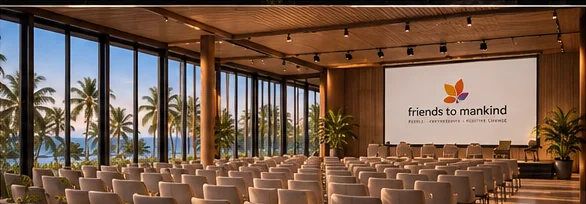
Dhyan Vimal — founderAn Institute programme in sessionThe same room, drawn for Talalla — up to around 120, ocean behind
03 · The human side
The software behind the hardware.
The technology is only half of it. The Dhyan Vimal Institute runs alongside the equipment — meditation sessions and consciousness study groups, open to members and to the public, and leadership and creation programmes delivered on the floor for management teams and companies. In a city, a floor like this fills from the office district around it. On this headland it is the villa owners and their guests — and a stretch of coast that has nothing of the kind along it today.
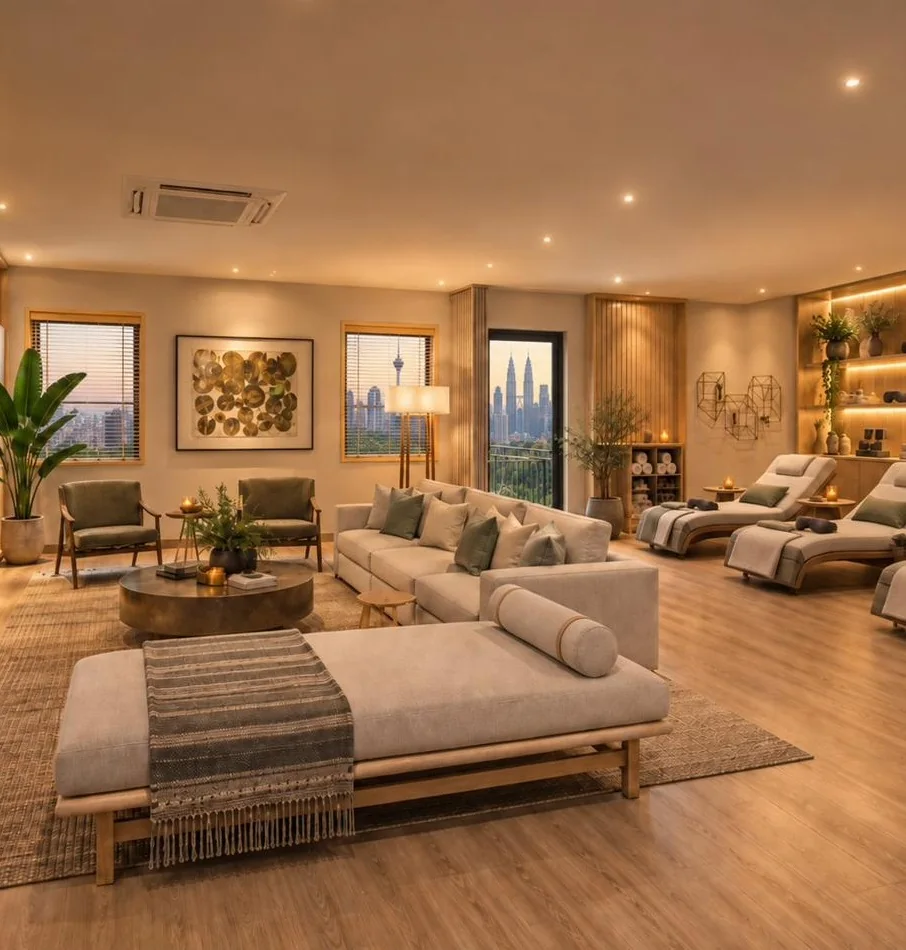
The recovery lounge — where most of the day actually happensRooms for members and visiting programme guests
04 · The concept
A club, a clinic and a company — under one roof.
Three businesses reinforcing each other at one address. It is what keeps the building alive across a whole day rather than one trading window.
The club
The reason people come.
Membership, gym, sauna, pool, restaurant, coworking and events — and the reason they keep coming back.
The clinic
Care, as a member benefit.
Treatment and physiotherapy offered inside the membership — the thing that brings people back weekly rather than occasionally.
The company
An operator in residence.
Zazen Health Solutions on the floor — staffing it, and running its own technology on it rather than demonstrating someone else's.
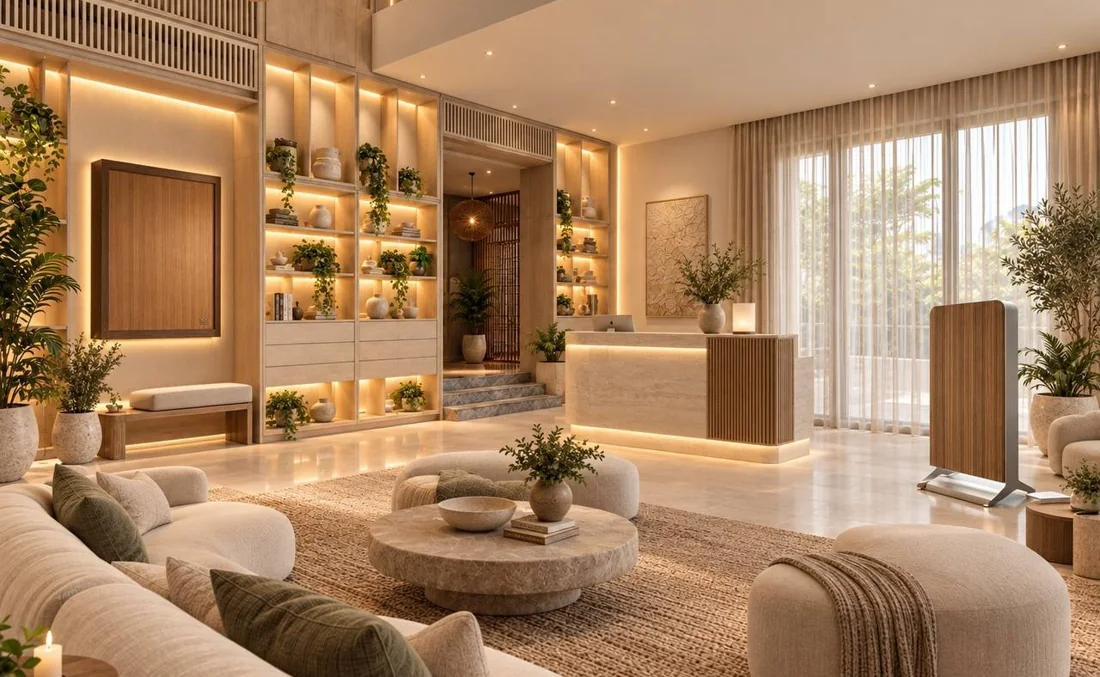
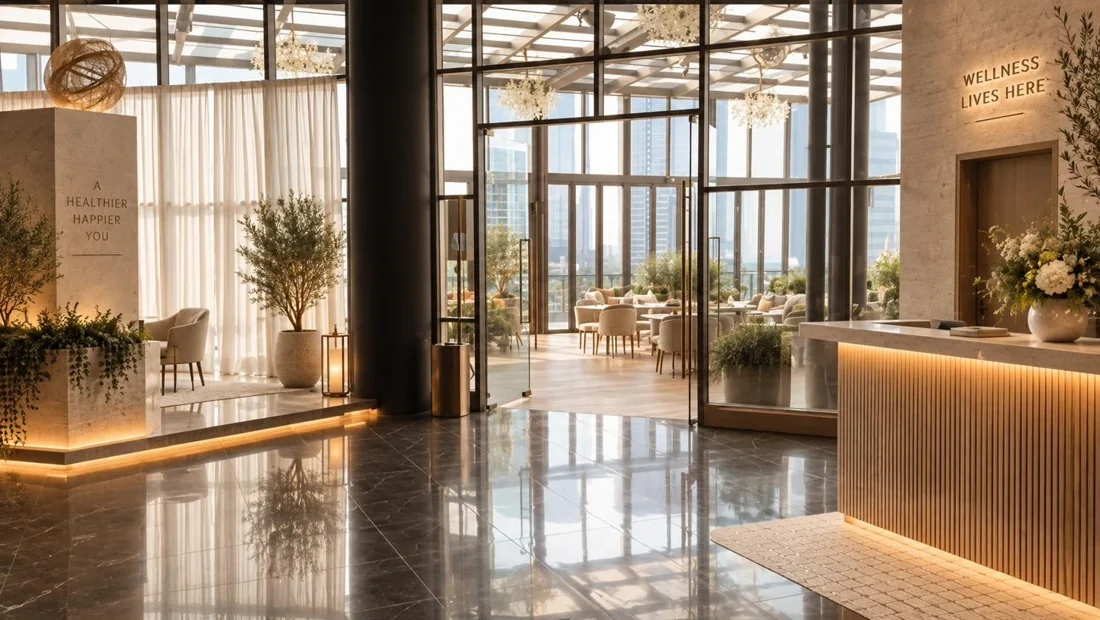
Arrival and receptionThe arrival lobby
05 · A club for every part of life
One membership, a dozen reasons to come back.
A desk for the day, a workout, a treatment, dinner with friends, a workshop, a night that turns into a party. A genuine third place, not a gym — and the reason a membership survives the second year.
Coworking — desks and quiet rooms, all dayRestaurant & bar — dinner, drinks, long tablesEvents & workshops — Institute programmes, private hireTrain — Vasper, CAROL and the gym floorHyperbaric — HBOT chamber suiteInfrared sauna — Scalar Balanced FIRRed light — panel therapy roomLight bed — full-body red & near-infraredIHHT lounge — monitored altitude sessionsPool & terrace — cold plunge, sun, unwind
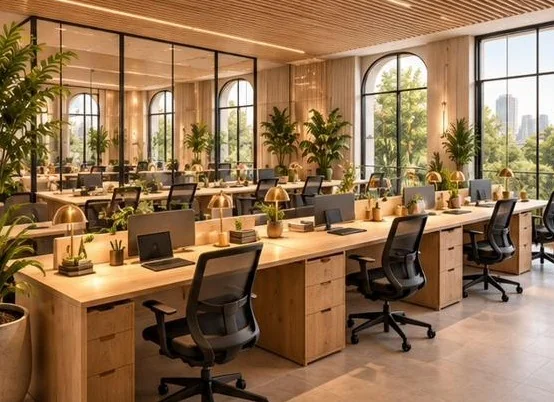
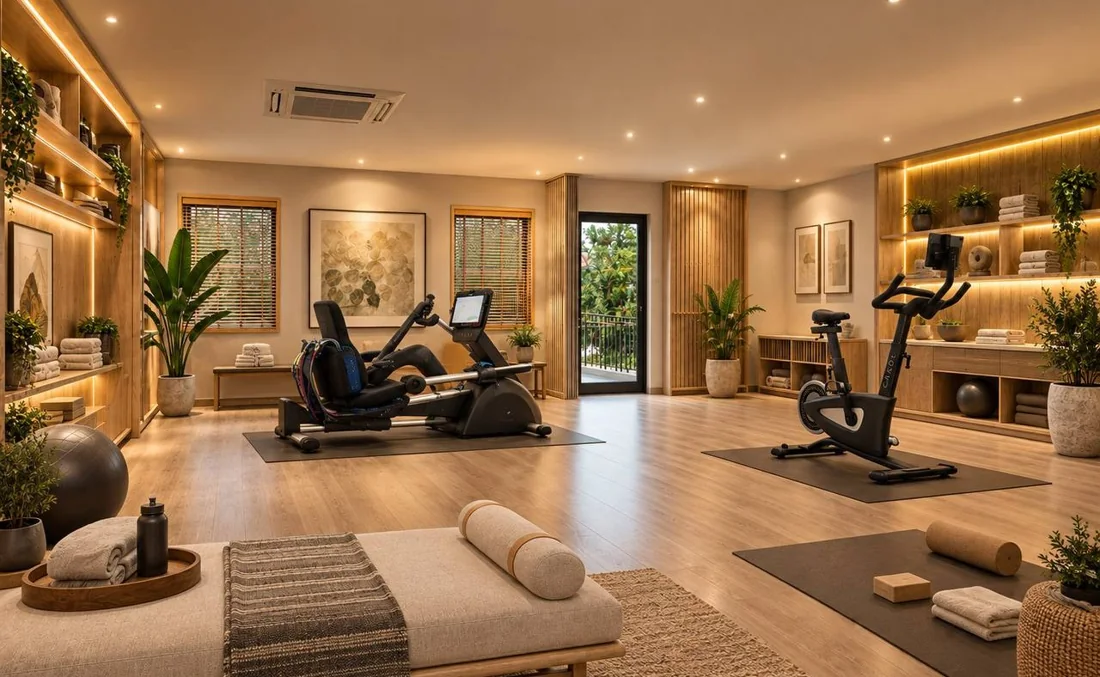
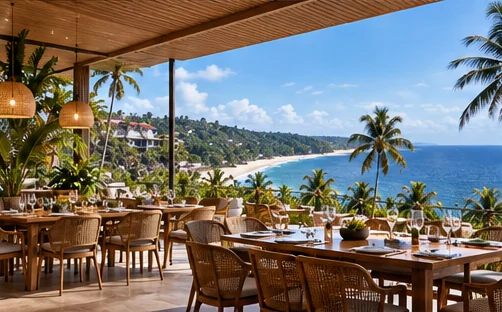
Coworking — desks and quiet roomsThe gym floorDining on the terraceLounge and bar, open to the terraceSauna and cold plunge off the pool deckThe building, set back from the cliff among the palms
06 · Day into night
Dinner, conversations, and quiet nights.
Long tables in the evening, a glass of wine as the light goes, and the kind of night that starts as dinner and stays as conversation. Talalla is a quiet beach — for private celebrations or louder music, spaces are designed sound-isolated, such as a cave room with glazing open only toward the ocean, so the peace of the bay remains undisturbed.
Daytime by the poolSocial gatherings, dining and events
07 · The treatment floor
Not a spa with a gym attached.
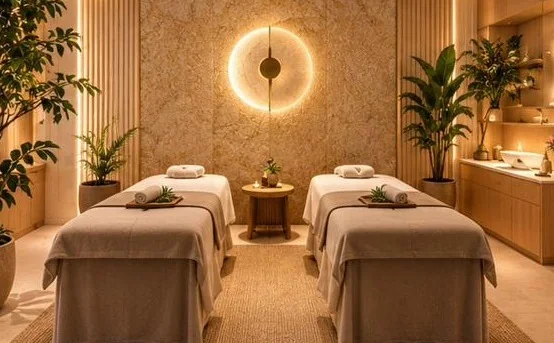
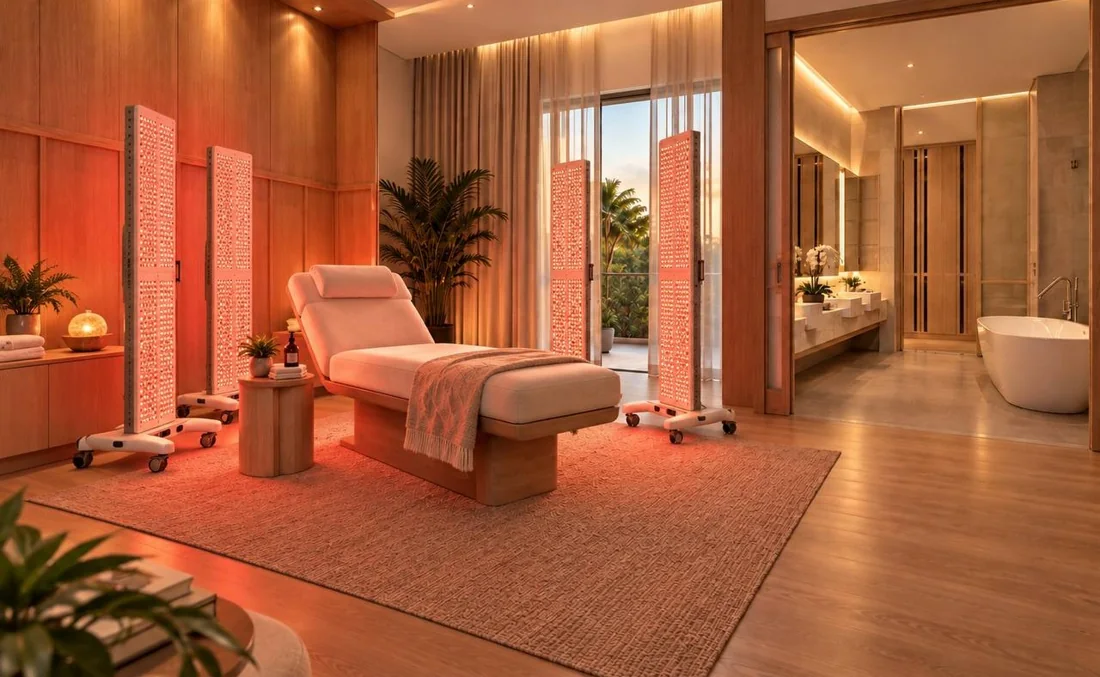
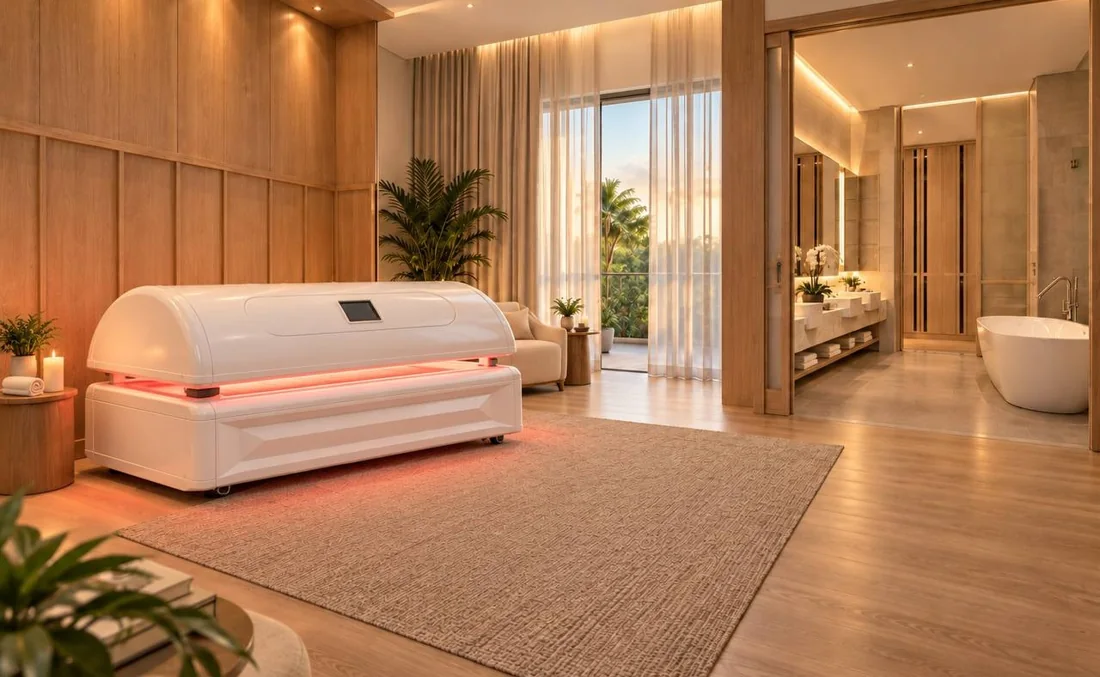
Hyperbaric oxygen, red light, infrared heat, controlled altitude, cold, and the treatment rooms to go with them — a clinical floor, staffed, rather than a wellness corner. This is the part that makes the difference between a nice amenity and a reason to travel.
Hyperbaric oxygen suiteTreatment roomsRed light therapyFull-body red and near-infrared bedScalar Balanced infrared saunaThe treatment room, drawn for Talalla
08 · The piece that is ours
Zazen Scalar.
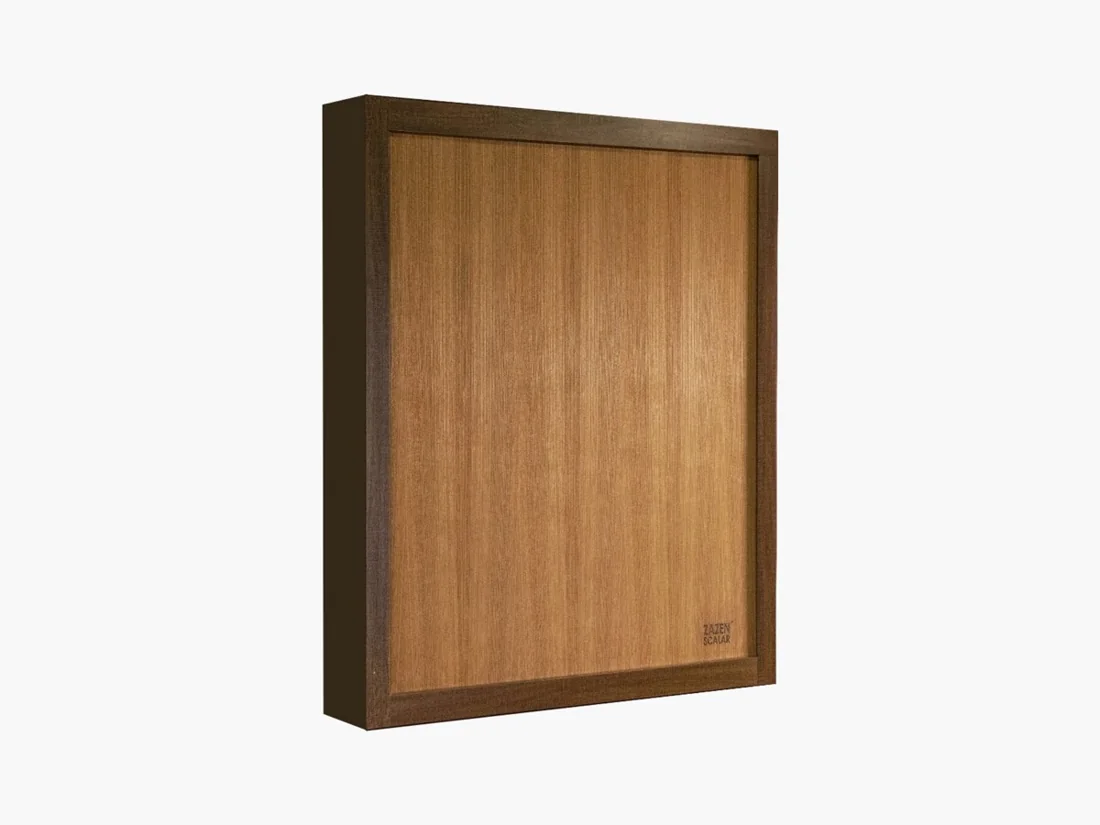
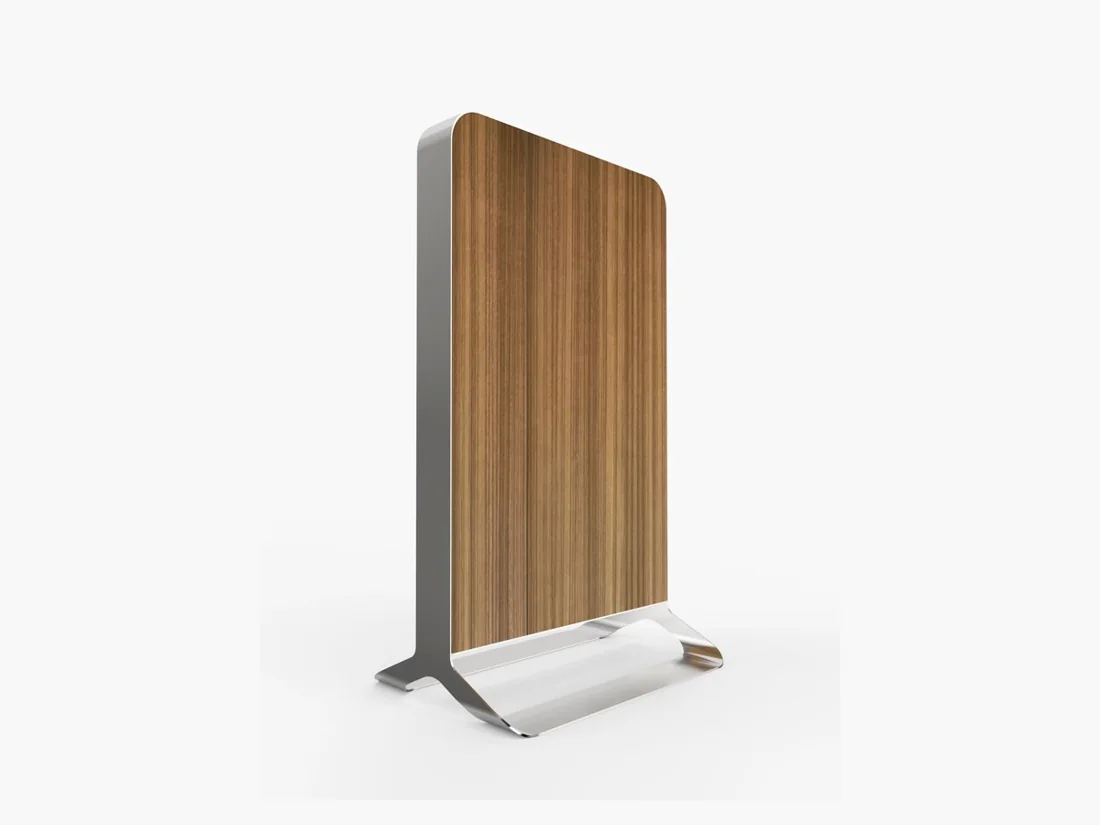
Developed over many years by Zazen Health Solutions in Malaysia, Zazen Scalar panels generate a scalar field tuned to 7.83 Hz — the Schumann resonance, the Earth's own background frequency. The flagship 300 Core fills a whole room rather than treating one person: the gym, a treatment room, a meditation space or the lounge sits inside the field, and a guest does nothing at all to receive it. It is the one technology on this floor that costs a member no time. It is already running in the network's own facilities, and a floor here would be another of them.
The scalar lounge — the field fills the room; guests simply sit in it
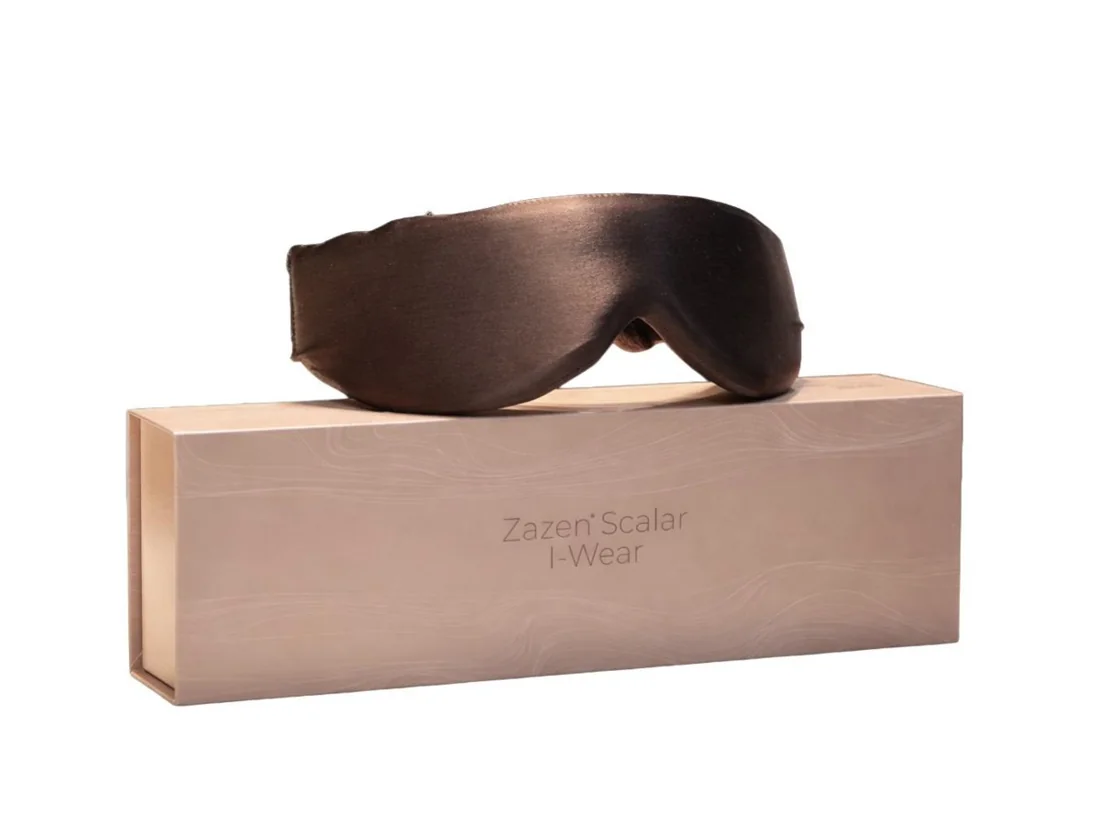
Scalar 500 Core — the larger wall panelScalar 300 Core — freestanding, the model that fills a roomScalar I-Wear — worn for rest and sleep
Research into scalar technology is still at an early stage; the effects described are as designed and as reported by users, and are not presented as medical claims.
09 · The equipment
Every pillar of healthspan, one address.
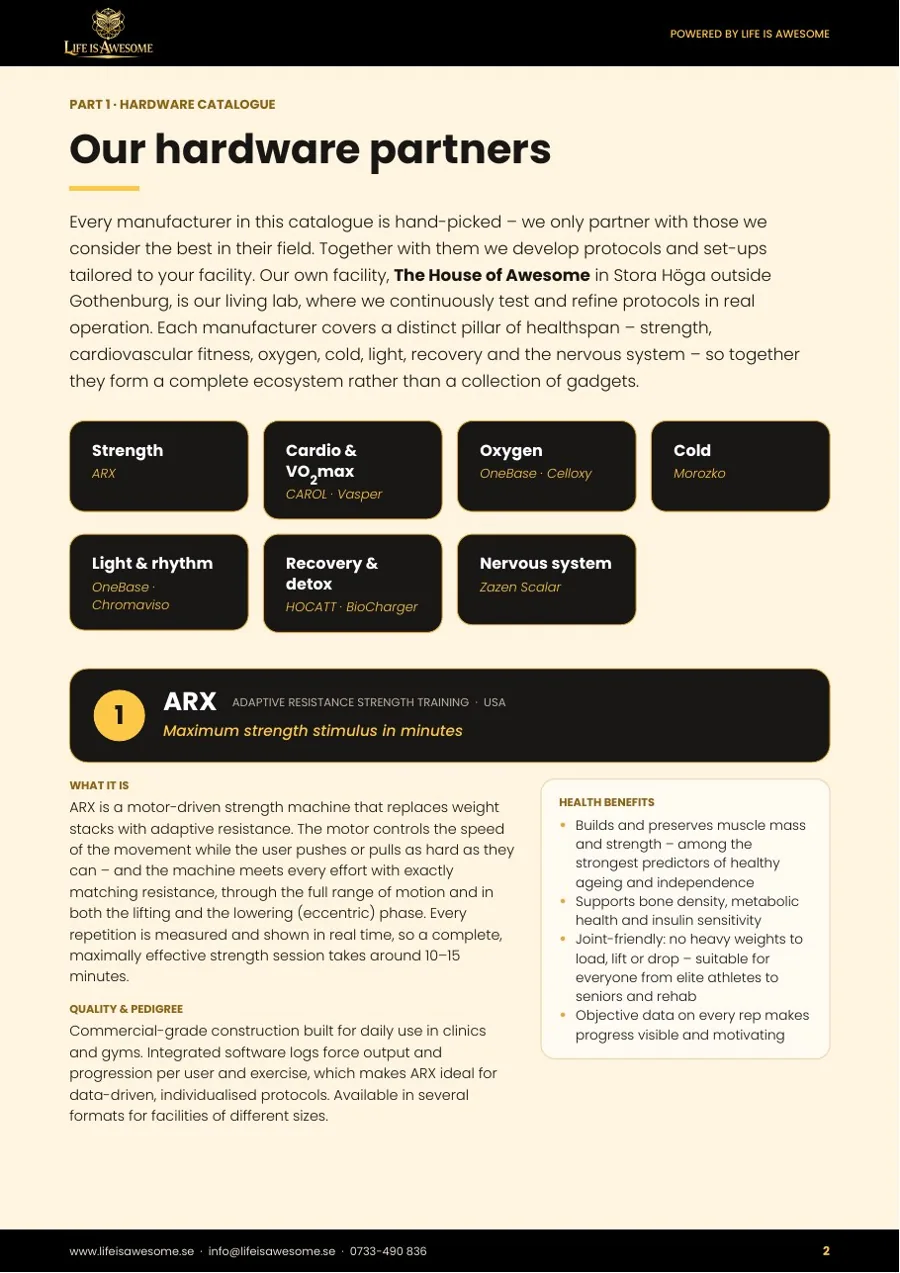
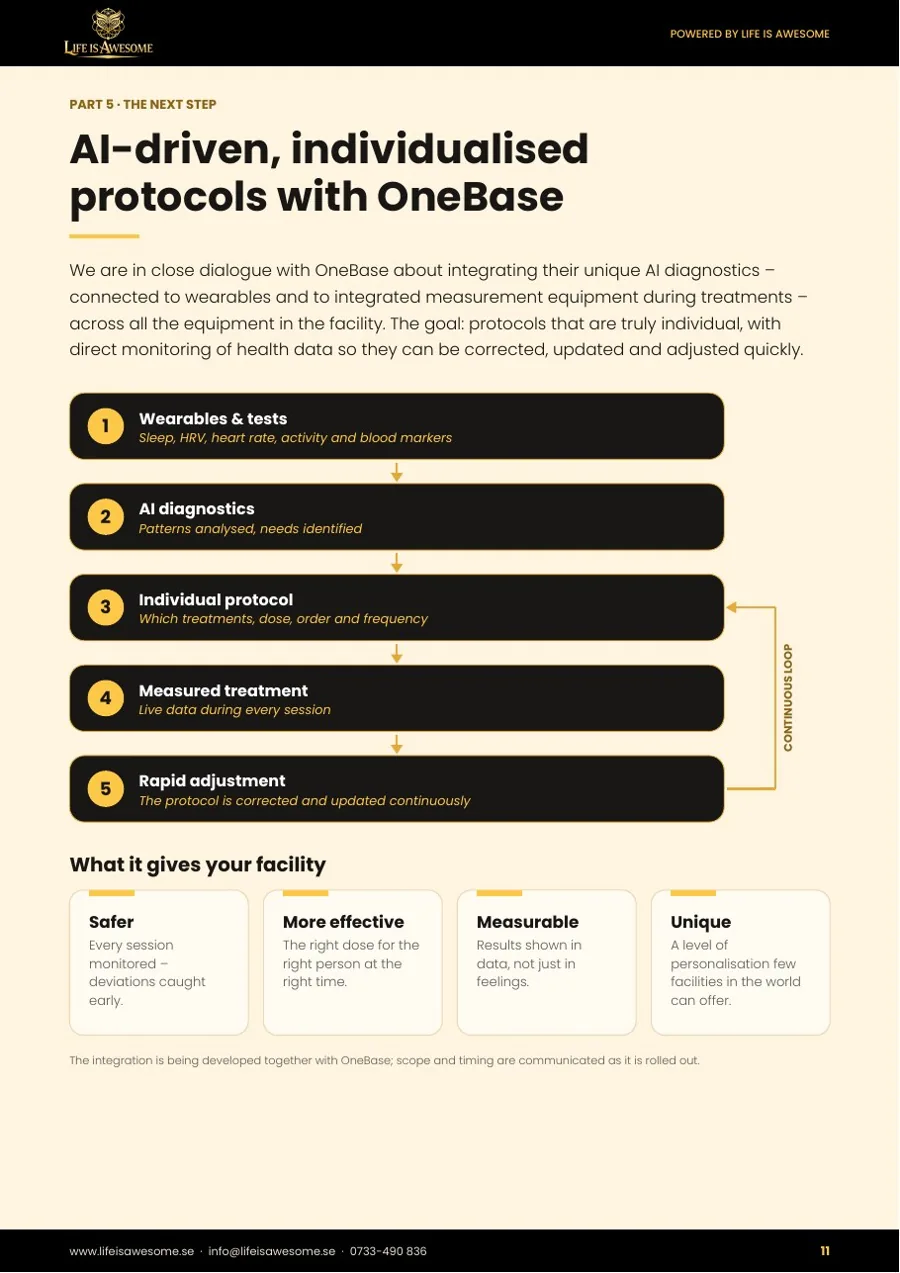
Strength, cardiovascular fitness, oxygen, cold, light, recovery and the nervous system — each covered by a manufacturer chosen for that one thing rather than bought as a bundle. All of it procured, installed and serviced through a single contact instead of assembled piece by piece from six countries.
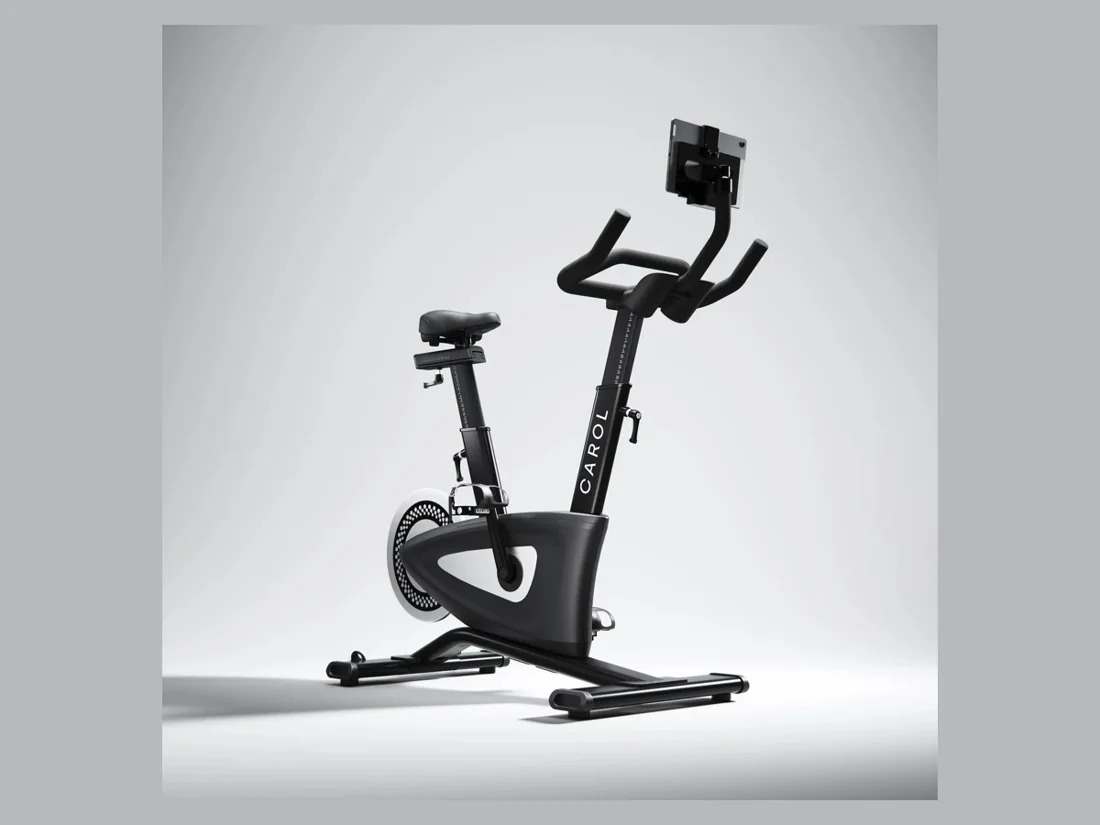
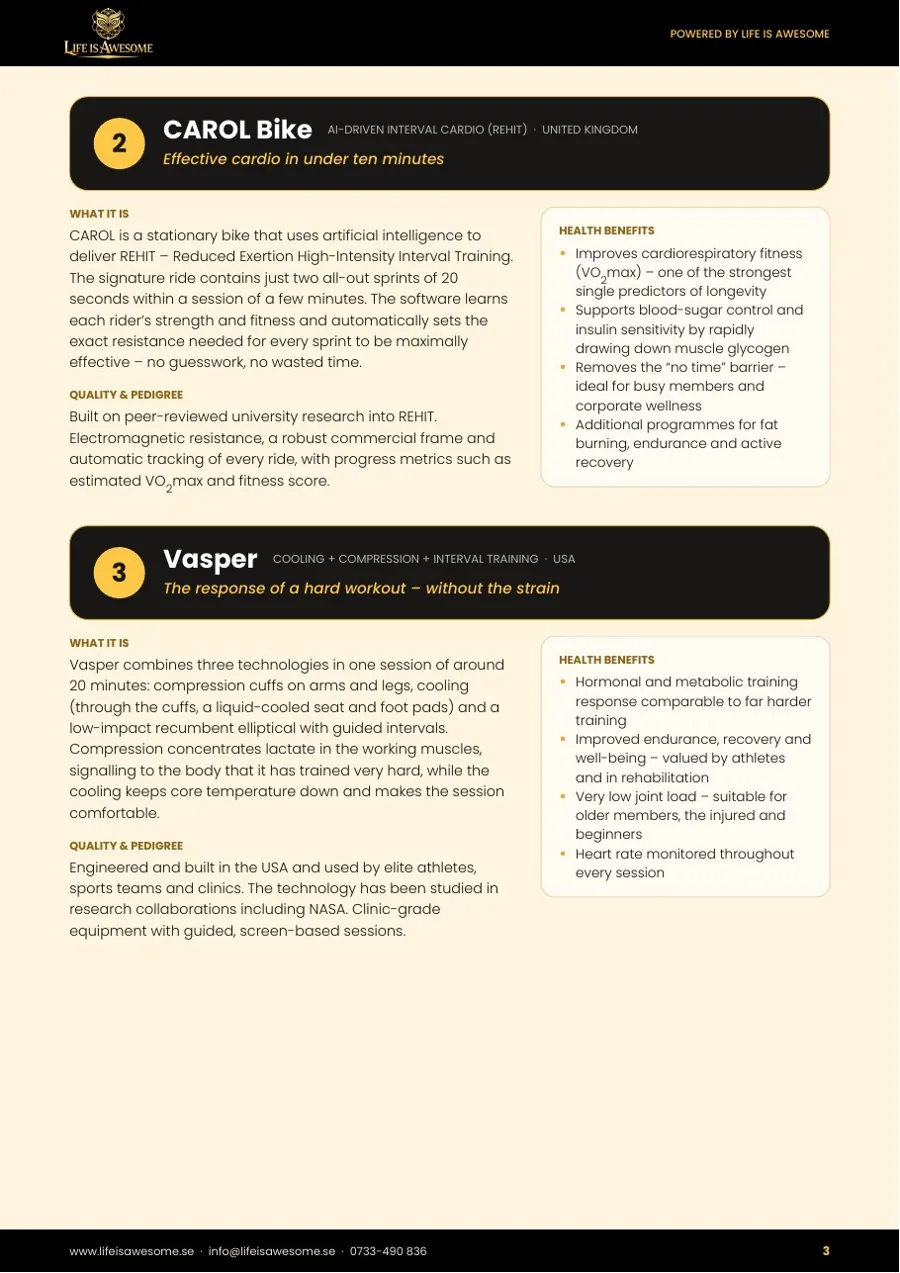
CAROL Bike
AI-controlled REHIT intervals — effective cardio in under ten minutes
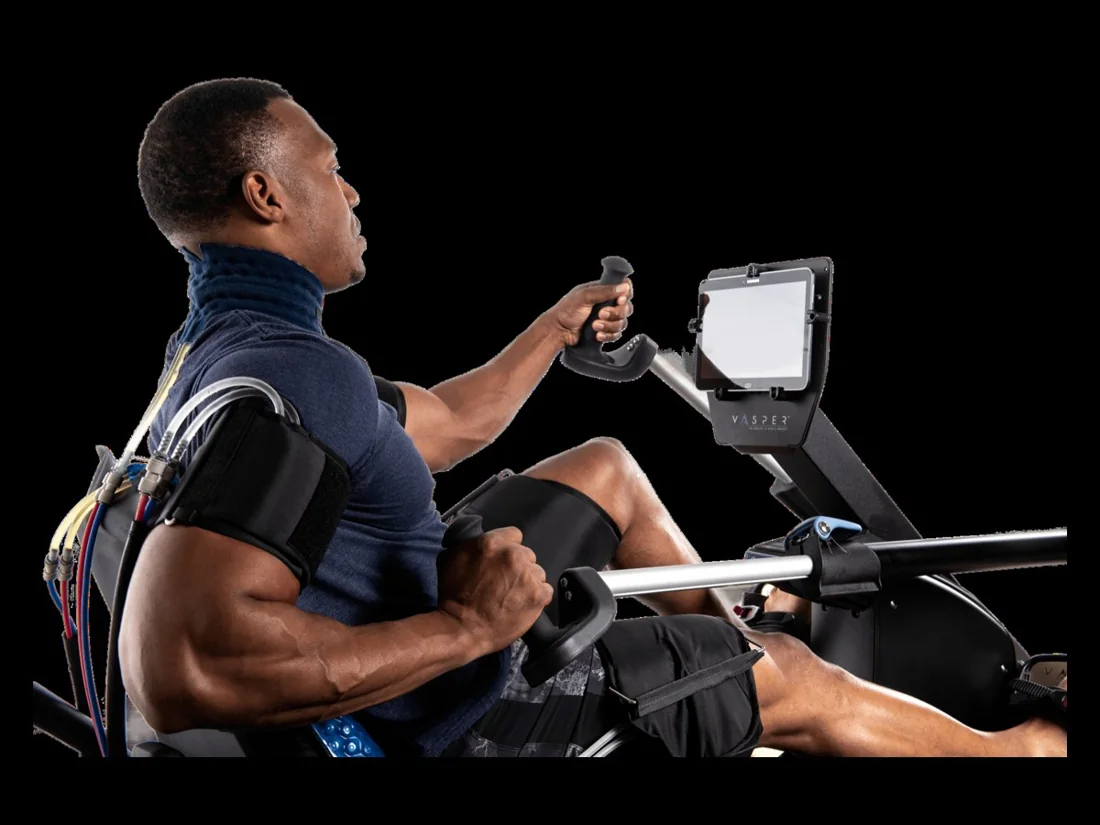
Vasper
Compression and cooling — the response of a hard workout without the strain
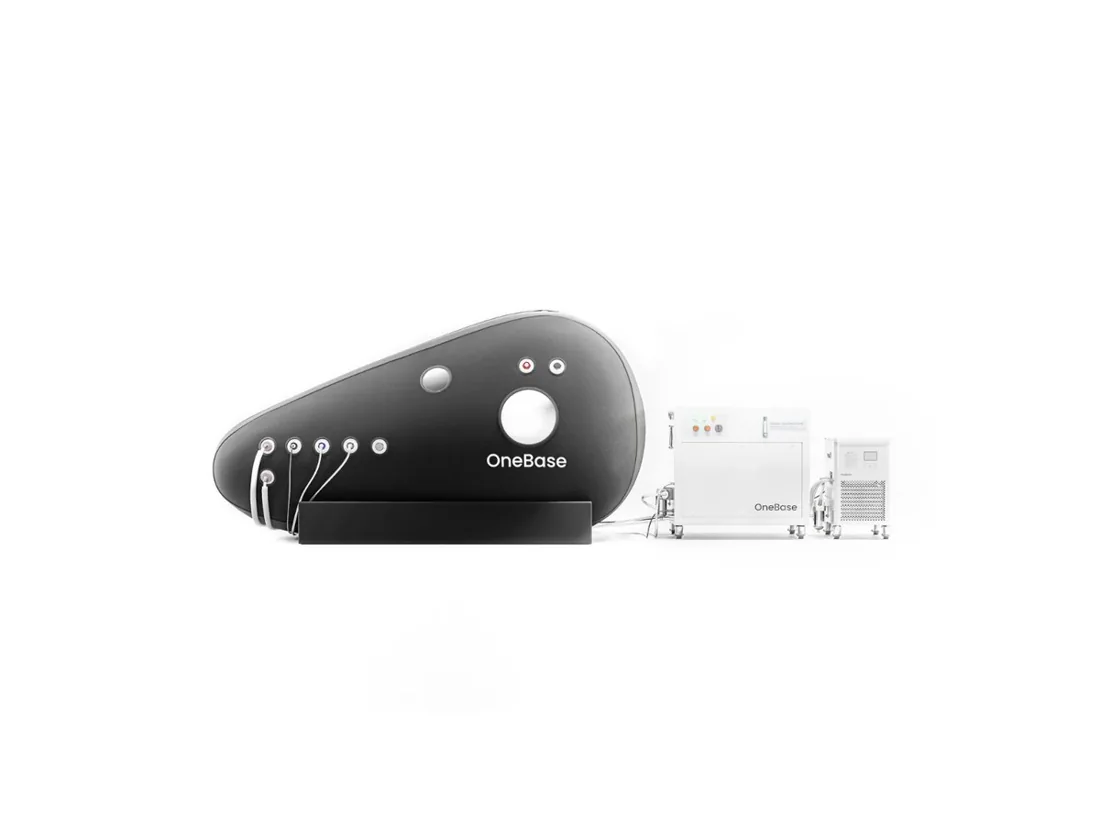
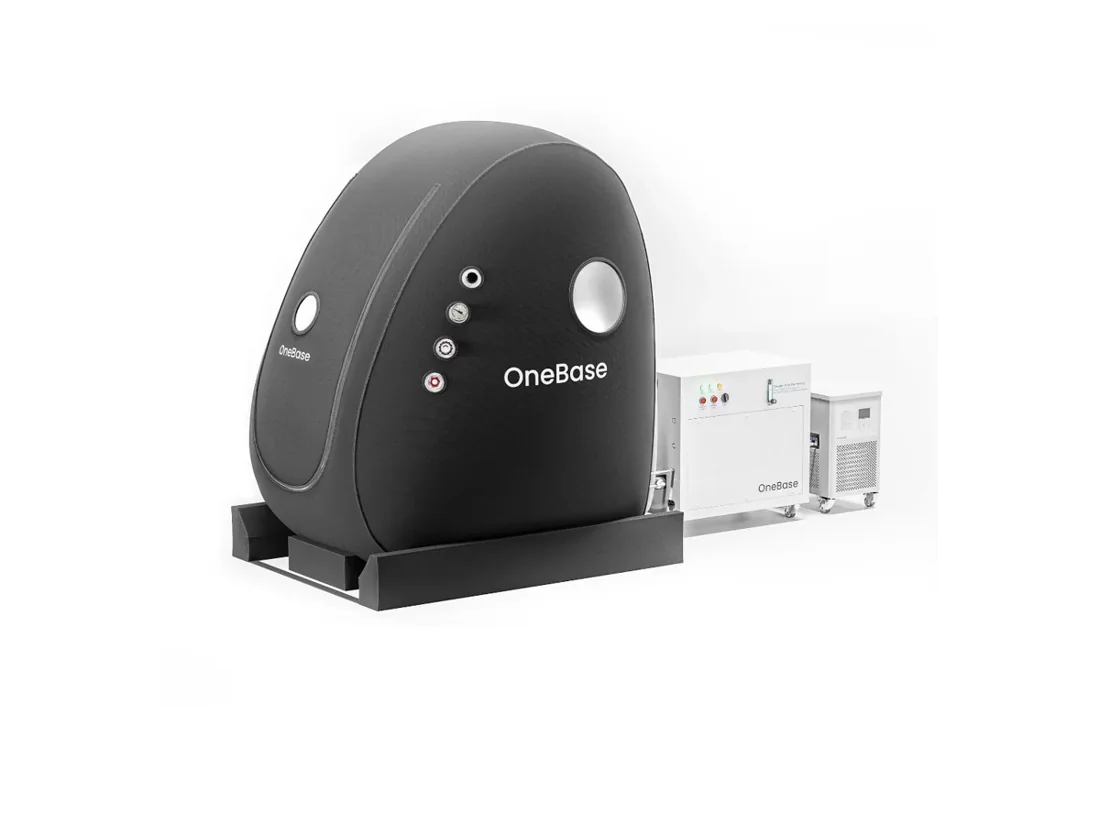
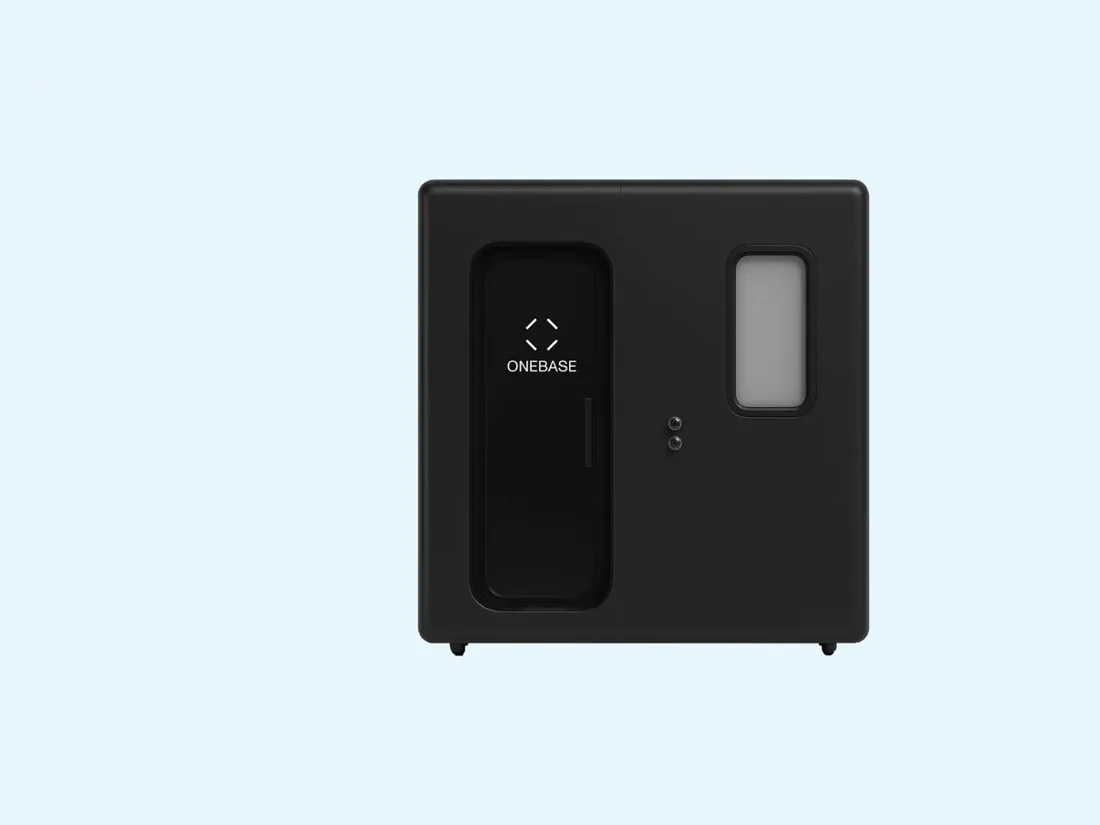
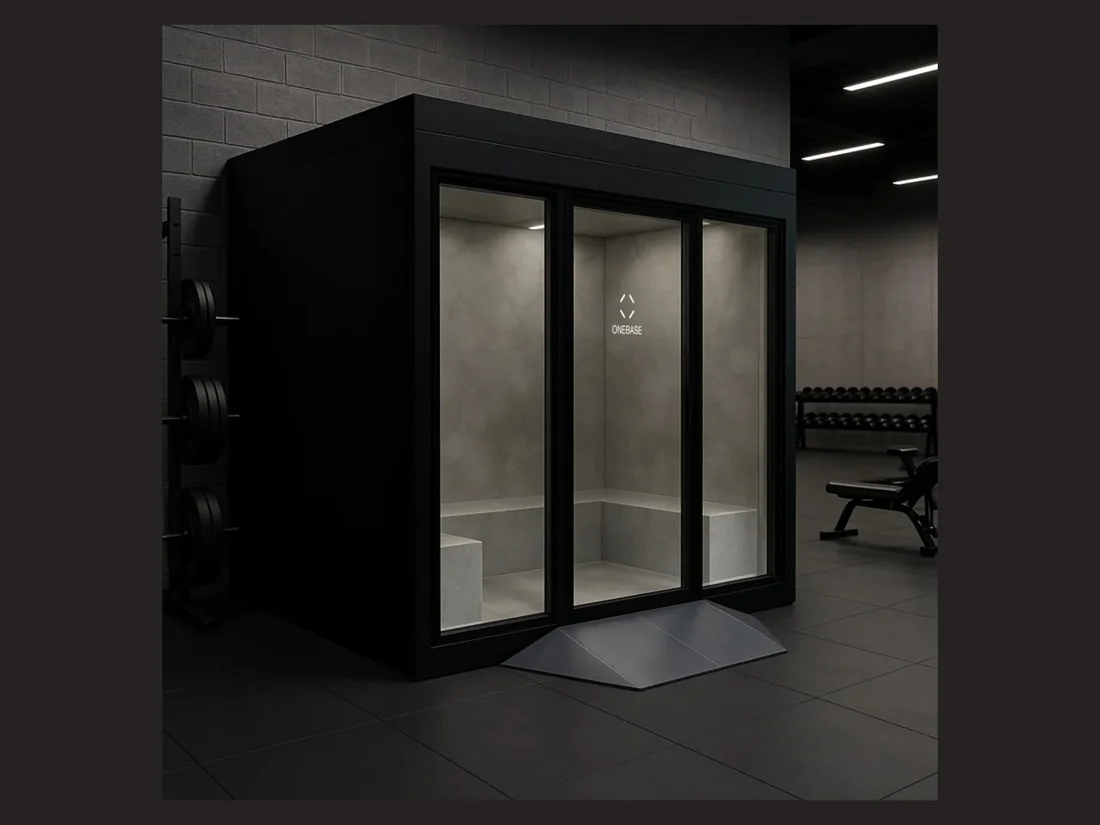
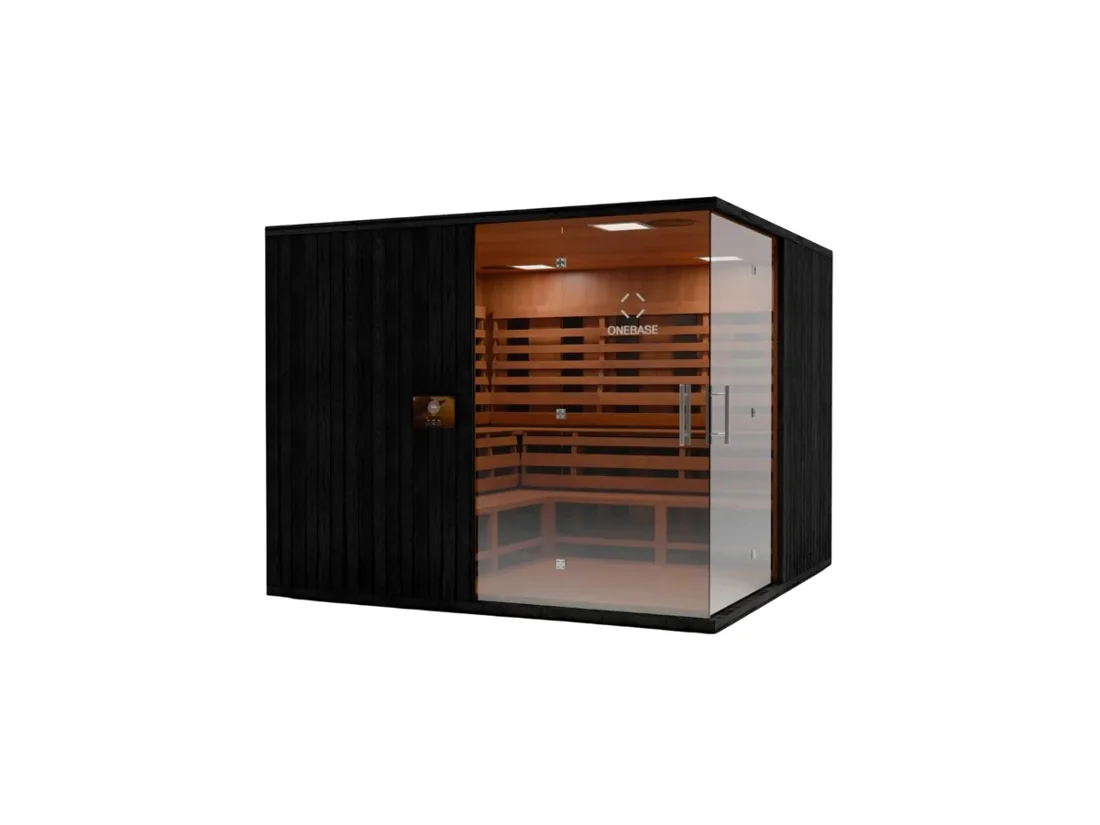
OneBase AirSuite
A modular HBOT room with a built-in breathing system
AirFit & AirFlex
Soft-chamber formats, including a seated and accessible version
OneBase AirForm
Compact chamber for smaller rooms and private installations
OneBase Red Light
Full-body beds and targeted panels, 10–20 minute sessions
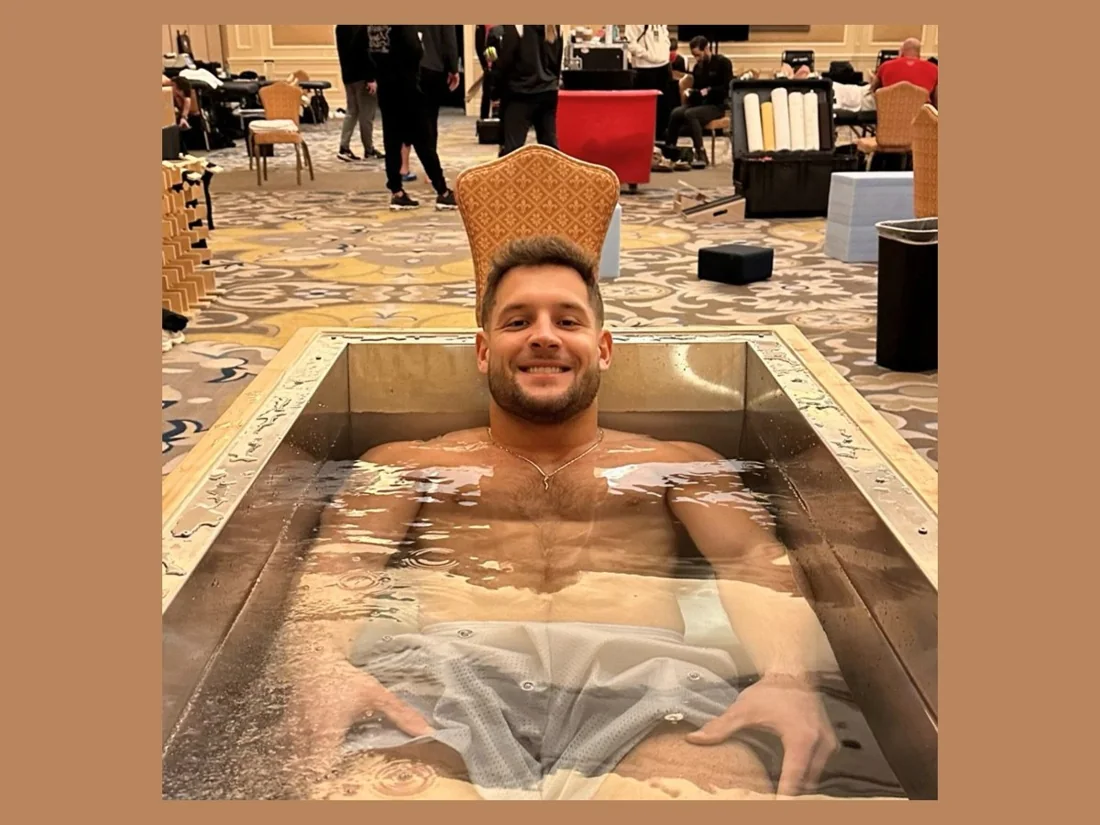
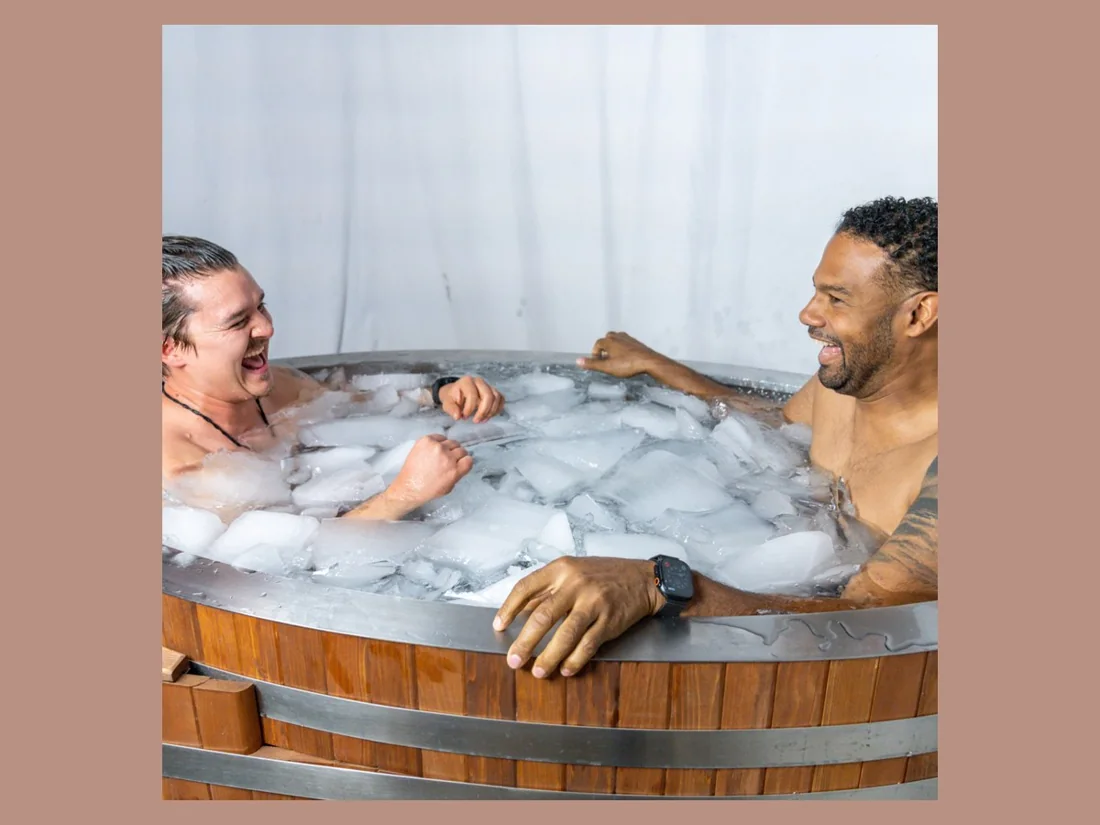
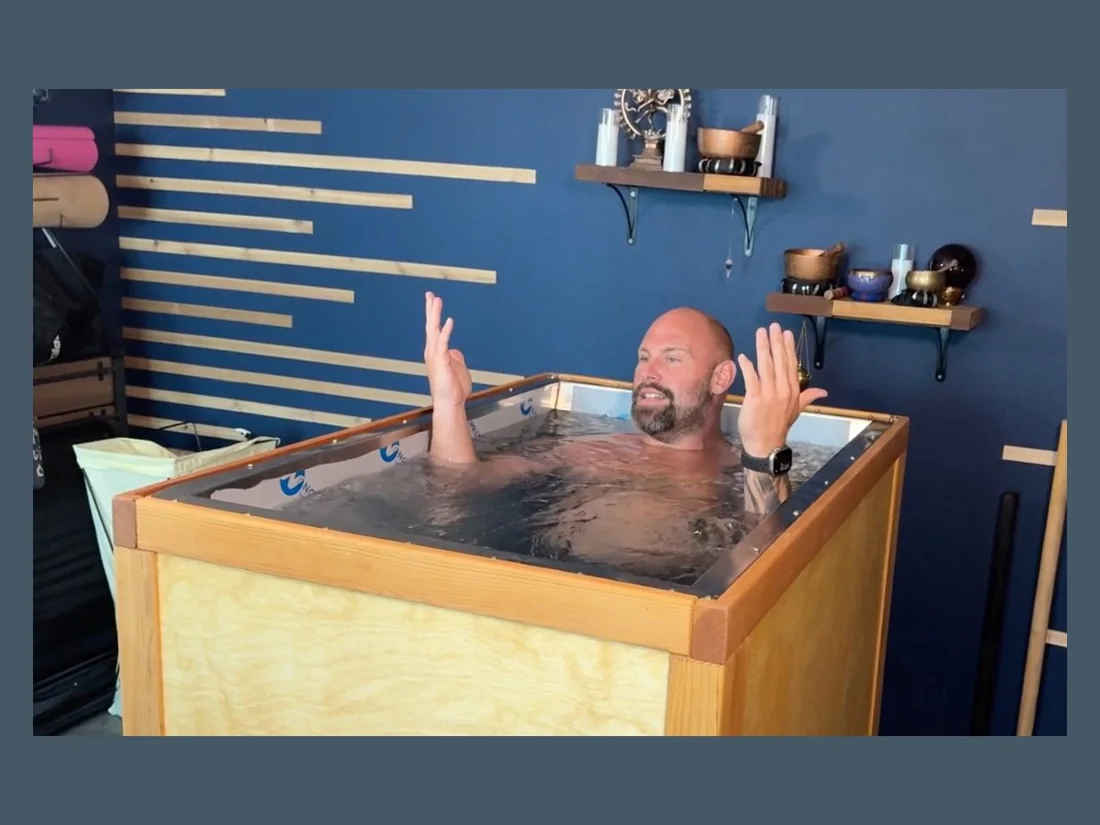
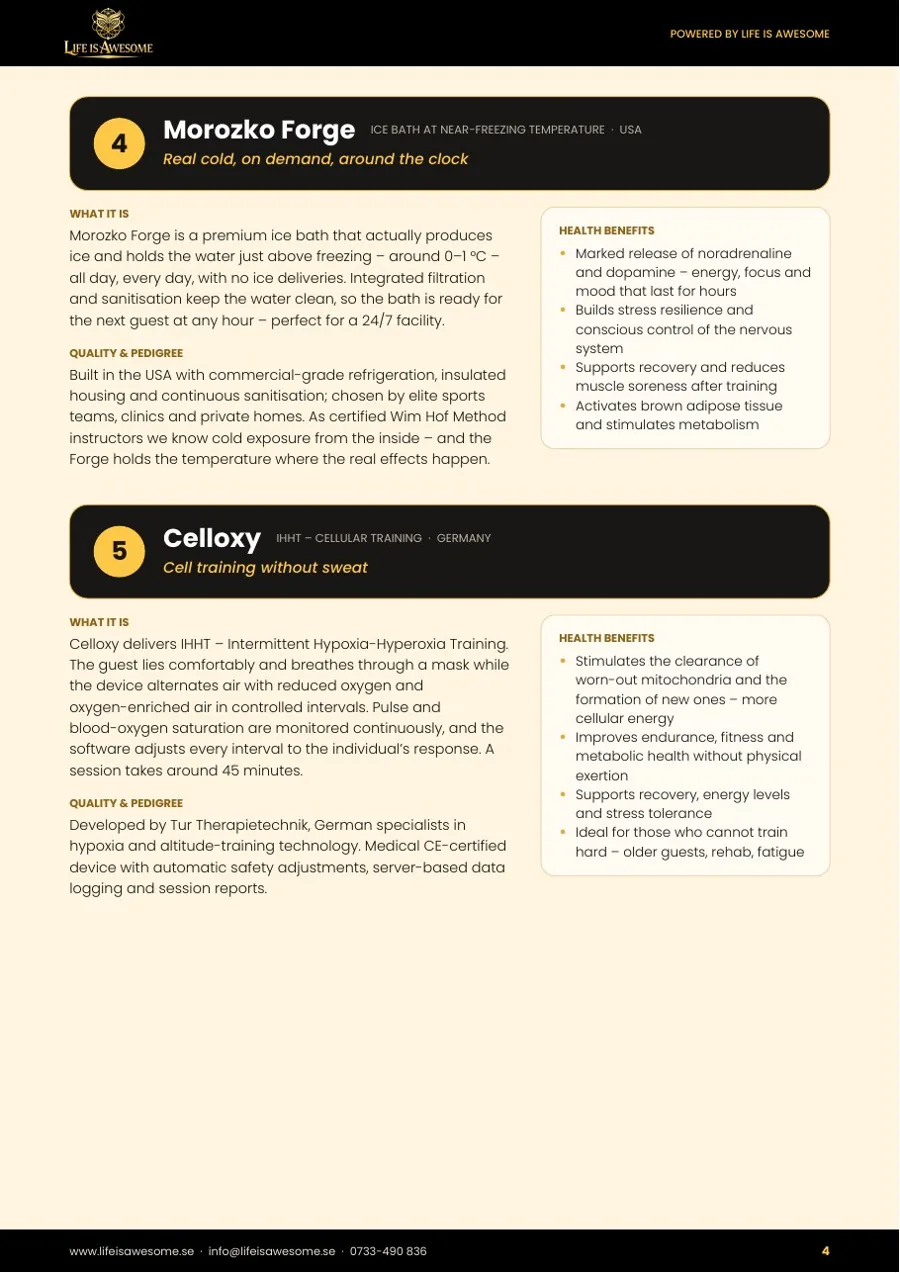
Morozko Forge
Ice held at 0–1°C around the clock, with its own filtration
Cold room
Electrically cooled, no ice deliveries, ready at any hour
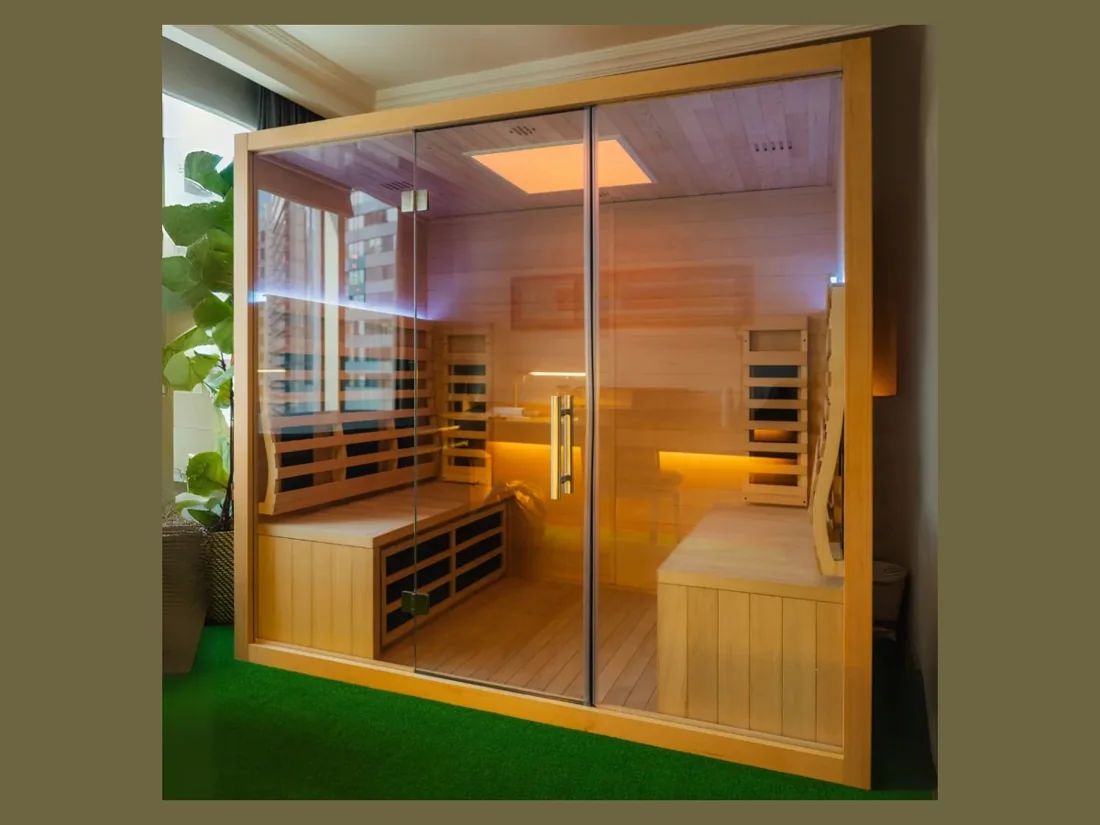
Zazen FIR Sauna
Far-infrared cabin combined with a scalar field
FIR cabin, commercial
Commercial cabin format for a club floor
Zazen Scalar
A field that fills the room, not a device you queue for
StrengthARX — motor-driven adaptive resistance; a full session in 10–15 minutes, every repetition measured
Oxygen & altitudeCelloxy IHHT — monitored intermittent hypoxia and hyperoxia, around 45 minutes, no physical exertion
Light & rhythmChromaviso circadian lighting, developed with Danish hospitals and installed across Nordic healthcare
Recovery & detoxHOCATT and BioCharger
Nervous systemZazen Scalar — see above
10 · The partner
Powered by Life is Awesome.
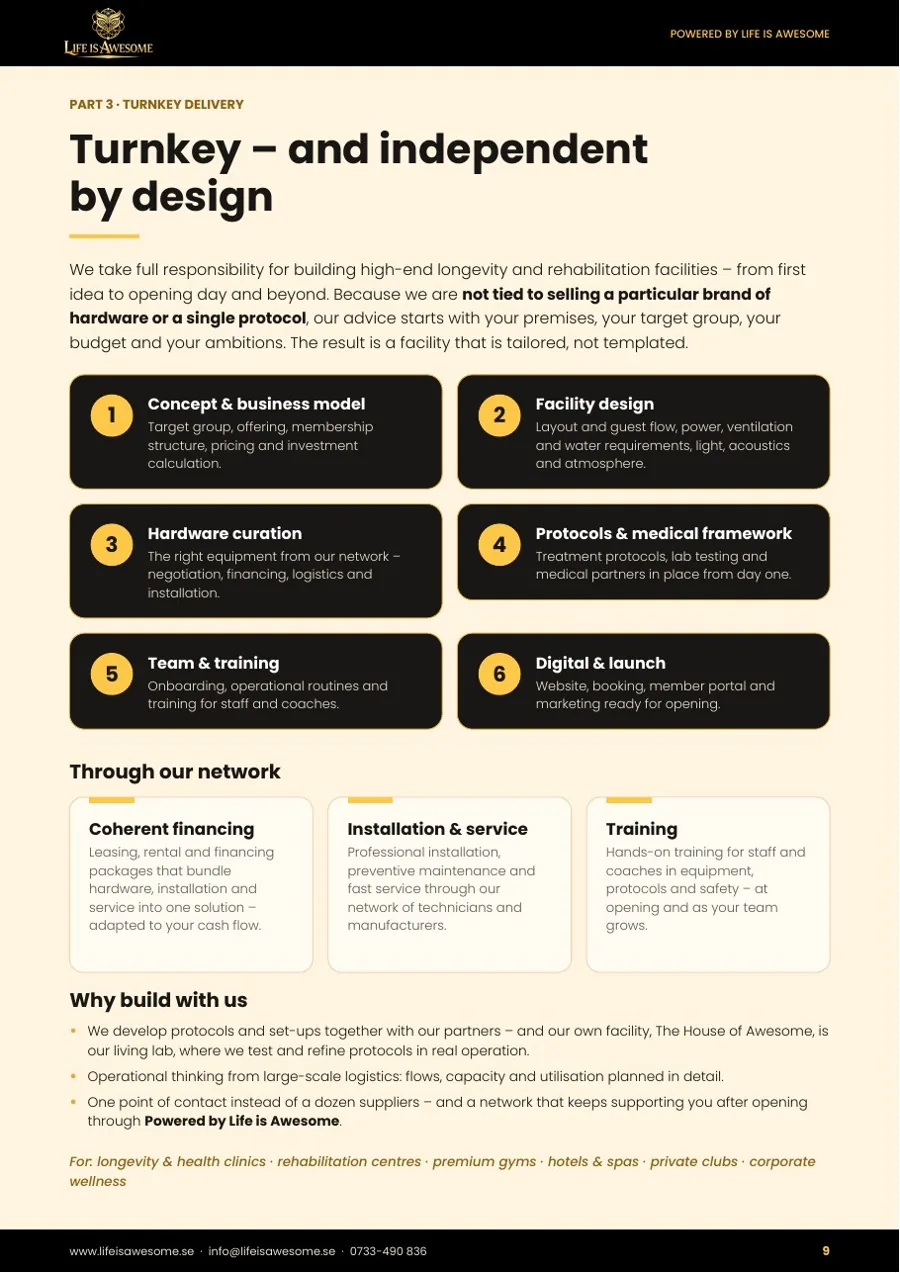
A turnkey longevity partner rather than a shopping list. Life is Awesome is a Swedish company that takes a facility from empty room to working floor — the operating concept and the protocols, not just hardware in a room, plus equipment, financing, installation, training and service through one point of contact. They are brand-independent: every manufacturer in their catalogue is hand-picked for its own field rather than bundled from a single supplier.
Concept & method
The operating model.
How the floor actually runs day to day, and the protocols behind each modality — not a room full of machines with nobody to sequence them.
Treatments & diagnostics
The menu, and the measurement.
The treatment list a member buys, and the testing that shows whether any of it worked.
Equipment & sourcing
Six partners, one contact.
Procured, installed and serviced through a single relationship rather than six separate ones in six countries.
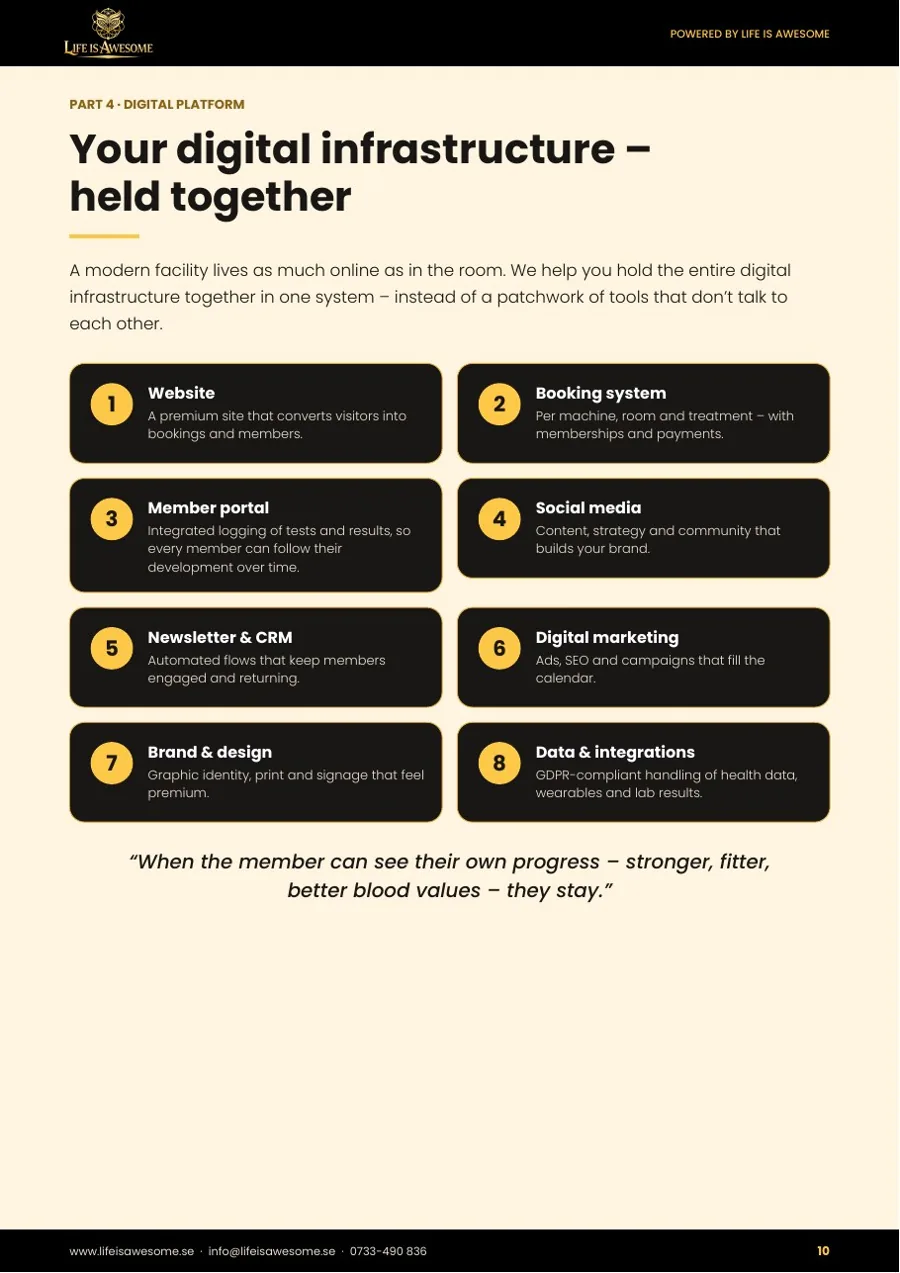
Platform & network
Booking, data, people.
The digital platform for booking, member data and programme delivery — plus access to the wider clinical and commercial network behind it.
Their own facility, the House of Awesome at Stora Höga outside Gothenburg, is the working proof — a live clinic and gym where protocols are tested and refined in real operation before they are installed anywhere else. That matters for a site like this one: a floor at Talalla would not be an experiment, it would be a second instance of something already running. It is also asset-light and modular, so it can start focused and scale into the building rather than requiring the whole thing on day one.
Cold, properly done — at the House of AwesomeMembers, not marketingProtocols tested in real operation before they are installed elsewhere
11 · What it does for the headland
The clubhouse lifts the villas, and the villas lift the clubhouse.
This is the part that matters to whoever buys the land. A wellness club of this kind next door is not decoration — it changes what the villas are.
A reason to be there
Somewhere to go.
A house on a quiet coast is beautiful and can be isolating. A restaurant, a bar, a gym, a treatment floor and a room full of people, a short walk away, is what turns a holiday house into somewhere you actually spend time.
Year-round footfall
The coast stops being seasonal.
Institute programmes and corporate groups arrive on their own calendar, not the tourist one — guests with a reason to come in the months a beach alone would not fill.
Something nobody nearby has
A draw in its own right.
Nothing of this kind exists along this stretch of coast today. People travel for equipment like this — and the villas next door are the nearest place to stay.
Deeper
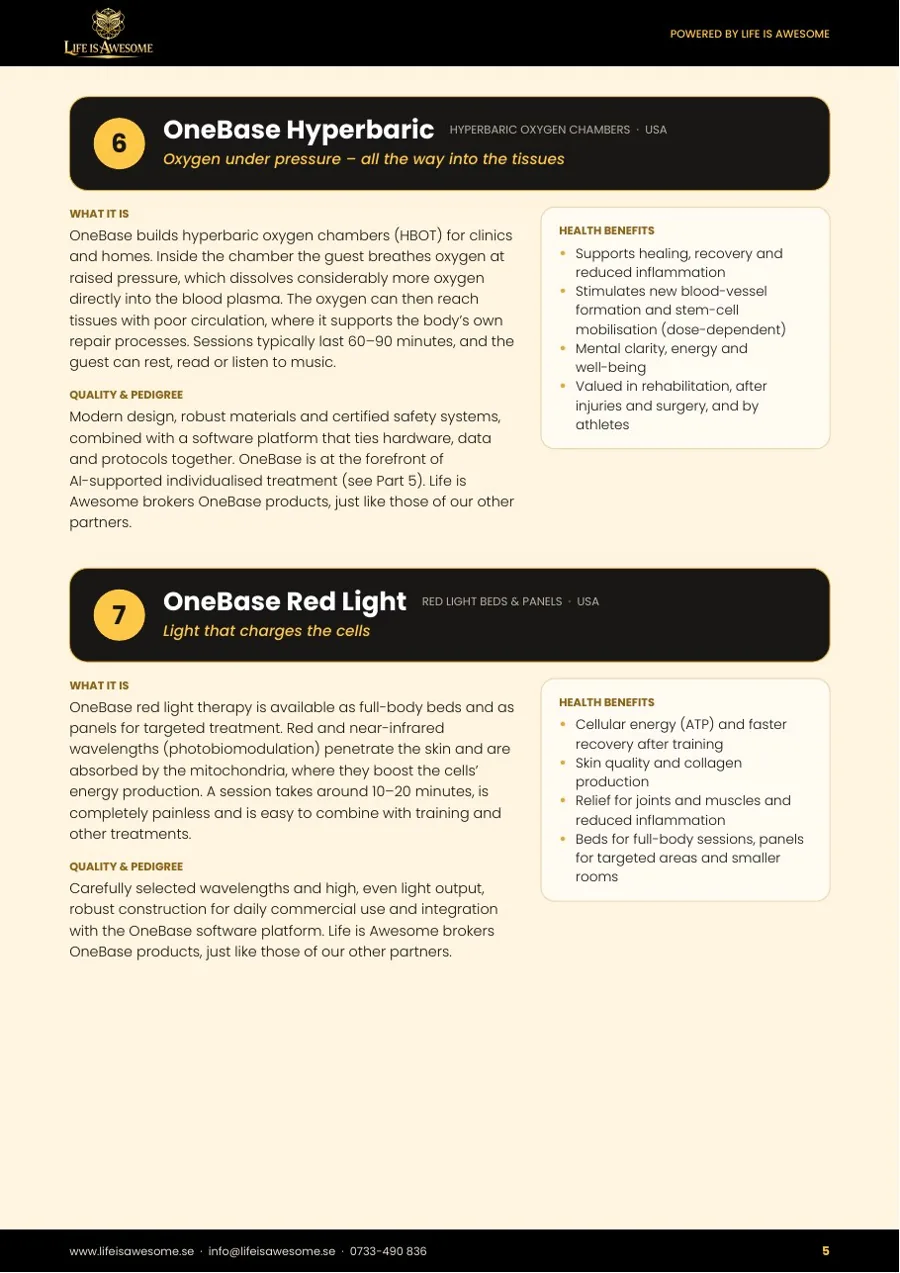
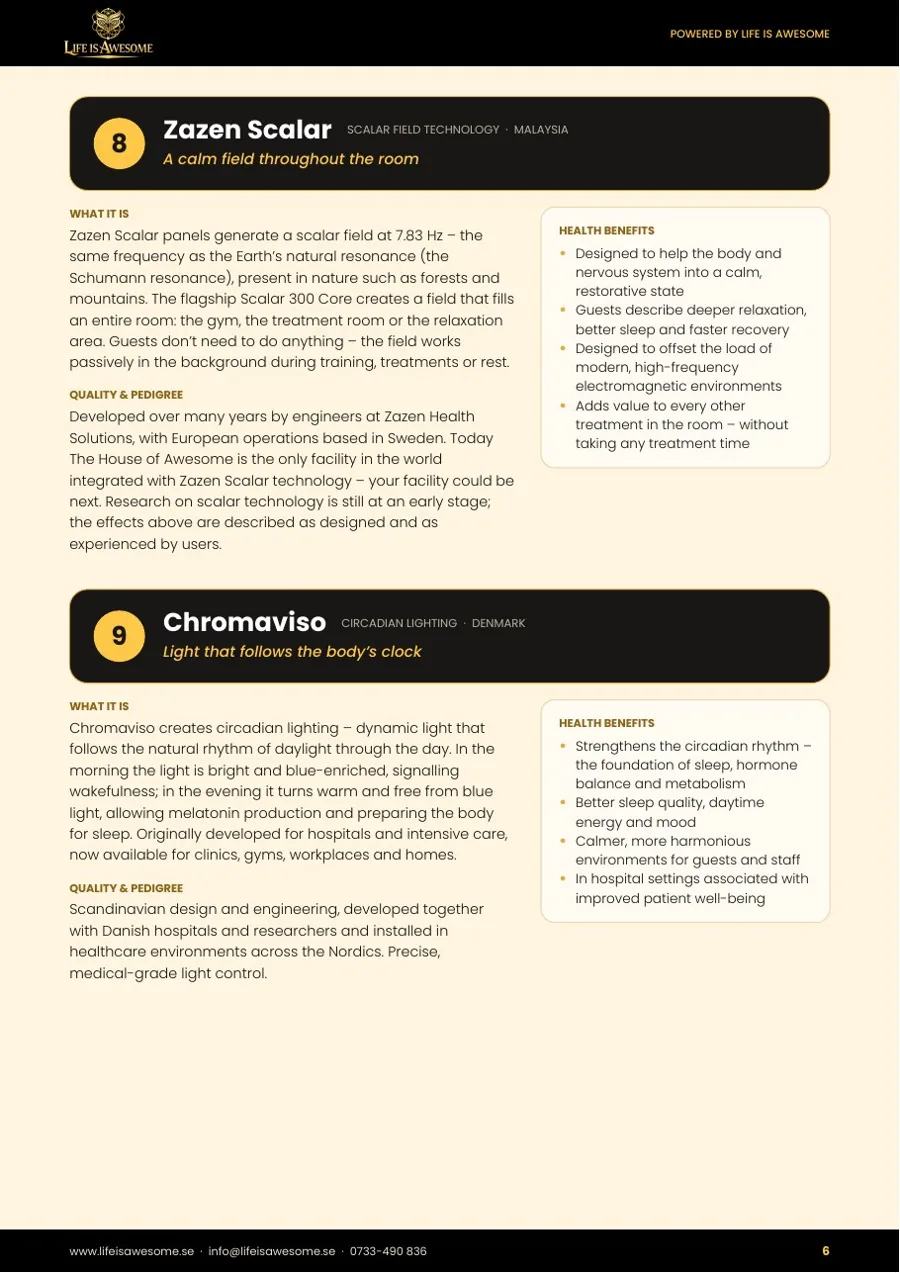
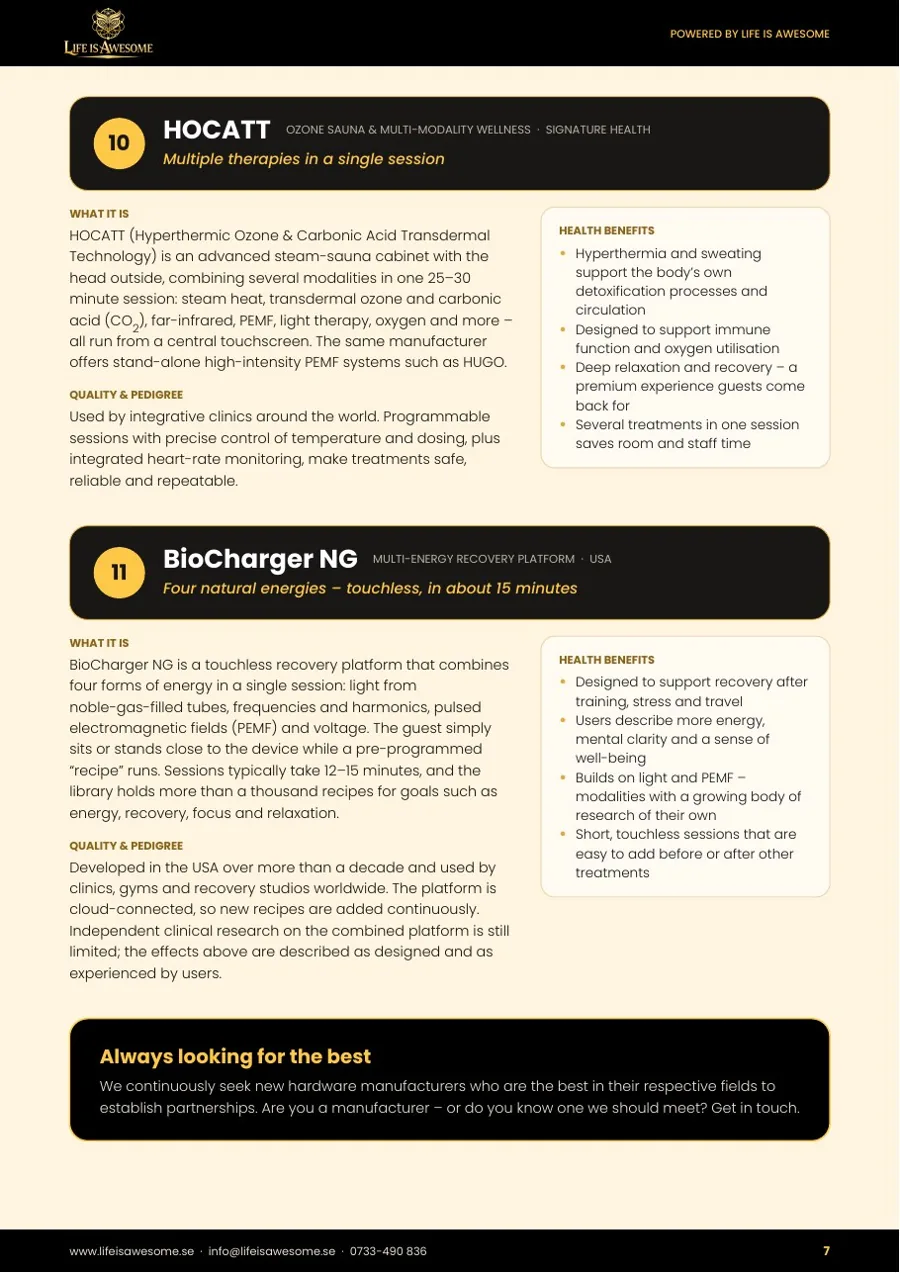
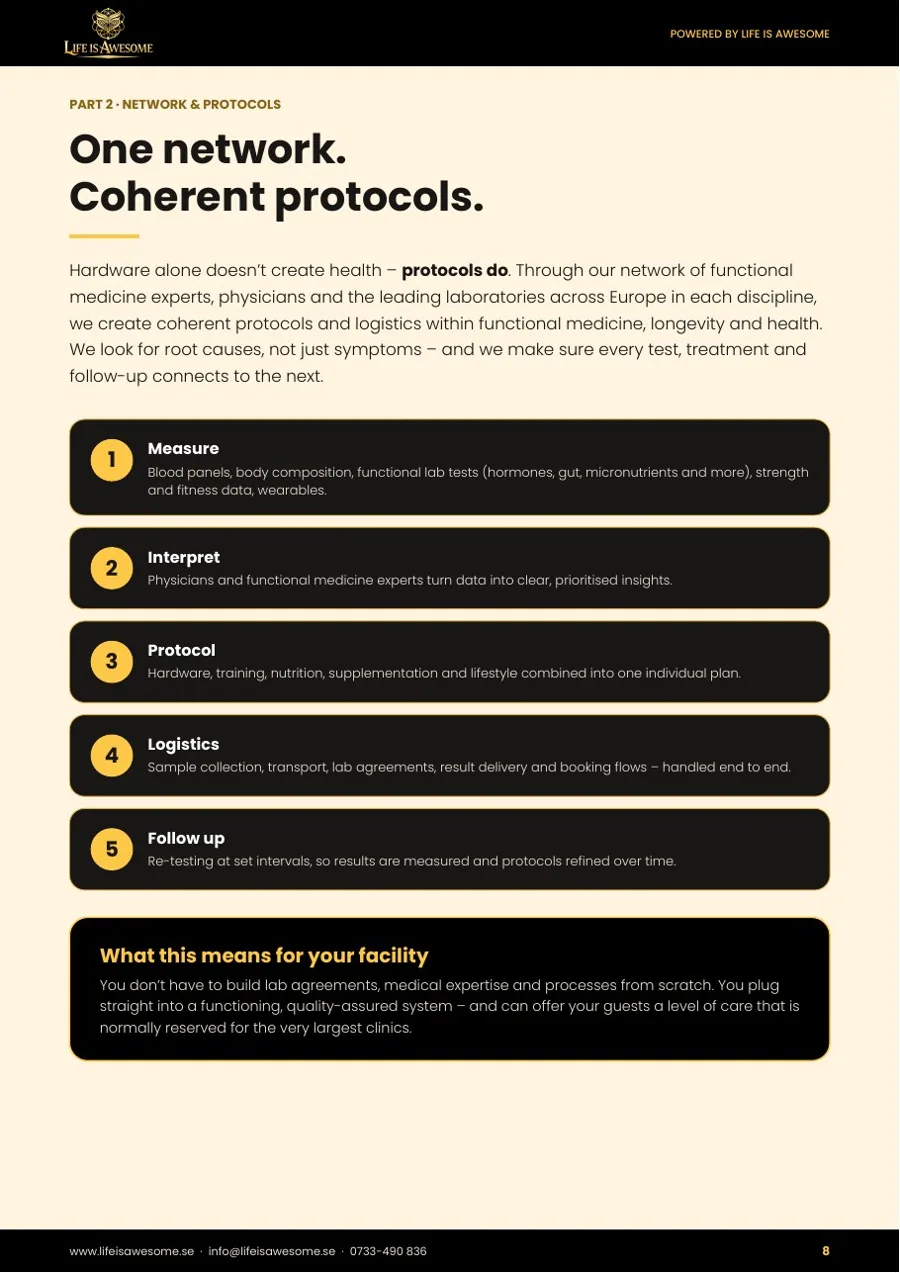
The Life is Awesome partner catalogue — all twelve pages
+
Every hardware partner, what each machine is, how it is built, and what it is for.
The clubhouse stands on land retained by the sellers and is not included in this sale. Every image of the clubhouse in this section is a design study: no Friends to Mankind clubhouse has been built yet, here or anywhere. What does exist today is the network behind it, the Institute’s programmes, and the equipment and operating partner described above.
The Ground
Solid rock, and what that buys you.
Foundations
Rock, not sand.
The headland is solid rock. Foundations are shallow, there is no piling, and on a coastline where erosion decides what survives, that matters. The same rock makes cutting roads and terraces dearer than it would be elsewhere — a real cost, worth budgeting from the start.
Below ground
A floor cut into the rock.
Solid stone means a building here can go down as easily as up, and the rock does the work that engineering would have to do elsewhere. What that is worth depends on the scheme — one house can put whole floors beneath its terraces, ten can each take a level below them.
The elevation
Thirty metres up.
High enough that the ocean carries the whole way round, and far enough above the road behind that it disappears. The beach below stays quiet enough to feel private, reached on foot or by the funicular.
The site
Eleven and a half thousand square metres.
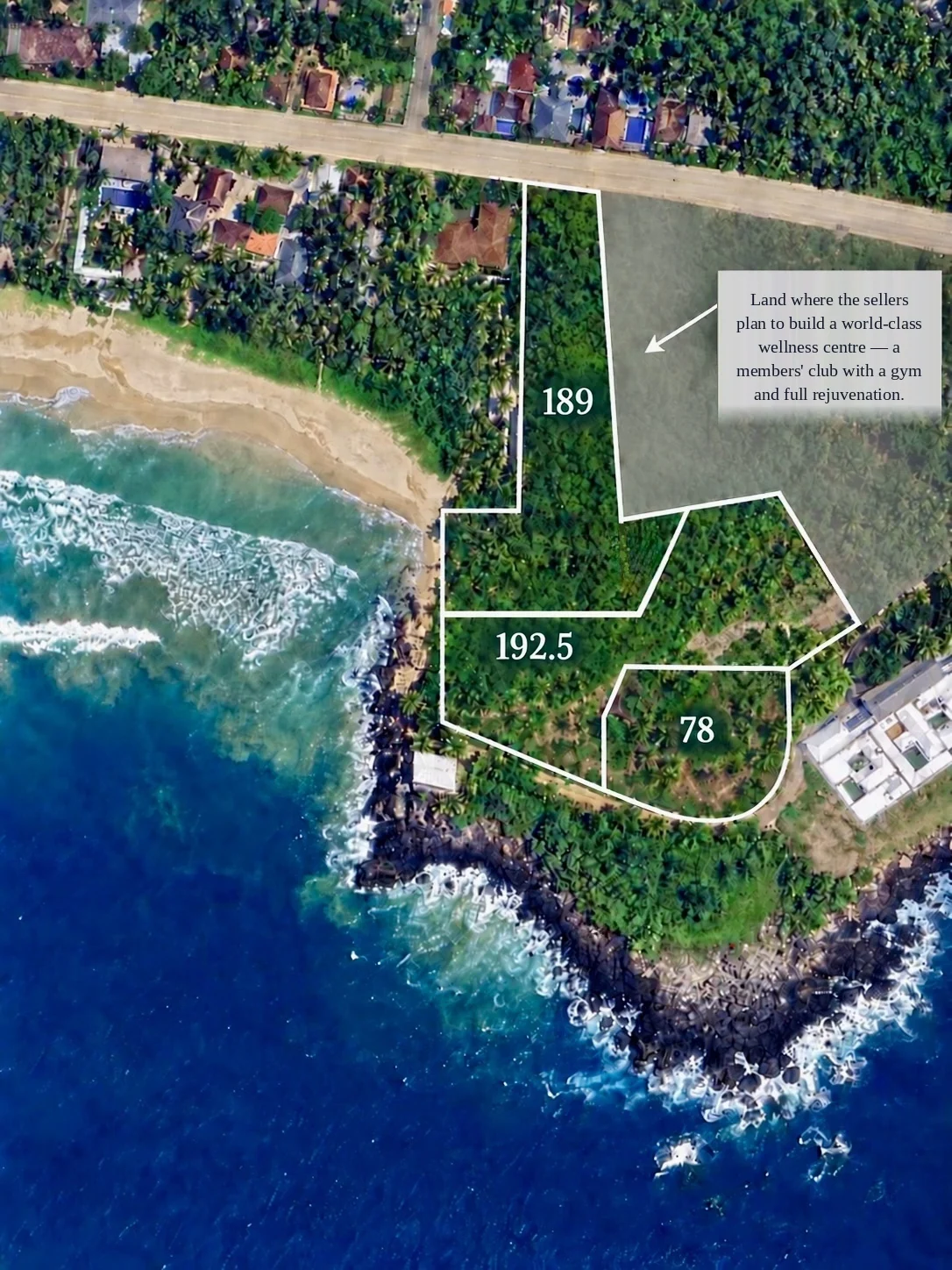
Three parcels running to roughly 11,600 square metres, with the access road and the management building at the top corner. What that carries is the buyer's to decide: ten houses on plots of 700 to 1,000 square metres each, or a single estate with four guest houses and the rest left as garden.
As It Stands
Filmed, not rendered.
The land as it actually is today, walked and filmed rather than drawn.
Looking west along the top of the cliff
A short walk around the land
The Location
On the attractive south coast, easy to reach.
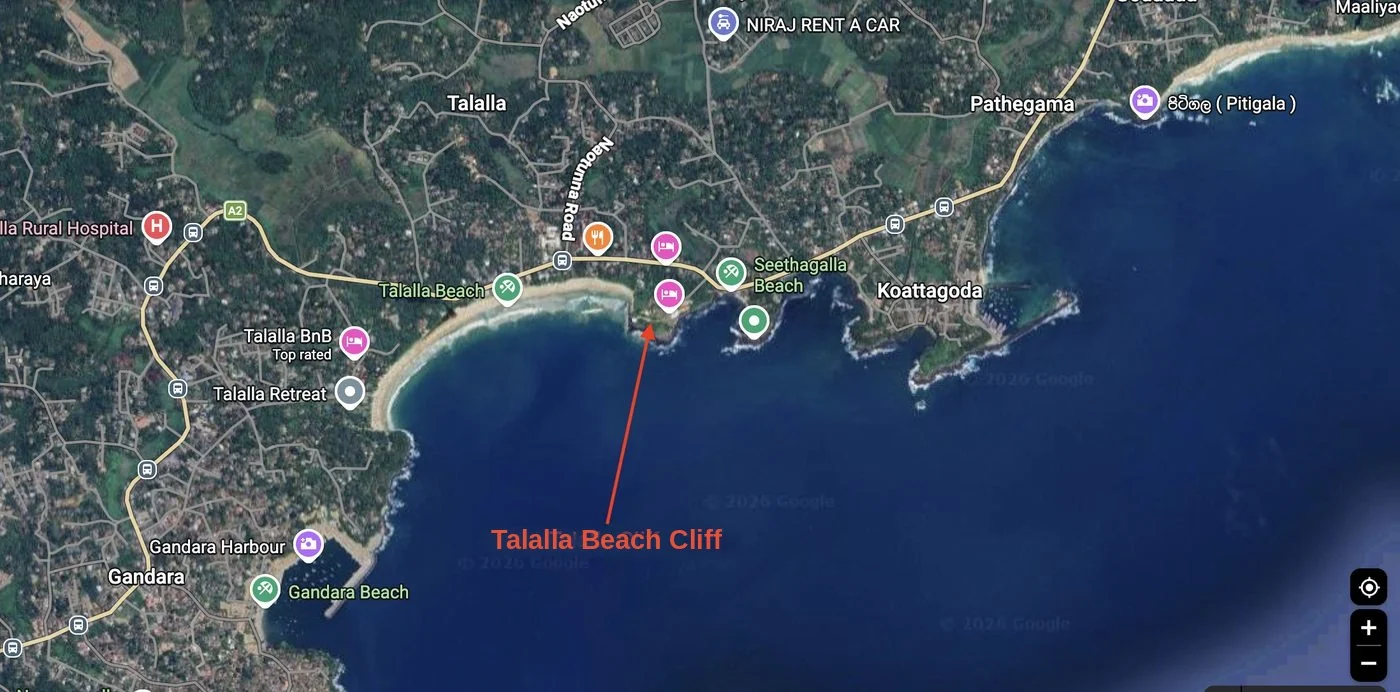
Talalla — a small coastal town between Matara and Tangalle, on Sri Lanka's southern tip
Direct frontage on the Colombo–Matara main road; highway access most of the way to the airport
Minutes from Talalla Beach and Seethagalla Beach, within easy reach of Galle, Mirissa and Tangalle
Part of Sri Lanka's most attractive coastline — the south and southwest — but a stretch of it that hasn't been built up the way the rest has, still boutique, not yet a large-hotel destination
Sri Lanka posted a record 2.36 million tourist arrivals in 2025, up 15% on the year — and the south coast is where that money is following
189 perchesBare land, cleared for development
78 perchesBare land plus the part-built 15-room hotel & clubhouse
192.5 perchesPartly bare land, partly a poured foundation base — not yet built above ground
The grey area is a further adjoining holding, not included in this sale — the sellers' own plans for it are a separate world-class wellness centre and members' club of their own.
Other Options
Two other things this land could be.
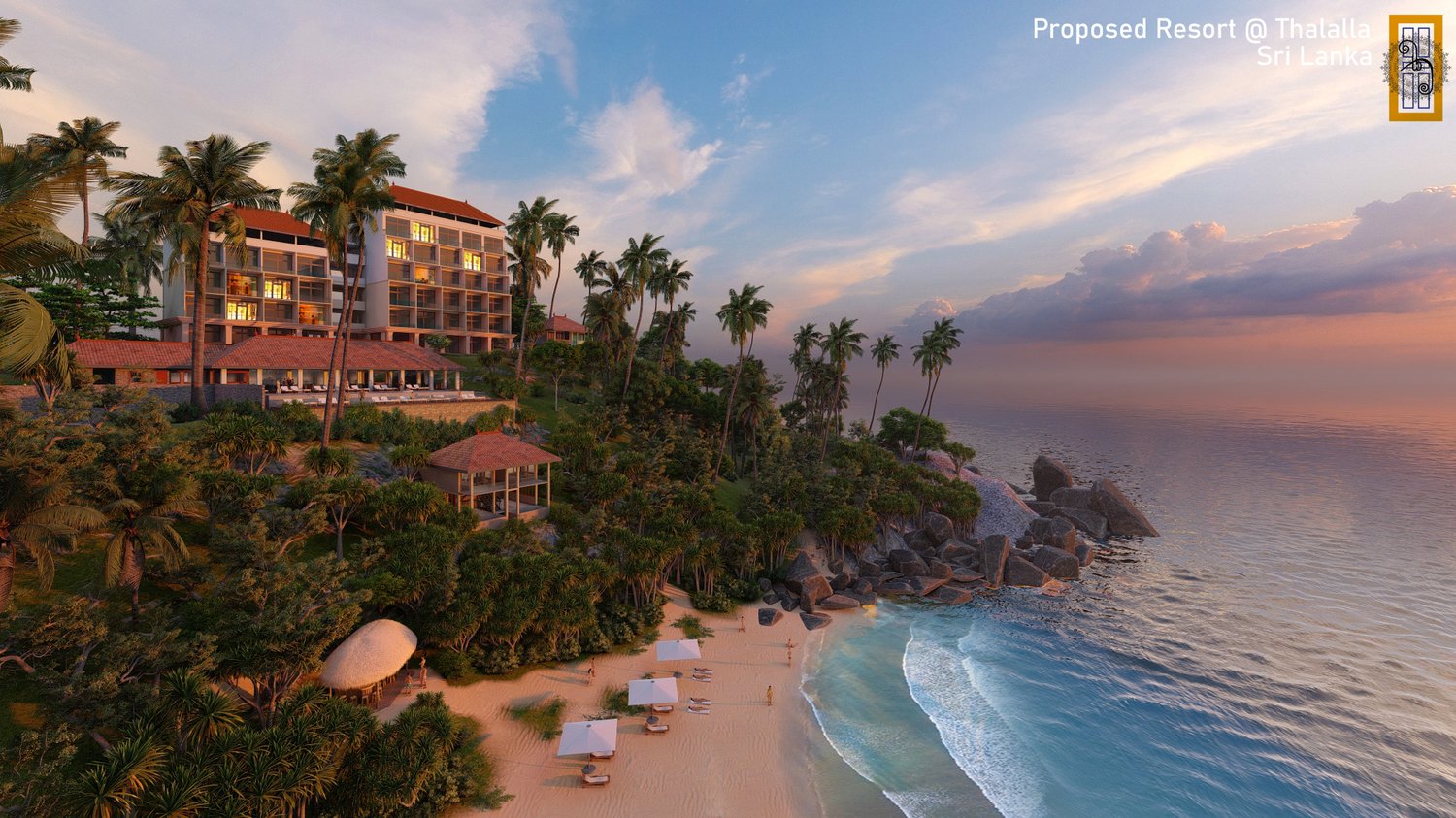
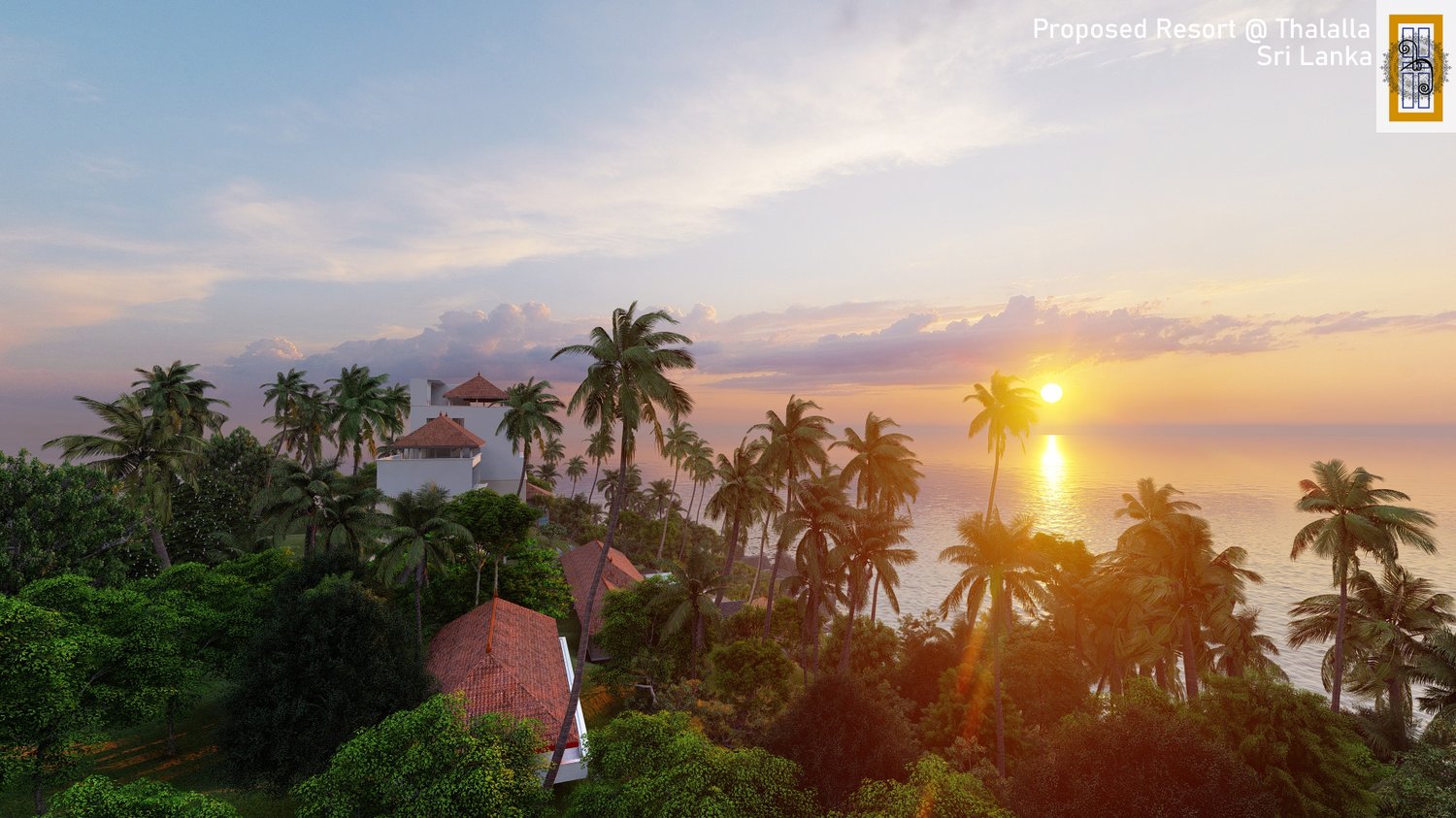
The two schemes above are the ones the sellers would choose. They are not the only things this land can hold — several architects have studied the site over the years, and two further concepts are drawn and available. Nothing here is fixed; the final use is the buyer's to shape.
Other option
A boutique hotel, already half built
+
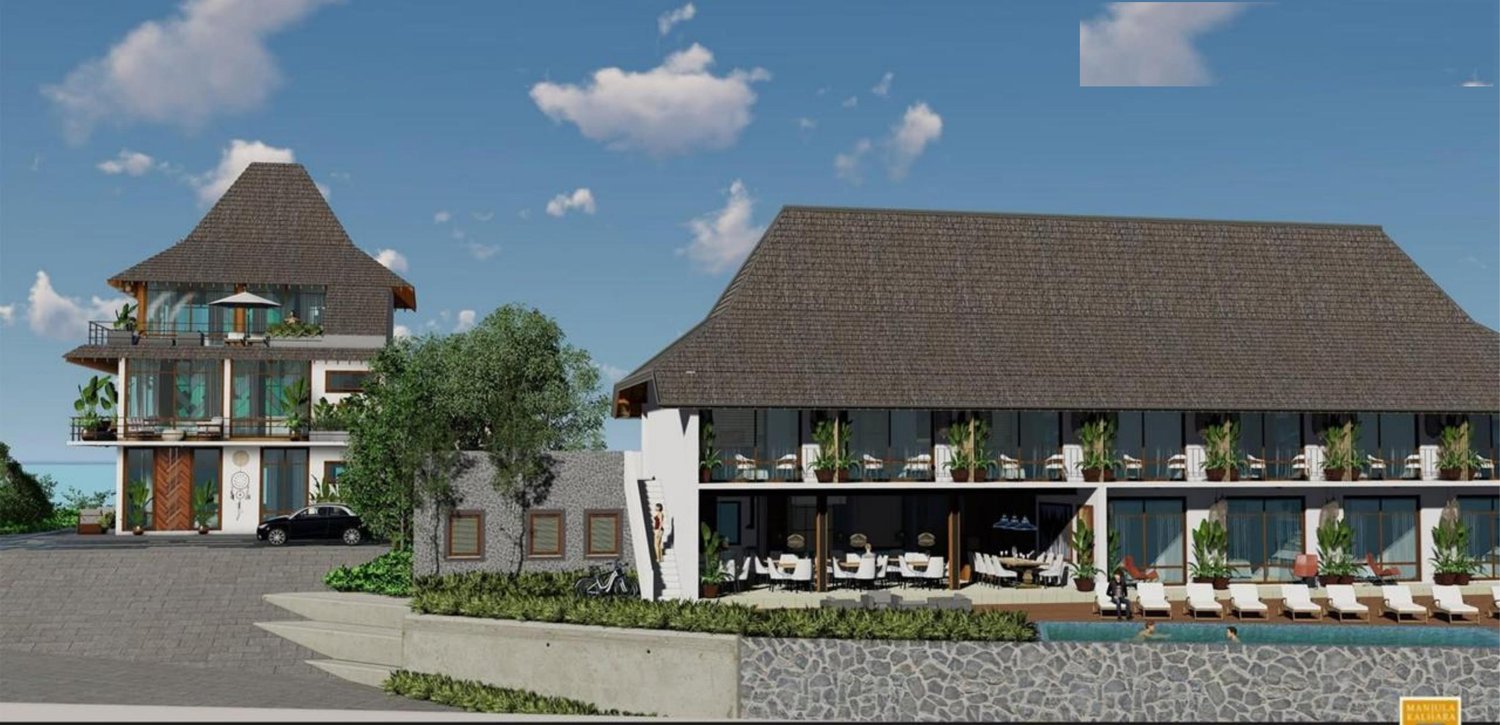
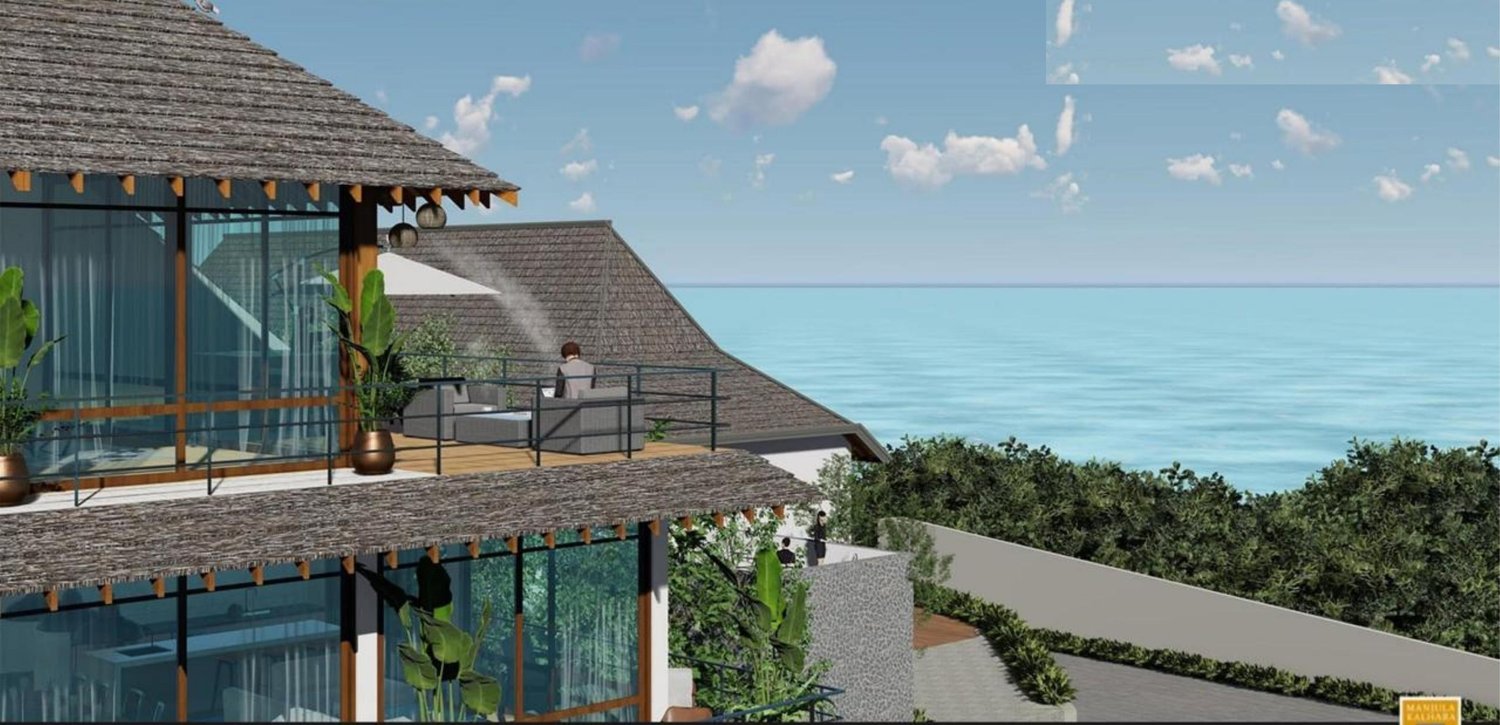
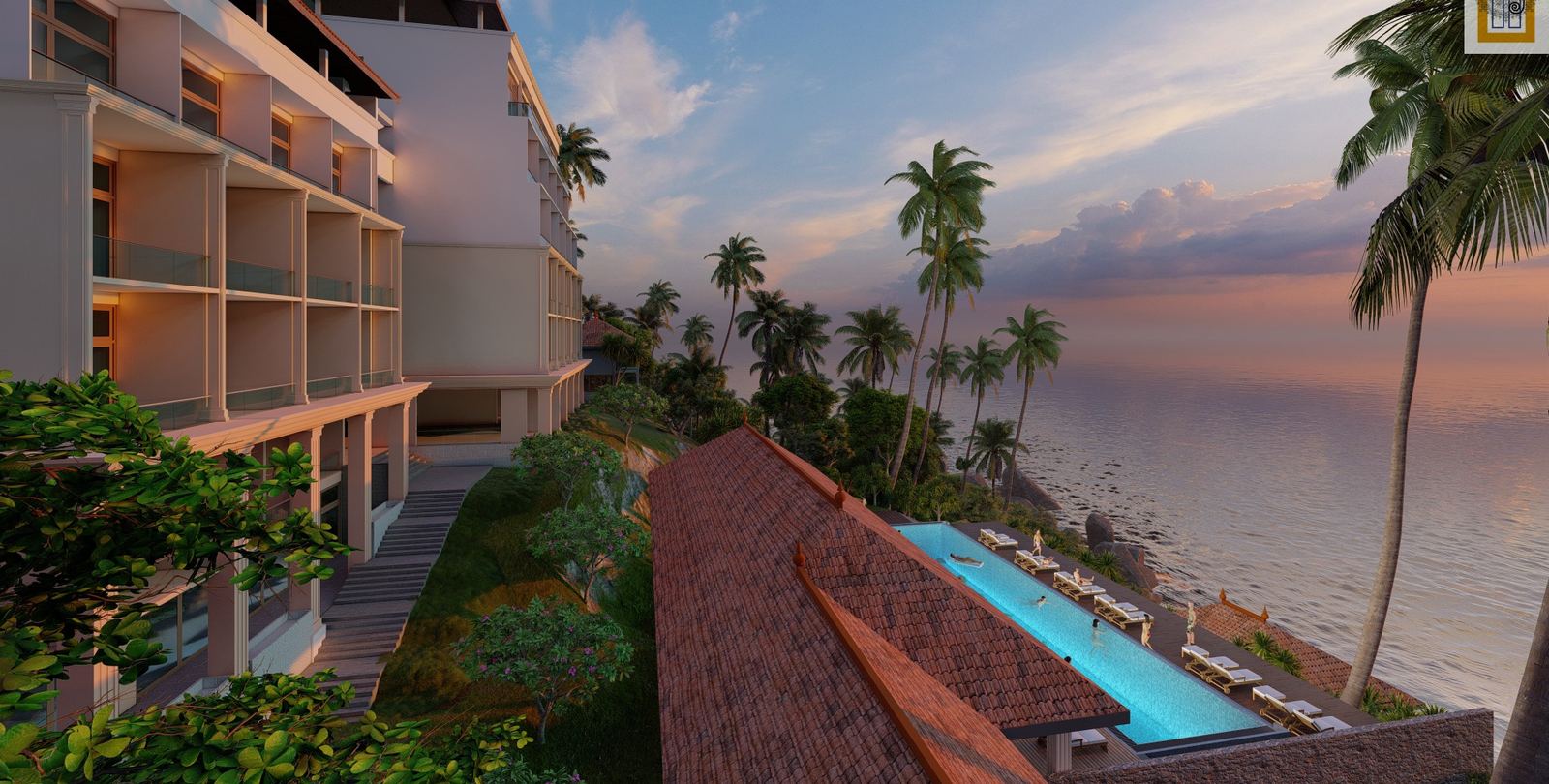
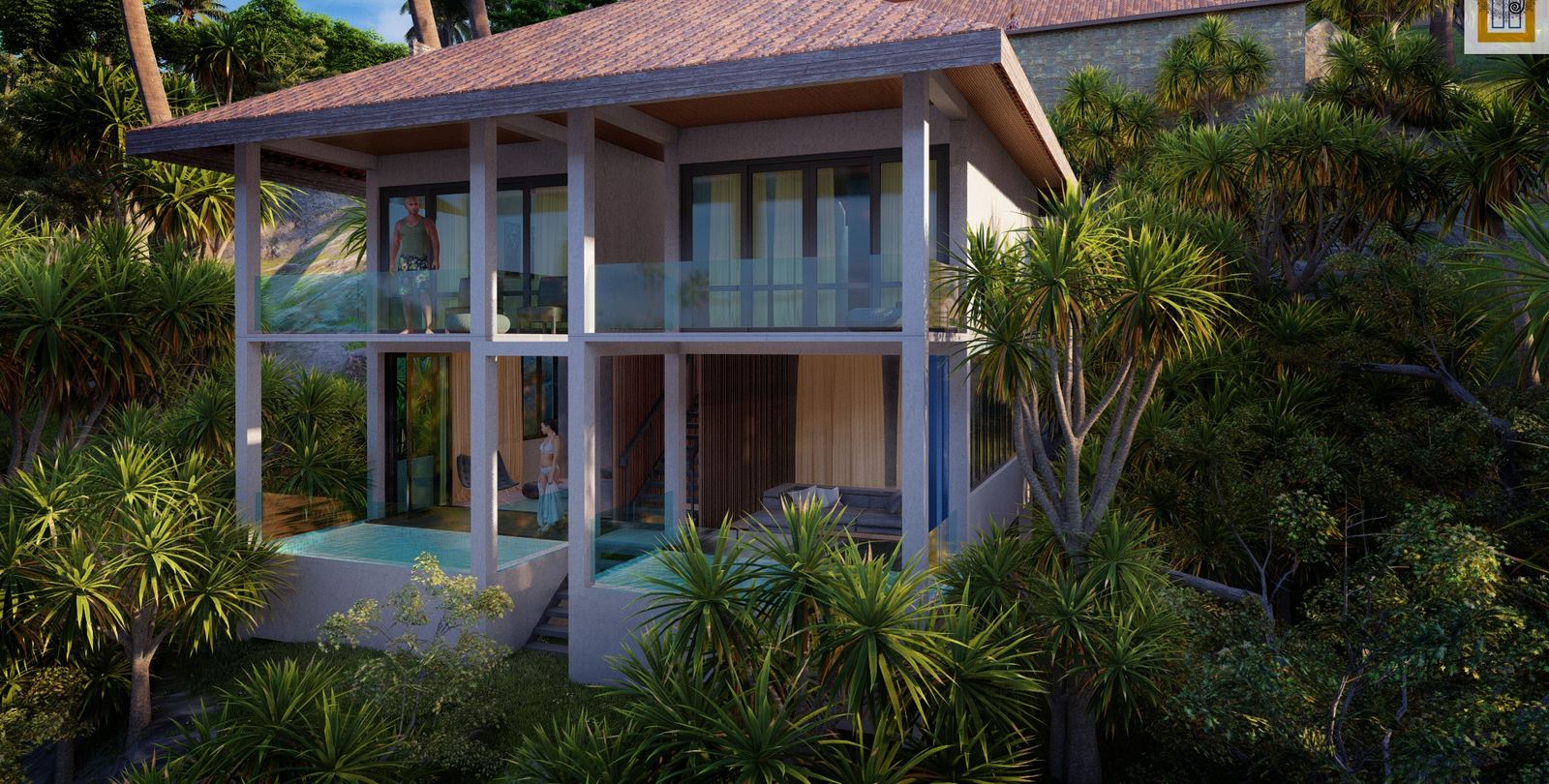
A 15-room boutique hotel and clubhouse on the 78-perch parcel, roughly half built and standing today. Finishing it produces a small operating hospitality asset rather than a development from bare ground.
Exterior & pool terraceOcean-view balcony
Other option
A full-scale hotel, five storeys
+
A larger hotel — five storeys, 42 rooms — drawn up for the 189-perch parcel. A full hospitality build rather than a boutique one, for a buyer who wants scale and operating income over private sales.
Aerial view at sunsetView at sunrise
Concept designs from several architects who have studied this site over the years — illustrative only, shown to demonstrate what the site can carry. Not included in the sale.
Beyond The Coast
The island it happens to be on.
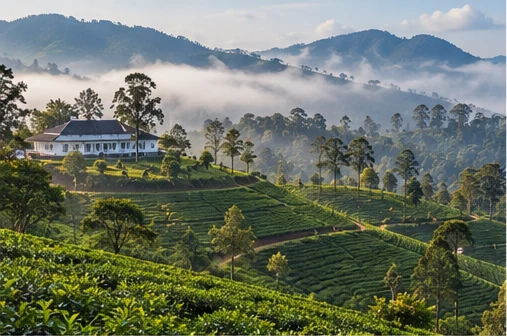
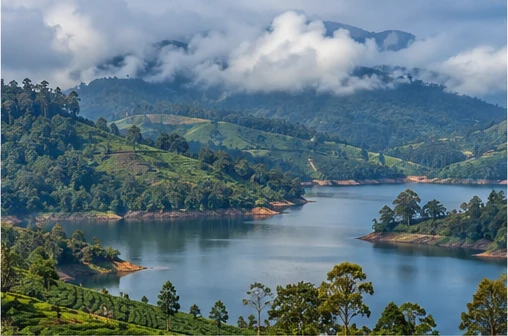
A few hours inland the air changes. Above a thousand metres it settles at around twenty-two degrees and more or less stays there — tea estates, old planters' houses, reservoirs lying in the valleys. Nothing needs heating. Nothing needs cooling. There is no month you would plan around.
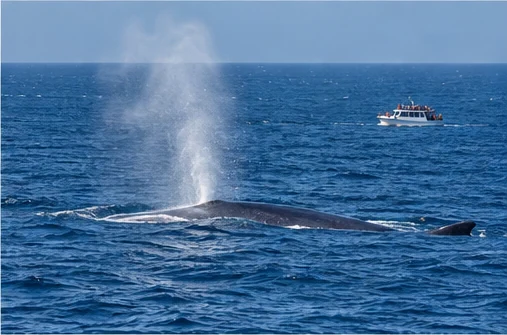
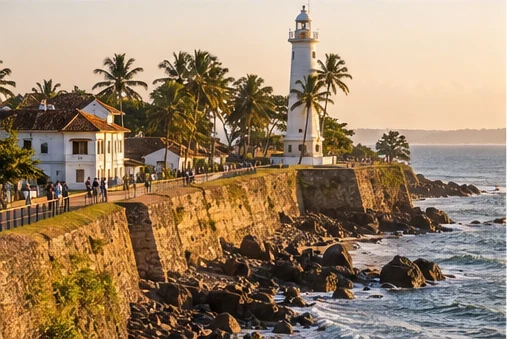
Off this coast there are blue whales that never leave. They are the only population known to feed in warm water rather than swimming to the cold to do it, and boats go out to them from Mirissa, half an hour west. An hour the other way there is a Dutch fort with a lighthouse on the end of it and people eating dinner inside the walls.
None of that is a reason to buy a headland. It is just what happens to be near one.
The hill country, two hundred kilometres northBlue whales, thirty kilometres westGalle, an hour along the coast
See the rest of the island—11 more images↓
Up There
Tea, water and a slow train.
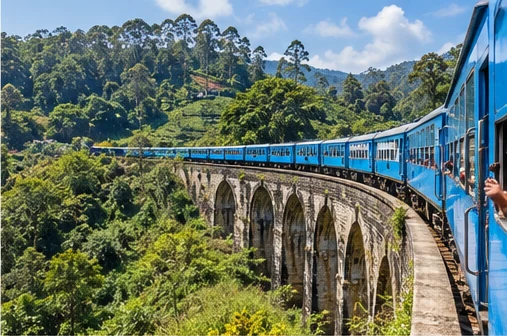
The highlands are working country rather than scenery. Estates still pick by hand, the factories still run, and the bungalows the planters built are now mostly small hotels — Camellia Hills, above Castlereagh Reservoir, is the sort of thing meant. People do buy land up there and build on it; the climate is the reason.
The reservoirs sit in deep valleys between the slopes, and several are on the seaplane network, which means the amphibian that lands twenty minutes from this site also comes down up there. The train, meanwhile, takes hours to cover very little ground, which is the entire point of it.
A reservoir in the tea countryThe hill-country line
The Animals
Leopard, elephant, and the whales that stay.
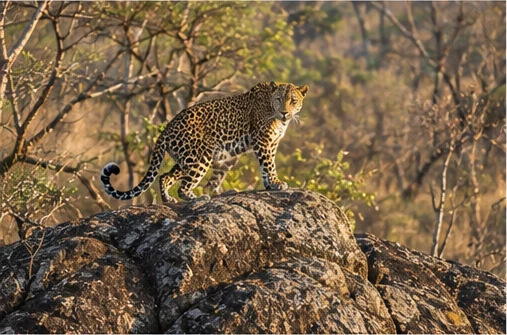
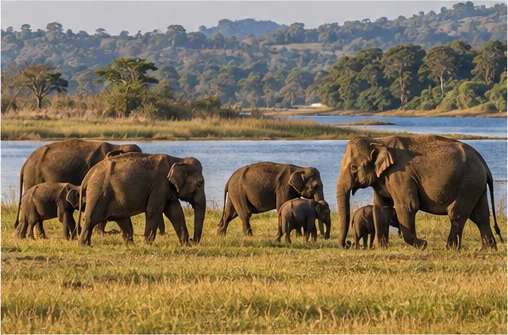
Yala is a morning's drive east and is reported to hold one of the densest leopard populations anywhere; Udawalawe, inland, is where the elephants are, in herds, with calves, in the open. Neither is an expedition — you leave early and you are back for lunch.
The whales are the stranger thing. Every other blue whale population on earth migrates to cold water to feed. This one does not. It stays in the warm, which is why you can go and look at the largest animal that has ever lived from a boat that left half an hour from here.
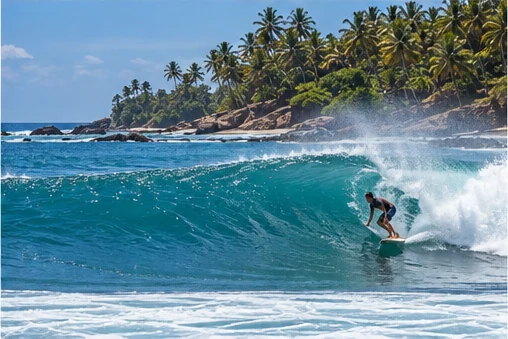
Yala, a morning eastUdawalaweHiriketiya is ten minutes east
This coast surfs roughly November to April. When it goes flat the east coast turns on, from about May to September. The island is never out of season — only the side you happen to be standing on.
Galle
A walled town, an hour west.
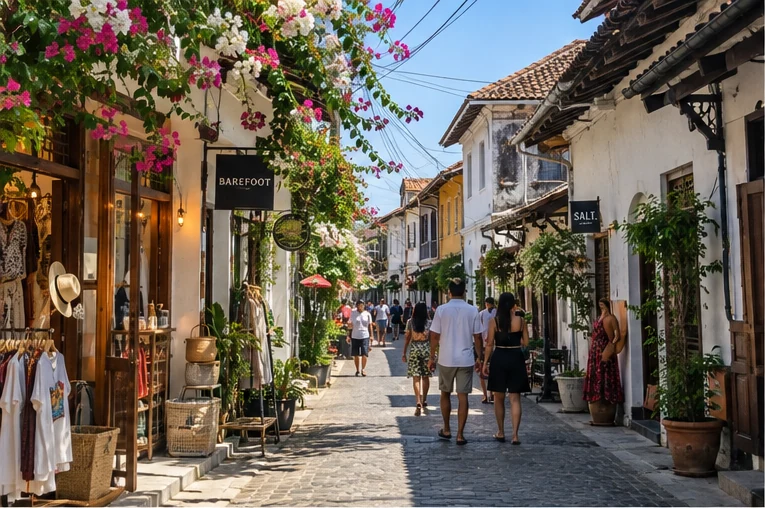
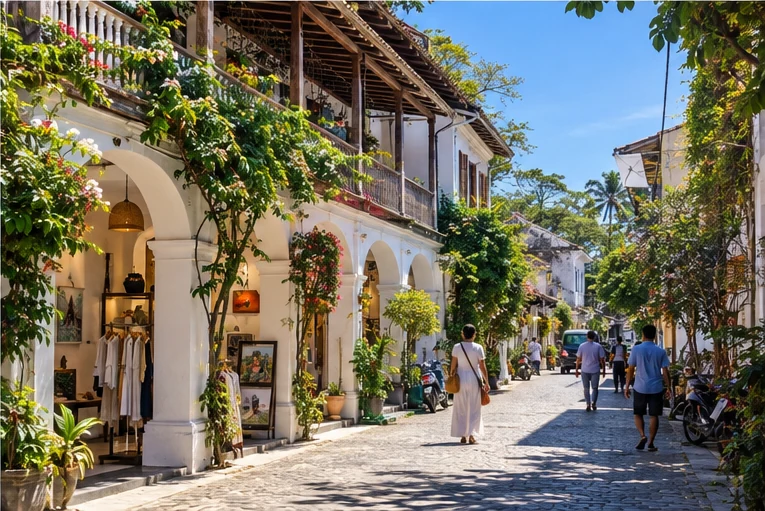
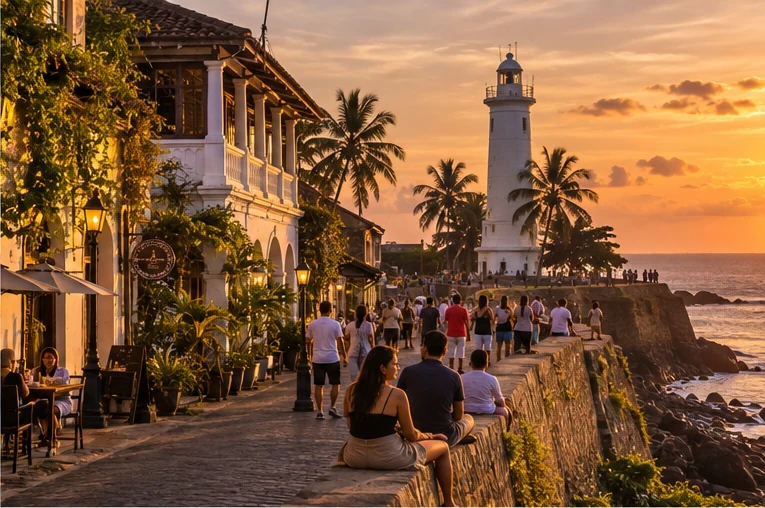
The Dutch built it on a promontory in the seventeenth century and it is still entirely inside its own walls — a grid of white colonnaded streets, a lighthouse at the point, and ramparts people walk along in the evening because that is where the breeze is. It is a UNESCO World Heritage site, and it is also simply where everyone on this stretch of coast goes for dinner.
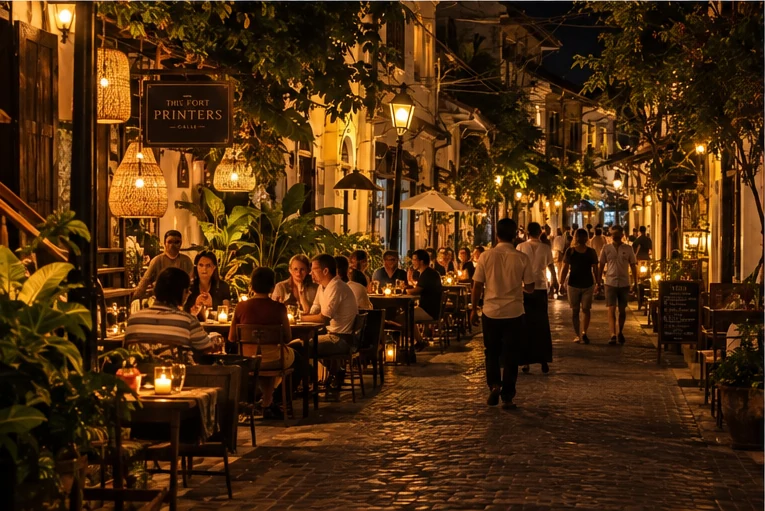
Inside the walls: galleries, bookshops, linen shops, a dozen good restaurants in courtyards. Close enough that it is an ordinary evening out, and the reason you would never feel marooned here.
The point, and the lighthouse on itColonnades and galleriesDinner in the old townEvening on the ramparts
The People
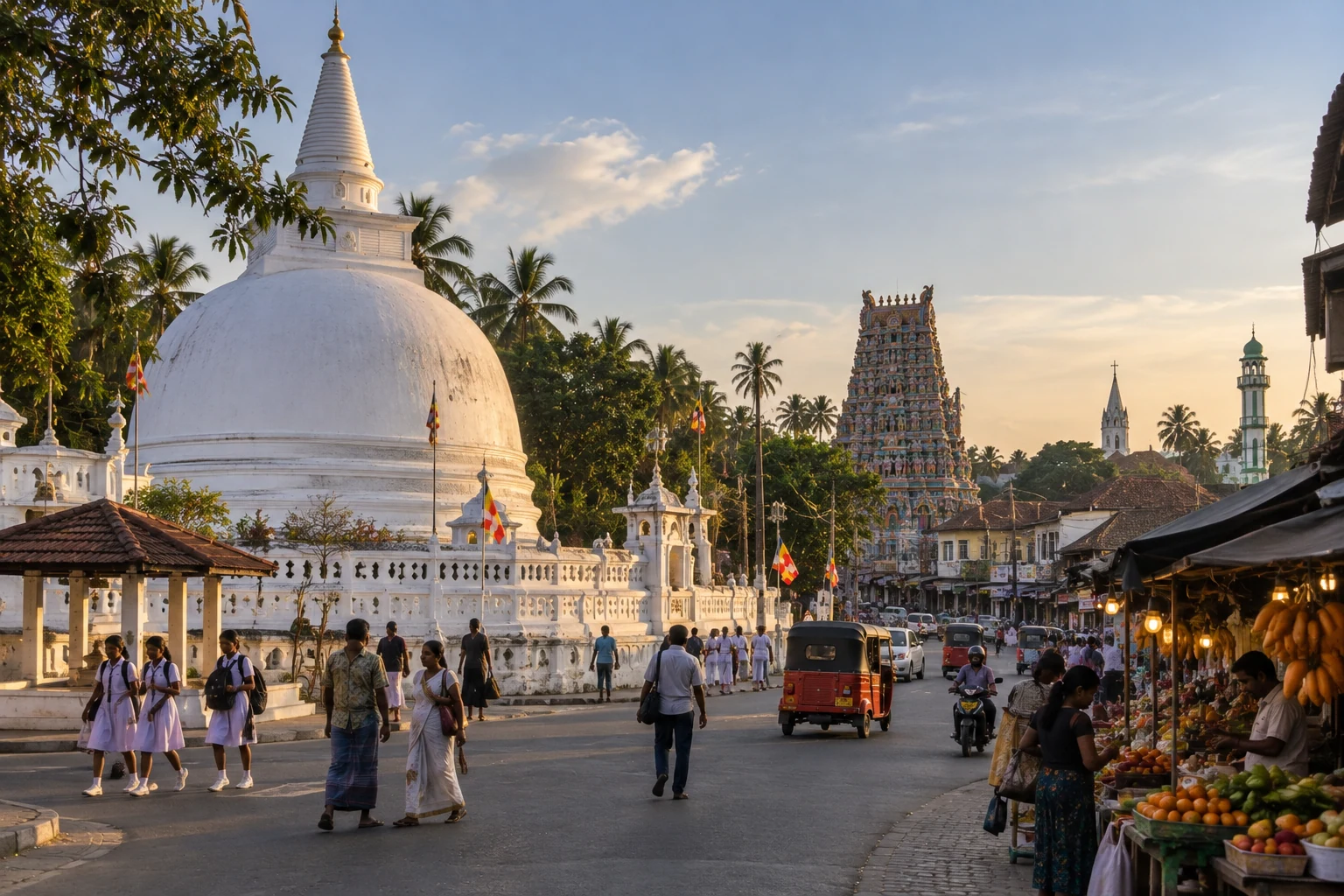
Four faiths, one street.
In most towns here a Buddhist stupa, a Hindu kovil, a church and a mosque stand within sight of one another, and the public calendar makes room for all four. It is not presented as tolerance. It is just the arrangement, and it is old.
The thing visitors tend to mention before the beaches is how people behave towards strangers. It is difficult to describe without sounding like a brochure, so it is probably better left as something you check for yourself.
A main street at six in the evening — schoolchildren walking home, the fruit stalls lit, the temple behind them.
The Country
Which way it is going.
Sri Lanka had a bad few years in the early 2020s and has spent the last two climbing out. A government elected in 2024 on an anti-corruption platform has shifted something measurable: on Transparency International's index the country moved up fourteen places in a single year, from 121st to 107th, reversing a sharp fall. The score still sits below the global average, so this is progress rather than arrival — but the direction is not in doubt, and people who have done business here through both periods describe the day-to-day as different.
Alongside it: an IMF programme, a national anti-corruption plan, and a steady opening toward foreign investment in a country that was already comparatively open to it.
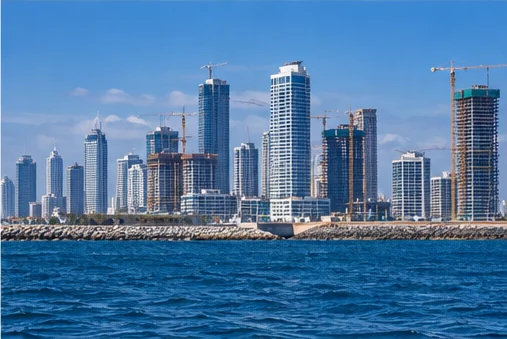
Colombo is 190 km up the expressway — a metropolitan area of roughly six million with a skyline being rebuilt in real time. Port City, on reclaimed land beside the old harbour, is the largest single development in the country's history.
Where this ends up is the open question. It is a tropical coast with the climate, the beaches and the wildlife, sitting at a point in its development that Thailand passed decades ago. That gap is either an argument against buying here or the whole reason to.
Colombo from the water — Port City rising on reclaimed land beside the old harbour.
Temperatures are typical year-round figures for the hill country above 1,000 m. Corruption Perceptions Index figures are Transparency International's for 2024 and 2025. Drive times are by public road and indicative. Land in Sri Lanka, this holding included, falls under restrictions on foreign ownership — a long lease or a local structure is the usual route, and a question for a Sri Lankan lawyer early.
The Coast
Talalla, morning and evening.
Clear Title
Clear title, clear deeds.
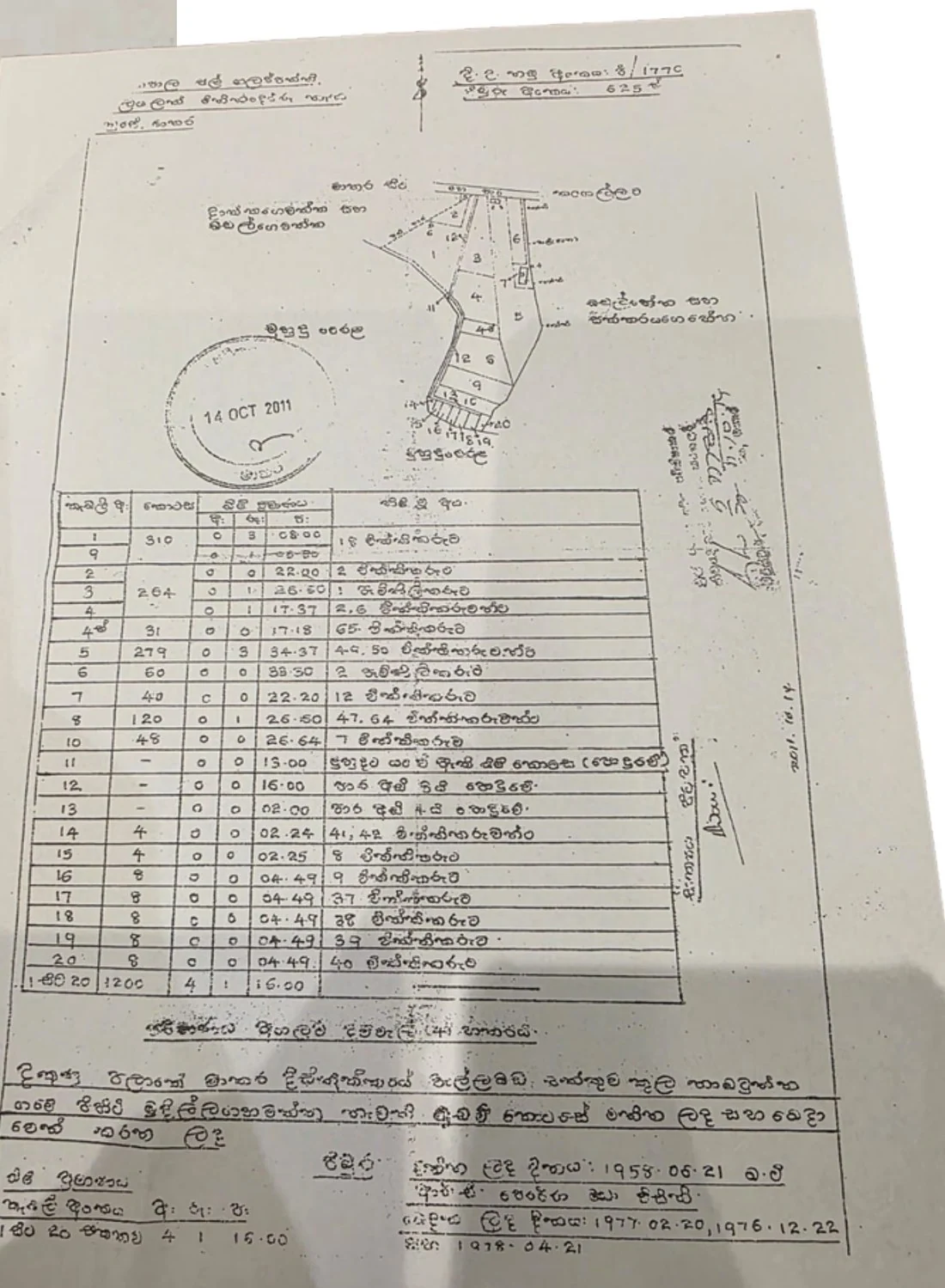
Land title in Sri Lanka can be complicated — fragmented ownership, gaps in the chain of title, claims that surface late in a transaction. This holding is not that. The deeds are registered, the survey plan was prepared by a licensed surveyor and filed with the authorities, and the chain of title is documented.
The title deeds, the registered survey plan and a current Certificate of Encumbrance are available to a buyer's lawyer on request, so the position can be verified rather than taken on trust.
The registered survey plan for the land, filed with the relevant authorities in 2011.
The Offer
$7.2M
All three parcels — 459.5 perches (2.87 acres) — including the part-built 15-room boutique hotel and clubhouse. Clear title, clear deeds. Offered as a single sale; open to a joint venture or development partnership with the right buyer.
Asking price from the seller; not a third-party appraisal.
Walk the cliff with us.
A private viewing · site survey & title documents · a term sheet
Viewings, Sri Lanka & local connectionsShani Perera+94 77 737 6060 · shaniperera333@gmail.com